

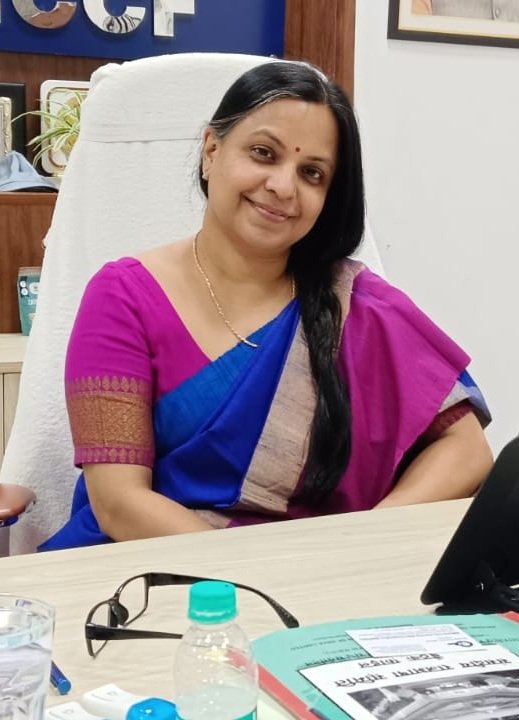
Anice Joseph Chandra
MD, NCCF
The National Cooperative Consumers’ Federation of India (NCCF) is the country’s apex consumer cooperative organization, responsible for procuring and distributing essential commodities to ensure price stability and consumer welfare. Over the years, NCCF has been steadily expanding its commercial operations and reinventing itself as a trusted market player. Anice Joseph Chandra, Managing Director of NCCF, in conversation with Sanjay Verma, Editor of Coop Talks, shares insights into the Federation’s changing role and the road ahead.
Q 1; NCCF targets Rs 12,000 crore turnover this fiscal. This represents a 45 percent growth. Is this possible ?
A; In the recent years, NCCF has been consistent in its growth, The target is definitely achievable. Since the last sixty years, we have understood the nuances of reaching out to the consumers well. Since the last two years, we have struggled to establish ourselves. However, we are enhancing our business growth continuously and we have formulated effective business plans for this. We have constantly got support from Ministry of Consumer Affairs, Food and Public Distribution, Ministry of Cooperation and other agencies.
Since the last two years, Price Support Scheme and Price Stabilization Schemes, for which NCCF is one of the nodal agencies, have played an important role in the business growth of NCCF, improving the turnover.
Q 2;. Please tell us about NCCF brand Janah products. Do you think it is a good business enhancement initiative?
A; Yes, definitely it will give a big boost to NCCF’s business. We have around 19 outlets and there is plan to expand it to 40-45 stores by the end of this fiscal. NCCF’s flagship brand Janah , is a mission-driven initiative to provide quality fast-moving consumer goods –such as pulses, cereals, spices, edible oil, and daily essentials-at affordable prices ensuring transparency traceability, and trust , This initiative is positioned as a cooperative retail model backed up by centralized procurement, stringent quality control, technology-driven inventory and billing systems, and unified branding support. Under a pilot project, 60 products are identified, which are sold in the market currently. Based on the sales response of some of the products, we will launch such products soon. We have already got good response from few of the products like rice, tea, etc. We have started serious business practices for this initiative. We tied up with state and district level consumer cooperative stores. 2000 retail outlets have been identified where Janah products will be kept for sale.
We have also signed MoU with NCUI, National Rural Livelihoods Mission and North-Eastern Regional Agricultural Marketing Corporation( NERAMEC). Through tie-up with NERAMEC, we will market fruit wines, which are unique.
3 Q.; How many farmers have benefited from your procurement cycle ?
A; Last season, the number of such farmers was 152 lakh.
4 Q ; NCCF’s market intervention has proved beneficial in times of crisis. Please throw light on this.
A; We sold tomatoes at subsidized rates at Rs 48 per kg compared to prevailing market price of Rs 80 to 90 per kg. Despite selling at subsidized rates, we have earned profits, clearly signaling the fact that intermediaries were pivotal in the upsurge of prices.
5.Q; India aims for self-sufficiency in pulses by 2030-2031.. How can NCCF contribute to this mission ?
A; Around 42 lakh farmers growing pulses have been registered on NCCF’s E-Samyukti digital platform .We have introduced the concept of contract farming. The farmers in Gujarat, Tamil Nadu and Jharkhand sold at higher prices. The extension program has been done free of cost. Last two seasons when procurement was scarce, we distributed seed kits to the farmers free of cost. For Pulses Atmanirbharta Mission, with focus on 100 low performing agricultural districts, we will contribute to the mission through contract farming, free distribution of seed kits and pre-registration. The farmers will get seed distribution and procurement assistance.
6.Q; It has been emphasized that PACS should become the members of NCCF. What is the update on this ?
A; For this, our bye-laws need to be amended, which will be done soon. With PACS becoming members, this will definitely be profitable for business. However, we have to ensure that this does not happen at the cost of the farmers.
7 Q; It has been emphasized that NCCF should venture into exports. What do you say ?
A; For exports, directly processing paddy from the farmers, converting into rice and exporting to other countries is under the process. This initiative will be first of its kind and it will not be based on government subsidy. The payment to farmers will be made through DBT. For the two seasons, NCCF has started the process of commencement of commercial production of ethanol from maize in Bihar, Maharashtra, Chatisgarh and MP. After gauging response, it will be started in other places.
Q 8;. Youth-centric policies and programs are very important for cooperative organizations, more so in International Year of Cooperatives. What steps NCCF has taken to attract youth ?
A; Under PM Kaushal Vikas Yojana, we impart training to make youth self-sufficient by imparting them skills. Few of these skills are related to supply of toolkits to farmers barbers, etc. Our business associates are mostly young people. Similarly, for packaging and distribution chain of business, the youngsters are employed. For e-Samyukti digital platform, we will be using chatbots, for which we will need technical skills of young people. With rapid expansion of business and growing digitalization in the times to come, the avenues of youth employment will further increase.
Q 9; What is your vision of growth for the future ?
A; Over the next five years, the share of our commercial business should match that of our government business, reaching a 50; 50 ratio.





4 Responses
Experience trusted Houston Yellow Cab service. Our Yellow Cab Houston, Yellow Cab Houston TX, Houston Taxi Yellow Cab, Houston Yellow Cab Service, Houston Yellow Taxi, and Yellow Taxi Houston provide convenient, professional, and reliable rides. Enjoy safe and timely transportation across Houston for airport, business, or city travel.
Youre so cool! I dont suppose Ive read anything like this before. So good to find somebody with some authentic thoughts on this subject. realy thanks for beginning this up. this website is something that is needed on the web, somebody with slightly originality. helpful job for bringing one thing new to the web!
keep up the fantastic work, I read few articles on this site and I believe that your web blog is rattling interesting and has circles of good information.
I got what you mean , appreciate it for posting.