
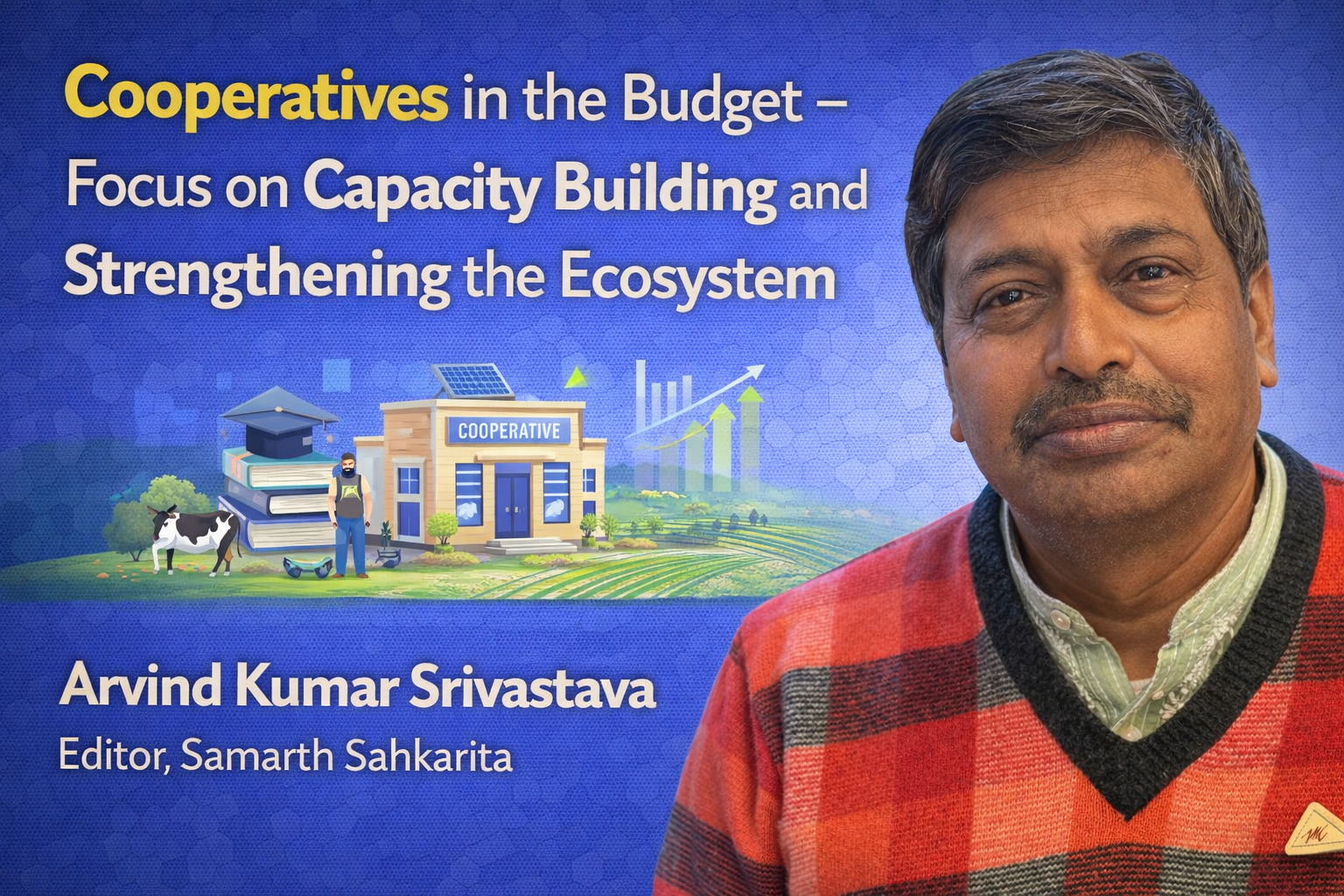

Arvind Kumar Srivastava
Editor, Samarth Sahkarita
The Union Budget for 2026–27 has been presented against the backdrop of heightened global uncertainties affecting trade and multilateralism, while also opening avenues through bilateral engagements. In this context, the Budget focuses on building resilience to volatile global dynamics. It aims to strengthen the ecosystem to accelerate and sustain economic growth, enabling the country to withstand challenges and seize emerging opportunities.
The Budget positions Atmanirbharta as a guiding principle and emphasizes fulfilling people’s aspirations by building their capacities so that they become active partners in the journey towards prosperity. The vision of Sabka Saath, Sabka Vikas, reiterated in the Budget, seeks to ensure meaningful participation from every community, region, and sector. Given their outreach and community-based structure, cooperatives have an important role in harnessing these opportunities for the benefit of the people.
The National Cooperative Policy, 2025 provides a clear direction for the development of cooperatives based on strategic pillars such as transforming cooperatives into professional and sustainable economic entities, promoting cooperative-led inclusive development, encouraging entry into emerging sectors, and inspiring youth through cooperative-oriented experiential learning. The Budget recognizes the importance of capacity building through quality education and training to achieve these objectives. More than 20% of the Ministry of Cooperation’s Budget has been allocated for such activities. An amount of Rs. 300 crore has been earmarked for the newly established Tribhuvan Sahkari University for 2026–27, in addition to Rs. 200 crore under the revised estimates for 2025–26. Enhanced allocations have also been made for the National Council for Cooperative Training (NCCT) and the Vaikunthlal Mehta National Institute of Cooperative Management (VAMNICOM).
Export promotion in the face of global trade challenges is another key focus of the Budget. Cooperatives have been recognized as a sector with significant export potential, and the National Cooperative Exports Limited (NCEL) has been entrusted with this role. To strengthen its functioning, the Budget has allocated Rs. 450 crore as grants-in-aid to NCEL, which constitutes more than one-fourth of the Ministry’s total outlay.
The role of cooperatives in agriculture and allied activities remains central. With the objective of increasing farmers’ income, the Budget emphasizes diversification towards high-value crops such as coconut, sandalwood, cocoa, and cashew in coastal regions, and almonds, walnuts, and pine nuts in hilly areas. This diversification creates new opportunities for cooperatives and their members engaged in these crops.
Dairy cooperatives, which contribute significantly to India’s agricultural economy and support the livelihoods of more than eight crore farmers, receive focused attention. The Budget targets the operationalization of 7,600 dairy cooperative societies/milk pooling points and the installation of around 4,000 electronic milk testing equipment to strengthen milk value chains and ensure quality.
Women’s participation is a defining feature of the dairy cooperative sector, with over 48,000 women-led dairy cooperative societies at the village level. Recognizing this, the Budget proposes to bring two lakh women dairy farmers into the cooperative fold, further promoting inclusive growth and rural empowerment.
In the animal husbandry sector, the Budget introduces a Credit-Linked Subsidy Programme to generate quality employment in rural and semi-urban areas. It also promotes integrated livestock, dairy, and poultry value chains and encourages the formation of Livestock Farmer Producer Organizations. Additionally, support will be provided to 50 Fish Farmer Producer Organizations, cooperatives, and federations for establishing and modernizing market linkages under the Pradhan Mantri Matsya Sampada Yojana. These measures, along with the initiative to create Champion MSMEs, are expected to enhance the income of cooperative members.
Cooperative banks, serving rural and urban clientele, have become integral to the country’s banking system. Recent amendments to the Banking Regulation Act, regulatory consolidation, operational relaxations, and continuous engagement by the RBI reflect growing recognition of their role. The proposal to constitute a “High-Level Committee on Banking for Viksit Bharat” is expected to further strengthen their contribution to financial inclusion, particularly in remote and underserved areas.
The Budget also provides specific tax concessions to cooperatives by allowing deductions to (a) primary cooperative societies for the supply of cattle feed and cotton seed produced by their members, and (b) inter-cooperative dividend income to the extent distributed to members. Additionally, exemption has been granted to dividend income received by notified national cooperative federations on specified investments.
A significant increase in the financial outlay for the Ministry of Cooperation is also noteworthy. The allocation has risen to Rs. 1,744.34 crore for 2026–27 compared to the revised estimate of Rs. 981.31 crore for 2025–26. This enhanced allocation will support ongoing initiatives such as assistance through the National Cooperative Development Corporation (NCDC), computerization of Primary Agricultural Credit Societies (PACS), and IT-based interventions for strengthening Agricultural and Rural Development Banks (ARDBs). An amount of Rs. 287 crore has also been earmarked as grants-in-aid for States and Union Territories.
In conclusion, the Budget deserves appreciation for its clear emphasis on capacity building within the cooperative sector, enabling it to maintain its rightful place in the economy on a sustainable basis. The supportive measures for agriculture and allied sectors further strengthen the cooperative ecosystem. With improved capacity and institutional support, cooperatives are well placed to leverage these opportunities for accelerated growth. However, the long-term cooperative credit structure remains largely outside the immediate focus, and it is hoped that these institutions will also receive due attention from the proposed High-Level Committee on Banking for Viksit Bharat.





One Response
Beautifully crafted, educative and informative.
Sharing knowledge and experience is indeed a noble job. You are great Sir, keep Sharing and educating us.