

Komal Gupta
Director-Strategy and Policy, Coop Talks & Founder, Konsult Komal
India’s app-based ride-hailing market has reshaped urban commuting over the last decade. Platforms such as Uber and Ola have embedded algorithm-driven pricing, real-time vehicle matching and digital payments into everyday life. Ride-hailing is no longer a niche convenience. It is a structural component of urban mobility across major Indian cities.
Yet despite this transformation, the sector’s ownership architecture has remained largely unchanged. Technology companies backed by private capital own and control the platforms, while drivers operate as independent service providers. The economic value generated through millions of rides is ultimately captured by shareholders and corporate boards. Over time, drivers have expressed concerns about high commission structures, fluctuating incentives and limited participation in governance decisions that directly affect their earnings.
The launch of Bharat Taxi introduces a different proposition.
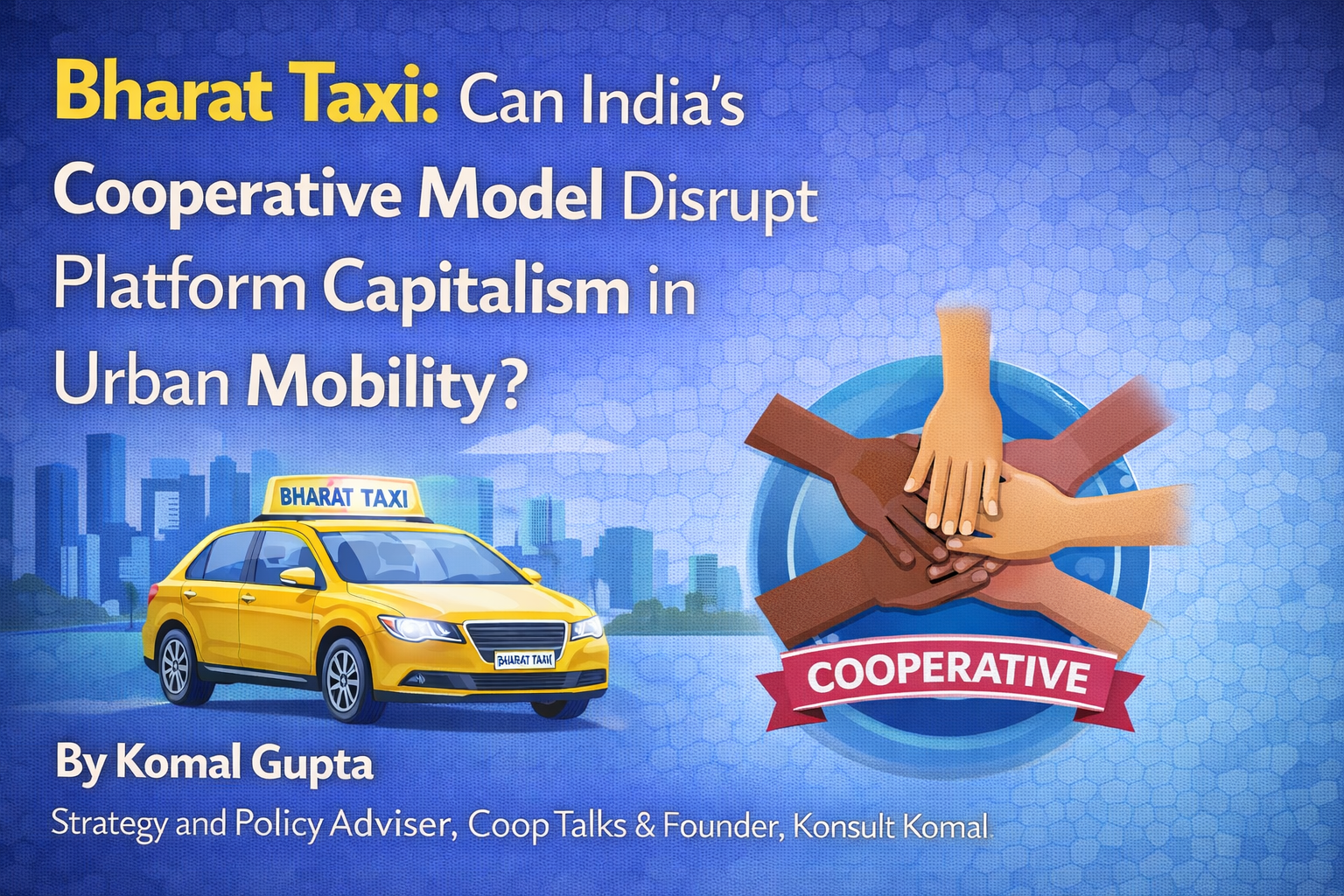
Bharat Taxi is operated by Sahakar Taxi Cooperative Limited (STCL), described in official communications as a multi-state cooperative society. The initiative has been launched in collaboration with the National Cooperative Development Corporation (NCDC) and is supported by cooperative institutions, including Amul and NABARD. While it has policy backing from the Ministry of Cooperation (MoC), it is structured as a cooperative entity rather than a government-owned enterprise.
Launched formally in February 2026, Bharat Taxi began operations following pilot runs in Delhi NCR and parts of Gujarat. Expansion to additional cities is planned in phases.
At its core, Bharat Taxi is structured as a driver-owned cooperative aggregator. Drivers can become members by making a nominal contribution and participating in the platform’s governance and surplus distribution. Unlike conventional aggregators, Bharat Taxi does not levy a per-ride commission. Instead, drivers pay a fixed daily access fee of Rs 30 to use the app. The intention is to allow drivers to retain a significantly larger share of the fare.
The central question now is whether this ownership innovation can compete effectively in a capital-intensive, network-driven mobility market.
The Cooperative Model in Context
Traditional ride-hailing platforms scale through heavy investment in technology, marketing and network expansion. Their revenue model relies substantially on per-ride commissions charged to drivers. While this has enabled rapid growth and widespread availability, it has also shaped earnings structures in ways that drivers often find unpredictable.
Bharat Taxi’s model attempts to reset that equation. Removing per-ride commissions and replacing them with a modest, fixed daily fee alters the incentive framework. In theory, higher retention per trip can translate into improved driver income stability. At the same time, collective ownership creates the possibility of participatory governance, a feature largely absent in privately held platforms.
The cooperative model is not new to India. From dairy to banking, multi-state cooperatives have demonstrated resilience and scale. The question now is whether that logic can be successfully extended into the digital platform economy.
Early Market Signals and Price Stabilisation
When Bharat Taxi began its early rollout in Delhi NCR, user expectations were high. Many assumed that a cooperative structure would immediately translate into significantly lower fares.
Initial feedback from users in Delhi suggested that, during the first phase, prices were at par with, and at times slightly higher than, those of competing apps. Waiting times were also reported to be longer in certain peak-hour situations, reflecting the early stage of driver onboarding.
However, conversations with riders over the subsequent weeks indicate that pricing dynamics have evolved. As more drivers have joined and network density has improved, fares appear to have stabilised.
One Delhi-based commuter noted, “In the beginning, the fare was similar and sometimes slightly higher. But within a couple of weeks, I started noticing that it was cheaper on average.” Another Delhi rider observed that current fares are often 20 to 25 per cent lower than competing platforms on comparable routes. Waiting times have also improved as supply has strengthened.
These signals suggest that while cooperative ownership does not guarantee immediate price disruption, cost competitiveness may improve as scale builds and operational efficiencies stabilise.
Scalability and Competitive Pressures
For Bharat Taxi to become a sustained alternative, it must compete not only on price but also on reliability, technological robustness and geographic coverage. Established platforms operate across hundreds of cities, with mature demand-supply matching systems and strong brand recall.
Bharat Taxi’s rollout in Delhi NCR and Gujarat provides an initial testing ground. Expansion will require disciplined driver onboarding, stable technology infrastructure and consistent customer experience. Cooperative governance, while democratising, must remain agile enough to make timely operational decisions in a dynamic market.
At the same time, the zero commission structure could prove attractive for driver acquisition. If drivers perceive higher net earnings relative to conventional platforms, onboarding momentum may strengthen organically.
Why This Experiment Matters
Bharat Taxi represents more than another mobility app. It is an attempt to reconfigure the distribution of value within India’s platform economy. The urban mobility sector continues to expand rapidly. Questions around ownership, profit allocation and governance are increasingly central to its long term sustainability.
If Bharat Taxi succeeds, it could demonstrate that cooperative ownership and digital platforms are not incompatible. It could provide drivers with a tangible stake in the systems they power and introduce competitive pressure on commission structures across the industry.
If it faces constraints, those lessons will be equally instructive for policymakers and cooperative institutions seeking to enter technology-driven markets.
Bharat Taxi now moves from pilot phase experimentation to scale testing. Its trajectory over the coming years will determine whether cooperative principles can meaningfully reshape India’s urban mobility landscape.