
Komal Gupta
Director-Strategy and Policy, Coop Talks & Founder, Konsult Komal
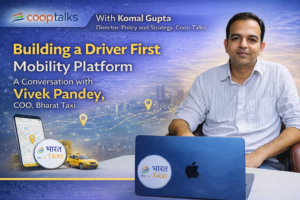
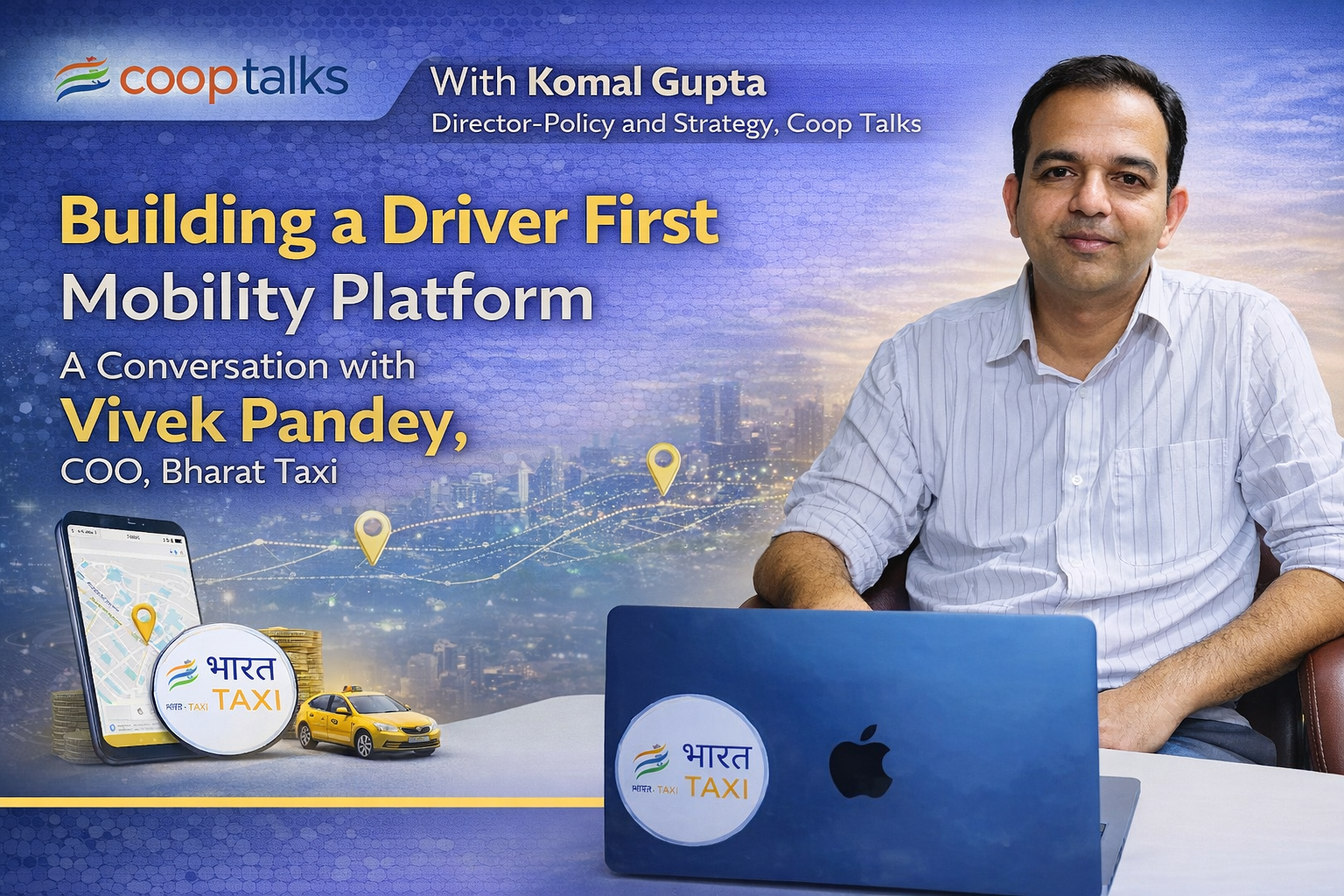
Our Director – Policy and Strategy, Komal Gupta, spoke with Vivek Pandey, Chief Operating Officer of Bharat Taxi, to understand the vision behind India’s emerging cooperative mobility platform. The conversation explores driver ownership, platform economics, and Bharat Taxi’s expansion strategy.
Q1. Many people still do not fully understand what Bharat Taxi is. How is it different from Uber or Ola, and what does the cooperative model mean in your case?
Before explaining the differences, I would first talk about the similarities. Bharat Taxi is also an app-based platform. Any driver who has a car and a smartphone, or any biker or auto driver, can register on the platform, go online, and start receiving ride requests. Similarly, consumers can request a cab, an auto, or a bike through the app.
From a user perspective, the experience is very similar to any other ride-hailing application. As a consumer, you will not feel any major difference in using the platform.
Now, coming to the differences. Bharat Taxi is a cooperative. It is not a corporate entity or a traditional private company. It is a multi-state cooperative society. The holding cooperative is Sahakar Taxi Cooperative Limited (STCL).
One important point is that India’s top eight cooperatives, such as Amul, IFFCO, NABARD, and NDDB, have invested in Bharat Taxi. They are the primary members, and they sit on our board. Beyond institutional participation, individual drivers can also become owners by purchasing shares. Each share costs 100 rupees, and drivers can buy one or more shares to become members.
This means that when Bharat Taxi generates profits and distributes dividends, drivers who are shareholders can also participate in those profits. So, drivers are not just service providers, but also stakeholders in the platform.
Another significant feature is governance participation. We have two board members who are drivers. These driver representatives sit on the board of directors, participate in decision-making, and contribute to policy formulation. So, when we say ‘Saarthi hi maalik’, it is not just a conceptual idea. Drivers are actively involved in governance.
The ethos behind Bharat Taxi is also different. We are a zero-commission platform. Unlike private platforms where commissions may increase over time, our mission is to remain zero commission. We charge only a minimal subscription fee, which is used solely to sustain operations, maintain the platform, and run teams.
In addition, we are working to build a social security ecosystem for drivers. This includes bringing drivers under insurance coverage and connecting them with government schemes. Some of these benefits are available for drivers who become members, while others are available for active drivers on the platform.
Since we do not charge commissions, the cost structure becomes more efficient. This also enables us to offer more affordable rides to consumers. So, the differences lie in ownership, governance, a zero-commission structure, and a focus on social security.
Q2. It has been about two months since launch. Are you still in the pilot phase?
No, we are not in the pilot phase anymore. We started with a pilot in Delhi NCR in December, followed by a soft launch in January. The official launch took place on 5 February and was done by the Honourable Cooperation Minister, Amit Shah.
After the official launch, we have seen strong growth. Currently, we are operational in Delhi NCR as well as in Gujarat, including Ahmedabad and Surat.
We are also in the process of launching in additional cities, including Vadodara, Lucknow, and Chandigarh. These cities are at various stages of rollout, and expansion continues.
Q3. So at the moment, Bharat Taxi is already multi-state. How many states are you currently operating in?
Currently, we are present across Delhi, Haryana, Uttar Pradesh, Chandigarh, and Gujarat.
In terms of scale, around five lakh drivers have registered on the platform. On a daily basis, approximately fifty thousand drivers come online.
When it comes to ownership participation, the number continues to grow. A few thousand drivers have already purchased shares and become members. Interest is increasing steadily, and awareness is gradually improving.
Q4. How are you building awareness among drivers, especially regarding ownership?
A significant part of awareness is community-driven. We call this driver-led onboarding or community onboarding.
We receive support from driver groups and unions. Individual drivers are also acting as promoters and champions of the platform. Since the platform is built for driver benefit and ownership, drivers themselves are motivated to spread awareness.
Word of mouth has played a major role in early growth. Alongside that, we are also using performance marketing, online campaigns, offline promotions, and newspaper advertisements.
We are also receiving support from cooperative institutions within our ecosystem. Since some of them are investors and promoters, they are helping promote Bharat Taxi through their networks and platforms.
Q5. Which cities will Bharat Taxi expand to next?
We are planning to launch in around thirty to thirty-five cities over the next year. When we say thirty cities, we are referring to anchor cities. Once we launch in an anchor city, we expand to surrounding areas.
For example, in Uttar Pradesh, Lucknow is the anchor city. We have already launched the driver app in Lucknow, and the consumer app will launch once we reach sufficient driver sign-ups.
Whenever we enter a market, we first onboard drivers. Once we reach a meaningful scale, we launch the consumer app. After that, we expand into nearby cities and districts.
After Lucknow, cities like Mumbai, Jaipur, Pune and several others are in the pipeline. The expansion is being planned in phases, with deeper penetration around anchor markets.
Q6. Which cities are currently performing the best?
At present, we have two major markets, Delhi NCR and Gujarat.
Delhi NCR is currently our largest market, given its scale and the fact that we started there first. Gujarat has also shown strong traction, particularly in Ahmedabad, where community-driven adoption has been very encouraging.
So currently, Delhi NCR is number one, and Ahmedabad is growing rapidly.
Q7. How will profits be distributed among members?
At this stage, we have not reached the profit distribution phase yet. A formula is being developed, but since we are still early in the journey, it would be premature to share specific details.
We will share more clarity once we reach that stage.
Q8. Do you believe the cooperative model is the future of platform economy businesses?
Technology today is widely available. Most platforms can build similar technology. Platforms that have existed for longer may have some advantages, but overall, technology is no longer the biggest differentiator.
What becomes more important is the business model and economics.
Mobility and gig economy platforms are low-margin businesses. In such businesses, there are three stakeholders: the consumer, the service provider or driver, and the platform acting as an aggregator.
If the platform’s objective is to maximise profits, then either the driver earns less or the consumer pays more. That is how private platforms typically create valuation.
In a cooperative model, the service provider becomes an owner. In our case, drivers become shareholders. This aligns incentives between the platform and drivers.
The platform is not trying to maximise profits. Instead, it acts as a utility that connects consumers and drivers. It charges only what is required for sustaining operations.
This creates a driver-first platform where value is distributed among stakeholders rather than concentrated within the platform.
Q9. Is the technology built in-house?
When we talk about the platform, it includes both technology and operations. The operations are fully managed internally.
On the technology side, we are supported by a tech partner, Namma Yatri. They also operate a similar platform in Bengaluru. It is a partnership model where the technology backbone is provided by the partner.
Q10. How much AI are you using in the platform?
Some aspects, like dispatch systems, are fairly standard across platforms. However, AI is widely used in areas such as consumer grievance redressal and driver support. Many queries are handled through AI-based systems, and only complex issues are escalated to human teams.
AI is also used to improve location accuracy, enhance driver-rider matching, and optimise operations. These applications help reduce costs and improve platform efficiency.
Q11. What are the operational challenges while scaling?
This is a very operations-heavy business. Technology is important, but execution on the ground is critical.
Launching in new cities requires building local teams, setting up operations, and ensuring quality. Building the right operational teams is the biggest challenge.
With industry experience, we understand how to build and scale operations, but finding the right people remains crucial. Hiring and building strong local teams is the first step before launching in any new city.
Q12. Customer grievance redressal is a major concern in this sector. How are you addressing it?
We have a dedicated grievance team. We recently added a new grievance support structure.
There is also a tech support team. Grievances can involve either drivers or consumers, such as challenges during rides or platform-related issues.
Driver verification is handled through both technology and physical checks. Since large numbers of drivers are onboarded, manual verification alone is not feasible.
We use Aadhaar APIs and other background verification systems to validate driver details and ensure safety.