
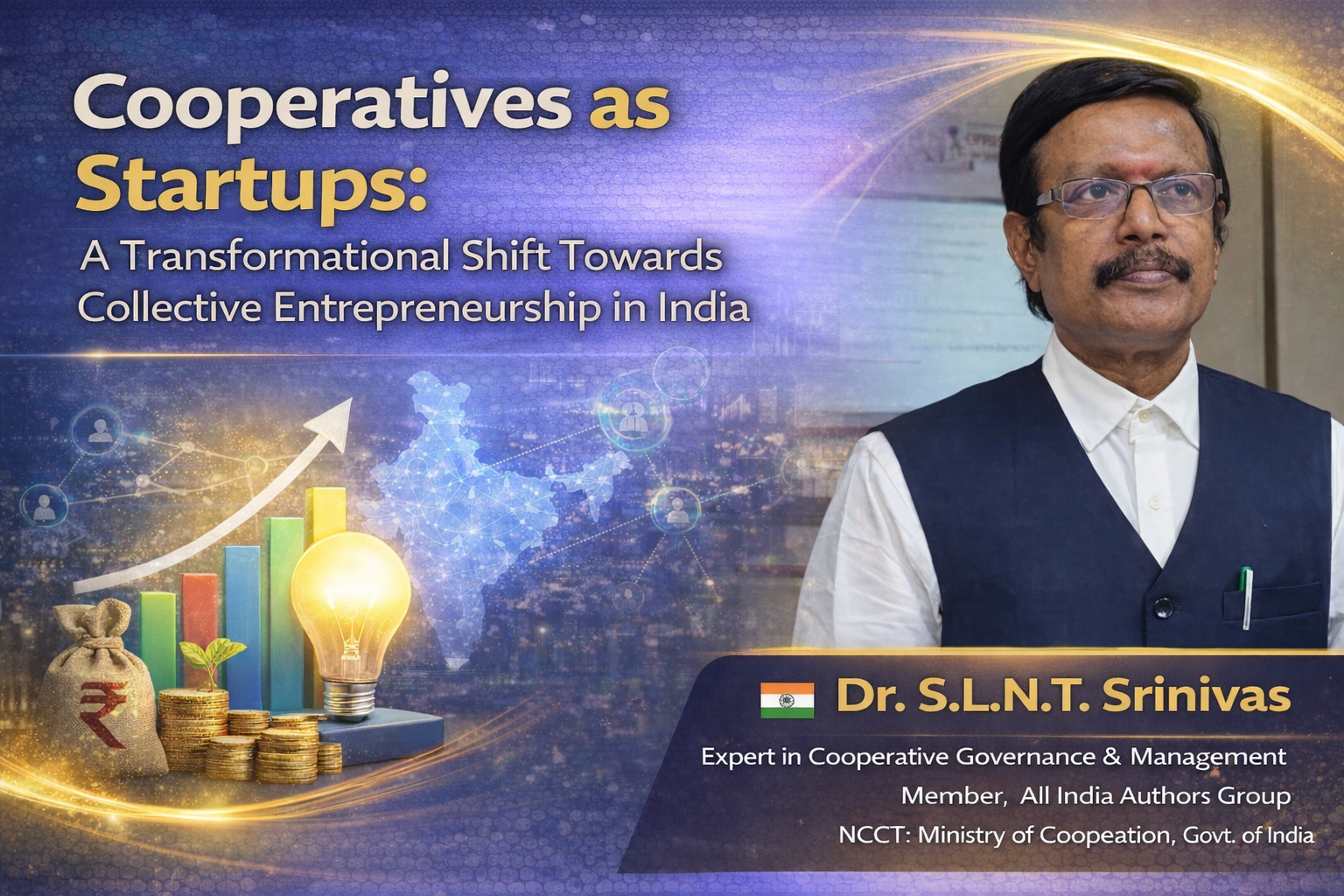

Dr.S.L.N.T.Srinivas
Dr.S.L.N.T.Srinivas
Expert in Cooperative Governance & Management
Member, All India Authors Group
NCCT: Ministry of Cooperation, Govt. of India
The recent decision of the Government of India to recognise cooperatives as startups under the revised Startup India framework marks a historic and transformative policy shift. By extending startup recognition to cooperative societies both multi-state and state-level, the policy redefines the very idea of entrepreneurship in India. Traditionally, startups have been associated with individual founders, venture capital and urban ecosystems. However, this reform acknowledges that collective enterprises rooted in communities can also be engines of innovation, growth and impact.
This move is not merely administrative .it is philosophical. It aligns strongly with the vision of “Sahkar se Samriddhi”, where prosperity is built through cooperation. By bringing cooperatives into the startup ecosystem, the government has opened the door for grassroots innovation, especially in agriculture, rural industries and community-based enterprises.
- What This Signifies for Cooperatives
The recognition of cooperatives as startups signifies a shift from perception to potential. For decades, cooperatives were often viewed as traditional, government-linked institutions with limited scope for innovation. This policy corrects that perception and positions cooperatives as:
- Innovative enterprises capable of scaling
- Engines of inclusive growth and social impact
- Viable business models in modern economic systems
It also formally integrates cooperatives into the national startup narrative, making them eligible for recognition, visibility and policy support. More importantly, it sends a strong signal that cooperatives are not legacy institutions, they are future-ready institutions.
- How This Can Be a Game-Changer
This policy has the potential to be a game-changer for the cooperative sector in multiple ways:
- a) Access to Startup Ecosystem
Cooperatives can now potentially access:
- Startup India benefits
- Incubation support
- Innovation platforms
- Technology partnerships
This will enable them to move beyond traditional roles into value-added, technically enabled and market-driven activities.
- b) Collective Entrepreneurship
Unlike conventional startups driven by individual founders, cooperatives represent collective entrepreneurship where ownership, risk and benefits are shared. This model is particularly suited for:
- Farmers
- Artisans
- Women self-help groups
- Rural youth
- c) Scaling Grassroots Innovation
Cooperatives can address large-scale social and economic challenges such as:
- Agricultural productivity
- Rural livelihoods
- Market access
- Climate resilience
This gives them a unique advantage over purely profit-driven startups.
- Outcomes, Challenges and Bottlenecks
Expected Outcomes
- Strengthening of rural and agricultural economies
- Increased financial viability of cooperatives
- Greater integration of PACS and grassroots institutions into value chains
- Expansion of inclusive and democratic business models
Challenges and Bottlenecks
However, the success of this policy depends on effective implementation:
- Lack of Awareness: Many cooperatives may not fully understand startup benefits
- Regulatory Complexity: Compliance procedures for cooperatives differ from startups
- Access to Capital: Traditional venture capital models may not suit cooperatives
- Capacity Constraints: Need for professional management and governance reforms
Without addressing these, the policy risks remaining symbolic rather than transformational.
- Will This Attract Youth to Cooperatives?
Yes this policy has strong potential to attract youth, but with conditions.
Today’s youth are increasingly interested in:
- Social entrepreneurship
- Impact-driven ventures
- Sustainable business models
Cooperatives, when positioned as startups, offer:
- Ownership with purpose
- Community impact along with income generation
- Opportunities in agri-tech, digital platforms, rural services and renewable energy
However, to attract youth:
- Cooperatives must adopt modern branding and digital platforms
- Success stories must be visible and relatable
- Training and incubation support must be youth-focused
- Creating Awareness for Policy Shift
Awareness is the most critical success factor for this initiative.
Key Strategies:
- Capacity Building Programmes
- Training through institutions like NCCT, TSU, NCDC,NCUI
- Awareness workshops at district and PACS levels
- Integration with Startup Ecosystem
- Inclusion in Startup India portal and policies
- Collaboration with incubators and universities
- Showcasing Success Stories
- Models like AMUL, SEWA, IFFCO
- Emerging cooperative startups
- Policy Convergence
- Alignment between Ministry of Cooperation, DPIIT and State Governments
- Digital Outreach
- Campaigns targeting youth and entrepreneurs
- Use of social media and innovation platforms
Conclusion: From Recognition to Realisation
Recognising cooperatives as startups is a bold and visionary step. It democratizes entrepreneurship, shifting the focus from individual wealth creation to shared prosperity and community driven growth.
However, recognition alone is not enough. The real success lies in:
- Building awareness
- Creating enabling ecosystems
- Strengthening governance and professionalism
- Ensuring access to finance and markets
If implemented effectively, this policy can redefine India’s startup ecosystem by making it more inclusive, equitable and rooted in grassroots realities.
The opportunity is immense. The foundation has been laid.
Now the challenge is to translate this policy into a people-driven movement of cooperative entrepreneurship.