
Komal Gupta
Policy & Strategy Advisor, Cooptalks India | Founder, Konsult Komal
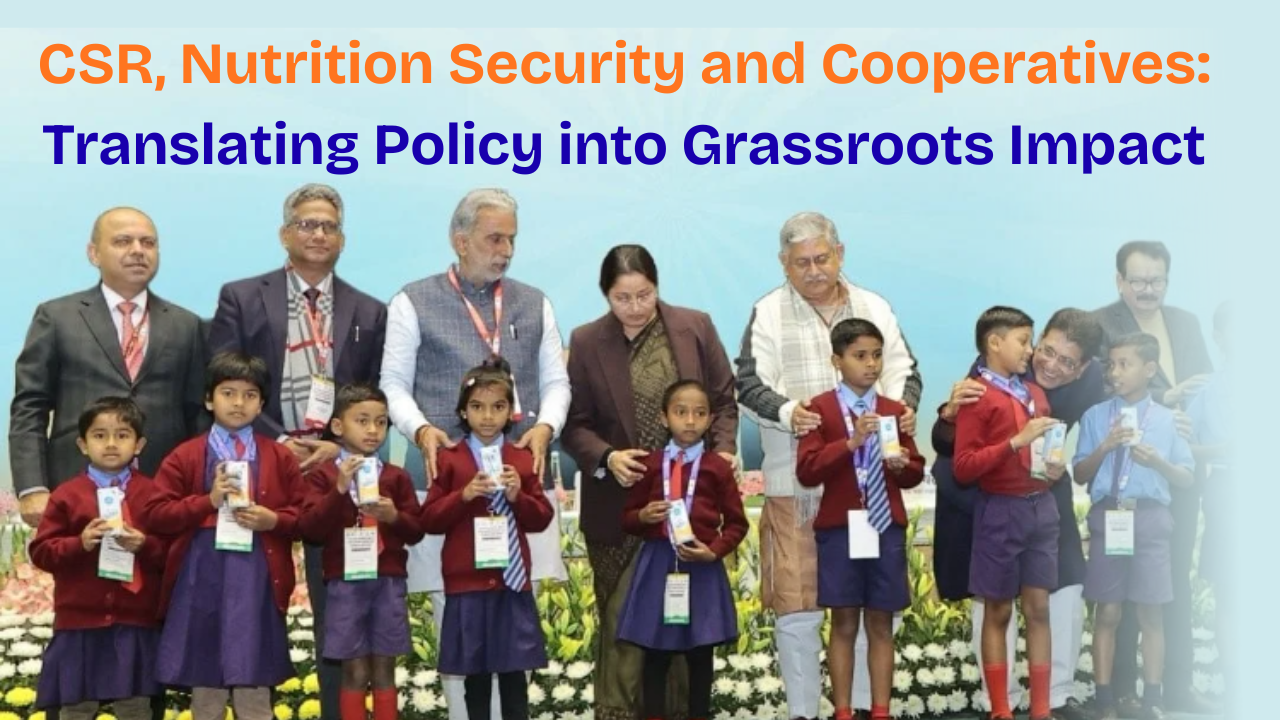
On 6 January 2026, a National CSR Conclave on Nutrition Security and Malnutrition Mitigation was held at Vigyan Bhawan, New Delhi, bringing together government representatives, CSR partners, cooperative leaders, and sector stakeholders. Organised by the National Dairy Development Board (NDDB) Foundation for Nutrition, the conclave spotlighted how nutrition outcomes can be advanced through coordinated institutional action and strategic CSR engagement.
This development is significant for the cooperative sector because it reflects an evolving policy approach that positions cooperatives not just as socio-economic entities but also as institutional partners in national development priorities, such as nutrition security.
Context of the Conclave
The conclave was framed around the urgent need to mitigate malnutrition and ensure nutrition security across communities. Malnutrition remains a persistent development challenge with profound implications for health, productivity, and human capital formation. Recognising this, the conclave sought to harness corporate social responsibility resources and institutional partnerships towards measurable impact.
At the event, the Giftmilk/Shishu Sanjeevani Programme was reiterated as a flagship initiative by the NDDB Foundation for Nutrition, aimed at improving child nutrition outcomes. The initiative, rooted in nutrition delivery through cooperative supply chains, signals how cooperative systems can be leveraged beyond production and marketing into public health priorities.
Key Launches and Institutional Engagement
The conclave underscored several strategic elements:
- The inauguration and focus on nutrition-centric programmes such as Giftmilk and Shishu Sanjeevani, which link dairy cooperatives with nutrition outcomes for children and mothers.
- Presentation of mementoes to CSR partners in recognition of their sustained contributions to nutrition-focused initiatives of the NDDB. This gesture symbolises growing collaboration between cooperatives and CSR actors within structured frameworks.
These developments illustrate how cooperatives and CSR partners can work symbiotically, aligning private capital and social responsibility with public interest objectives.
Policy Signals from Senior Leadership
The conclave was graced by several dignitaries from the government and cooperative ecosystems. Their participation highlights the institutional priority given to nutrition security and inter-sectoral cooperation:
- Shri Piyush Goyal, Union Minister of Commerce and Industry, emphasised that the fight against malnutrition must become a collective national movement involving government, industry, and communities. He articulated that CSR should be seen not merely as compliance with statutory requirements but as a strategic opportunity to address entrenched social challenges.
- Shri Krishan Pal Gurjar, Minister of State for Cooperation, reflected on the evolution of CSR into a social investment instrument. He cited programs such as Giftmilk and Shishu Sanjeevani as embodiments of how cooperative frameworks can catalyse structured nutrition outcomes.
The event was also attended by Secretaries and senior officials from the Ministry of Cooperation, the Department of Animal Husbandry and Dairying, the Ministry of Panchayati Raj, and the Ministry of Women and Child Development, reflecting a whole-of-government engagement for grassroots impact.
Inter-Ministerial Coordination for Impact
One of the most crucial takeaways from the conclave was the emphasis on inter-ministerial coordination as a driver of effective policy implementation. As articulated by Shri Goyal, nutrition security requires a convergence of efforts across ministries and institutional partners. This approach can unlock synergies between agricultural production, cooperative supply chains, health and nutrition programmes, and community outreach mechanisms.
For the cooperative sector, this policy direction points to a future in which cooperatives are not only economic agents but also platforms for integrated policy implementation. Dairy federations and primary milk unions, with their deep rural roots and established supply networks, are uniquely positioned to support initiatives that intersect with nutrition, livelihoods, and community welfare.
Strategic Implications for Cooperatives
The conclave underscores several implications for cooperative institutions:
- Expanding Role Beyond Production: Cooperatives can evolve into nutrition delivery partners, linking local production systems with community-level health and nutrition outcomes.
- Structured CSR Engagement: Rather than ad hoc engagements, cooperatives can participate in structured CSR partnerships through eligible implementing entities, where outcomes are clearly defined, tracked, and aligned with national development priorities.
- Governance and Institutional Convergence: Active engagement with multiple ministries and development programmes can enhance the relevance of cooperatives in national policy implementation, particularly in areas that require multisector coordination.
- Metrics of Impact: Integrating nutrition outcomes into cooperative performance indicators can signal a shift towards more impact-oriented, outcome-driven governance practices.
Conclusion
The National CSR Conclave on Nutrition Security and Malnutrition Mitigation reflects an evolving policy direction in which institutional collaboration, structured CSR engagement, and cooperative ecosystems are increasingly aligned to address national development priorities.
For the cooperative sector, this presents an opportunity to deepen its societal relevance, strengthen its role in national development frameworks, and contribute to sustainable, outcome-oriented models of institutional impact.
Coop Talks will continue to track such developments and provide structured analysis to support cooperative leaders, policymakers, and CSR partners advancing systemic, scalable solutions.