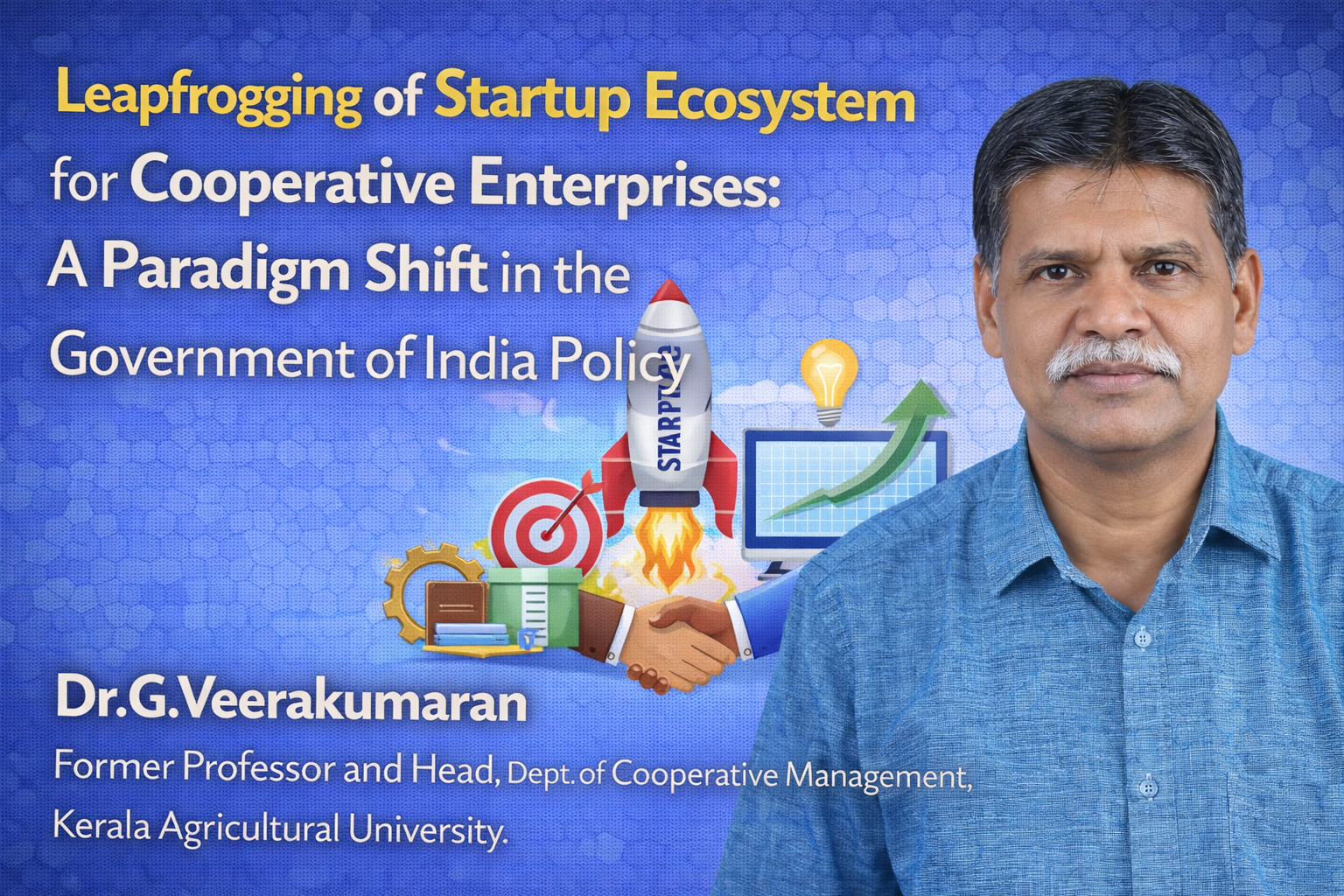

Dr.G.Veerakumaran,
Former Professor and Head, Department of Cooperative Management,
College of Cooperation, Banking and Management,
Kerala Agricultural University, Thrissur
Introduction
Human civilisations has emerged due to surplus food production, and as a result, trade started flourishing in the world. Both demand and supply-driven trade was carried out, cutting across the borders. International trade was carried out by the enterprising and skilled youth who are involved in import and export rare goods. Archaeological evidence proves that innovation and trade go together, which ultimately reflects the standard of living of the people. Europeans came to India for trading, but unfortunately, enslaved the continent for a long time and suppressed the enterprising culture and innovation among the people, resulting in low economic development. The post-independence period witnessed a massive expansion of social welfare schemes with focus on poverty-eradication. Investment in education and health paved the way for independent thinking and innovation. The paradigm shift from the controlled economy to the liberalised economy during the 1990s created a congenial climate for enterprises to grow favouring decentralisation of economic power. As in other developed economies, India too now witnesses a massive transformation to adopt Artificial Intelligence for its economic development and inclusive growth.
Startup Ecosystem in India
The Startup India initiative, conceived under the Department for Promotion of Industry and Internal Trade (DPIIT) of the Government of India, was implemented in all the states and has made India a land of opportunity for innovators, entrepreneurs and job creators. The said initiative supports a robust startup ecosystem by introducing a dedicated action plan focusing on three core areas; simplification and handholding, funding support and incentives and industry-academia partnership and incubation. Almost all the states of the country have played a pivotal role in registering a whopping number of 2.07 lakh startups in the decade. Out of this, 99000 are women-led startups. Altogether, the startups in 770 districts created 21.9 lakh jobs. Interestingly, among these, 118 are declared as unicorns, while 3418 were soonicorns. The startups were established across key industries, namely Agriculture, Education, Food and Beverages, Healthcare and life sciences, Information Technology services, Technology and Hardware, Professional and commercial services, Construction and Finance & Technology. A positive indicator is that, though the state of Gujarat stands as the best performer, Karnataka, Punjab, Tamilnadu and Uttar Pradesh stand as the top performers; while all other states have shown potential symptoms for the promotion of startups.
Technological Revolution and the Preparedness of the Government
Interestingly, the Government of India and all other state governments promote the following emerging and niche sectors. (Source: 5th Edition of States’ Startup Ecosystem Ranking)
- Deep tech and computing include Quantum software & Algorithms, Edge AI and tiny ML, Neuromorphic computing and brain-inspired chips.
- Climate, Energy and Materials focuses on sustainable infrastructure, such as long-duration energy storage, green hydrogen & green ammonia value chains, carbon removal & Direct Air capture (DAC), Advanced materials & Programmable matter and Climate risk analytics & adaptation.
- Life Science, Health & Bio highlights advancements in precision medicine & multi-omic diagnostics, cell & gene therapy platforms, synthetic biology for materials & food, digital therapeutics & remote monitoring and microbiome engineering.
- Food, Agriculture & Supply Chains focuses on modernising food production and delivery through alternative proteins & precision agriculture, agri-tech: regenerative & precision agriculture, cold- chain & last-mile perishables logistics, IoT & smart irrigation
- Mobility, Transport & Logistics focuses on the goods and people mobility, including electric aviation & enabling systems, autonomous systems for logistics and mobility as a service & multimodal platforms.
- Space & Frontier Tech covers the emerging space economy, specifically small-sat services & space data platforms and In-space manufacturing & servicing.
- Finance & Governance focuses on the development of emerging digital technologies such as Programmable finance & Digital Currency, On-chain compliance & AML for digital assets and Decentralised identity & verifiable credentials.
- Urban Built Environment & Industry 4.0 focuses on physical infrastructure such as smart buildings & distributed electrification, circular economy platforms & materials traceability and Industrial digital twins & predictive maintenance.
- Work, Learning & Creativity highlights advancements of emerging technologies in both living and nonliving sectors, like Human AI collaboration tools, lifelong learning/ micro-credential platforms and creator economy infra & tools.
- Security, Privacy & Trust focuses on the safety and protection with post-quantum cryptography & key management, privacy engineering & data clean rooms and synthetic media detection & verification.
- Consumer Frontier & Lifestyle Tech focuses on people’s health, entertainment and even stress management using modern technologies such as AR/VR & spatial computing apps and Longevity & wellness Tech.
The India–AI Impact Summit 2026 marks a defining global inflection point — transitioning from dialogue to demonstrable impact. Anchored in the principles of People, Planet, and Progress, it envisions a future where AI advances humanity, fosters inclusive growth, and safeguards our shared planet.’ The summit brought together the innovators world over and served as a ground for Indian entrepreneurship development. The Government of India has forecasted that the AI-driven technological revolution will transform the primary industry, manufacturing, and the service Industry related to its production and distribution. It seems that the government is also aware of the impact of Deep Tech and AI Anthropic on the economy. Therefore, the right initiative has been taken to incorporate all the above technological changes and the future developments into the policy and regulations for any entity to launch its startups.
Paradigm Shift in the Government of India Policy
The Department for Promotion of Industry and Internal Trade (DPIIT), Ministry of Commerce and Industry, Government of India, issued a trend-setting notification on 4th February 2026. Besides private limited company, partnership firm, limited partnership, the notification also included Multi-State Cooperative Society and a Cooperative Society registered under any State or Union Territory Cooperative Societies Act. Further, the notification stipulates the following conditions to declare an entity as a startup: if it
- Is in existence within a period of ten years (whereas for ‘Deep Tech Startup’, twenty years) from the date of its incorporation or registration;
- has a turnover for any of the financial years since incorporation or registration not exceeding two hundred crore rupees (whereas for ‘Deep Tech Startup’, three hundred crores); and
- is working towards innovation, development or improvement of products or processes or
services, or is a scalable business model with a high potential for employment generation or wealth creation.
This is a historical shift towards strengthening the cooperative movement . This has provided a level playing field for the cooperative sector to assimilate itself with the startup culture of the country. The democratic business model has all the potential to absorb the technology referred to in the earlier paragraphs. The techno cooperatives operating worldwide, platform cooperatives and the recently launched Bharat Taxi have proved beyond doubt that the model is sustainable and can be replicated in any innovative business venture. These cooperative startups will attract the STEM-educated, enterprising youth, believing in the social economy principles, such as equitable distribution of wealth and democratic management. This is a right step in the right direction at the right time.
Implications of the New Startup Recognition Framework on the Cooperative Startups
The Startup India Mission was in operation for a decade, but the cooperatives sector was ignored. Of late, the government now realises the importance of the cooperative sector for inclusive growth and has incorporated cooperative as an eligible entity for startup benefits. Along with the other startups, cooperative startups will also receive the following benefits:
- Section 80-IAC of the Income Tax Act allows cooperative startups to claim a 100% deduction of profits for any 3 consecutive years within 10 years of their registration.
- The cooperative startups can enroll in the BHASKAR (Bharat Startup Knowledge Access Registry), which is a unified digital platform connecting India’s startup ecosystem for collaboration, knowledge sharing, and discoverability.
- The cooperative startups, subject to the approval by the Registrar of Cooperative Societies, may avail the SIDBI-managed Fund of Funds for Startups (FFS).
- Further, the startups under the cooperative sector can utilise the Credit Guarantee Scheme for Startups (CGSS). Once DPIIT recognises those cooperatives, they can avail loans from the banks, NBFCs, and SEBI-registered Venture Debt Funds.
- Promoters of the cooperatives can also avail the Startup India Seed Fund Scheme (SISFS) to support early-stage activities such as proof of concept, prototype development, product trials, market entry, and commercialisation.
- At the initial stage, the cooperatives may create a network through the India Investor Connect, launched by DPIIT, which is an AI-driven platform that serves as a virtual marketplace for entrepreneurs to showcase ideas.
- MAARG (Mentorship, Advisory, Assistance, Resilience, and Growth) is a Startup India National Mentorship Platform. It will connect the promoters of the cooperative startup with academicians, industry leaders, entrepreneurs, investors, and experts for personalised guidance.
- If the cooperatives are creating innovative, scalable solutions with high potential for employment, wealth creation, and social impact, they may be considered for The National Startup Awards (NSA).
- The Cooperative Startups will have privileged access to the Government e-Marketplace (GeM) even without paying an Earnest Money Deposit (EMD).
- The cooperatives can self-certify compliance under nine labour and three environmental laws for a period of three to five years from registration.
The above mentioned are only a select few benefits for the cooperative startups. Besides this, many other benefits can be derived from different government agencies. Considering these benefits and the ideological supremacy of the cooperative enterprises, entrepreneurial youth may start their business ventures as a collective.
Conclusion
The vision of the government is indeed appreciable. It will lead to more youth participation in the cooperative sector. The cooperative sector can also use the state-of-the-art technology for employment generation and inclusive growth. New cooperative enterprises can also benefit from these measures. Within their area of operation, the existing cooperatives with long years of business experience, can act as a mentors for the youth cooperative startups which have emerged in such areas.. The cooperative principle of cooperation among cooperatives will help the cooperative startups to scale up their business turnover and extend their reach in other destinations. Since the cooperatives are doing business from ‘cradle to graveyard’, no business is new to the sector. Similarly, no state is new to the cooperatives. There are ample opportunities for the cooperatives to utilise the new national policy and regulations for the development of the startups. However, the issues like vested interests in the cooperative sector and the lack of professionalisation , need to be well addressed.
Selected References
- https://www.startupindia.gov.in/srf/images/SRF_2022_Result_page/National-Report-15-01-26.pdf. Retrieved on 26th February 2026.
- https://www.startupindia.gov.in/content/dam/invest-india/Templates/public/198117.pdf. Retrieved on 26th February 2026.
- https://d2p5j06zete1i7.cloudfront.net/Cms/admin/post/18/1770355736.pdf. Retrieved on 26th February 2026.
- https://impact.indiaai.gov.in/. Retrieved on 26th February 2026.
- https://www.cooperation.gov.in/sites/default/files/2025-07/NCP%28Eng%29_23Jul2025_v5_Final.pdf. Retrieved on 26th February 2026