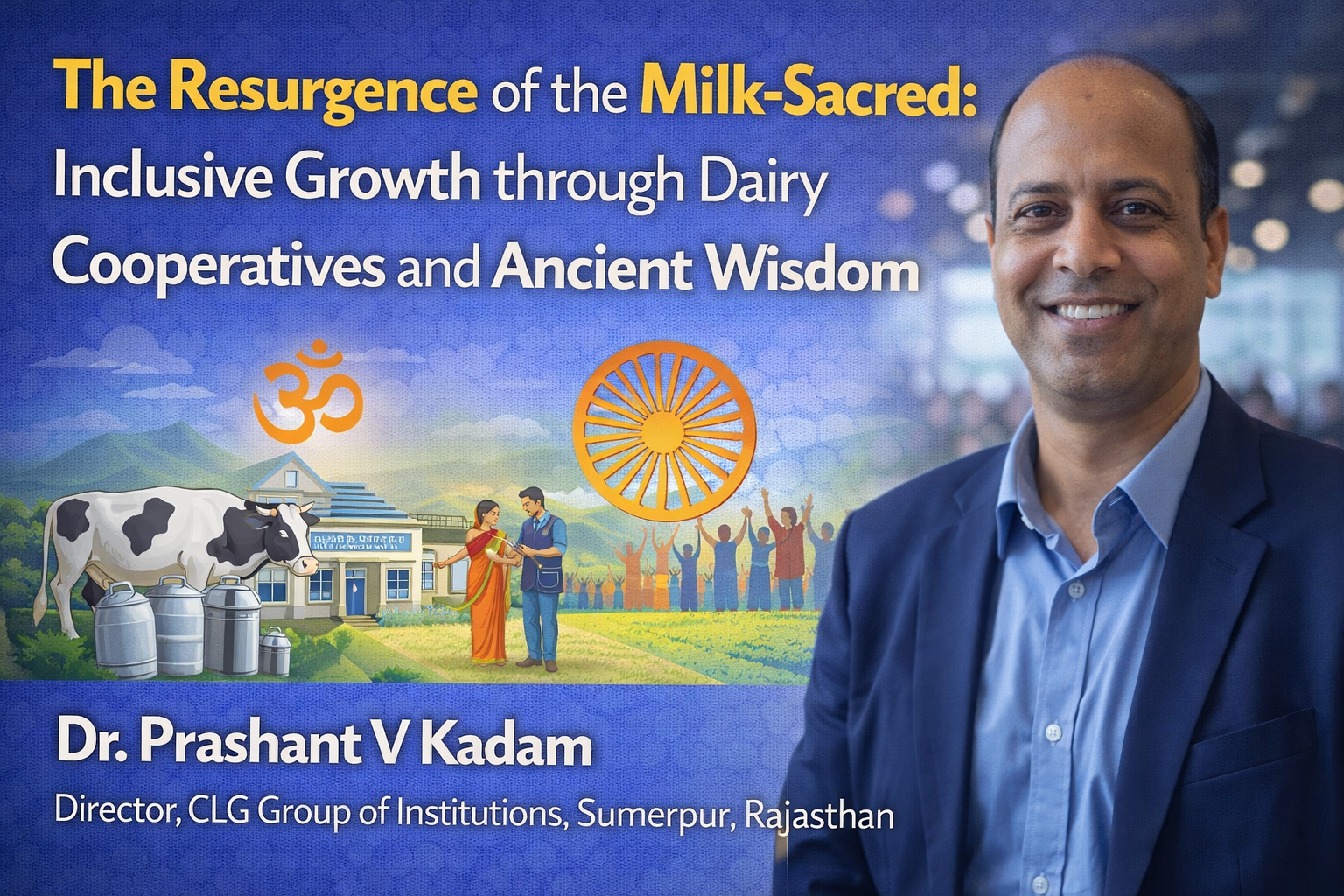

Dr. Prashant V Kadam
Director,
CLG Group of Institutions, Sumerpur, Rajasthan
The dawn of Viksit Bharat 2047 (Developed India 2047) is fundamentally tied to the rural economy, where the white revolution is transitioning into its second phase. Since the establishment of the dedicated Ministry of Cooperation in 2021, the cooperative sector has witnessed a tectonic shift in policy support. Yet, as the nation targets inclusive growth, it faces a paradox: while the “Amul Model” stands as a global beacon of success, many state-level dairy cooperatives remain stagnant or failing. To bridge this gap, India must pivot toward a reformative paradigm—one that marries modern cooperative incentives with the profound principles of Ancient Indian Knowledge Systems (IKS) for governance.
The Current Landscape: Incentives and Policy Momentum
The Ministry of Cooperation’s “Sahakar se Samriddhi” vision, headlined by the launch of White Revolution 2.0 in late 2024, has catalyzed a massive structural overhaul of the dairy sector through ambitious expansion targets, such as the registration of over 32,546 new multipurpose PACS as of early 2026 toward a five-year goal of 2 lakh societies. This revitalization is backed by aggressive procurement targets aiming for 1,007 lakh kg per day by 2029, alongside robust financial incentives including a 3% interest subvention under the AHIDF and additional working capital support through the SDCFPO scheme. Furthermore, the strategic digitization of 63,000 PACS seeks to instill transparency and modernize governance; however, the sector remains hindered by a “leaky bucket” syndrome where the potential of these reforms is often drained by political interference, a deficit in professional management, and a persistent disconnect between cooperative hierarchies and the primary producers on the ground.
Amul’s success is rooted in its three-tier structure: village-level societies, district unions, and a state federation. However, replicating this in other states has often failed because the “spirit” of the cooperative was lost to bureaucratic inertia. Inclusive growth is currently “at its edge” because reforms have focused largely on infrastructure (chilling plants and labs) while neglecting the human-centric governance required to sustain them. To move from a “quantity-driven” expansion to a “welfare-oriented” Bharat, the alignment with Ancient Knowledge Systems (IKS) offers a transformative governance framework.
The ancient Indian texts like the Arthashastra, the Shanti Parva of the Mahabharata, and the concept of Dharma provide a blueprint for “Self-Governance” (Swaraj) and “Collective Welfare” (Sarvodaya).
- The Principle of ‘Raksha’ (Protection and Stewardship)
In Kautilya’s Arthashastra, the leader (or board) is tasked with Raksha—the protection of stakeholders’ interests. In a modern dairy cooperative, this translates to Risk Management and safeguarding the marginal farmer against market volatility. Currently, 68% of India’s milk surplus is handled by the unorganized sector, where farmers are vulnerable to price exploitation. By adopting the Raksha mindset, cooperatives must prioritize “Price Security” over “Corporate Profit.”
- ‘Vriddhi’ and the Circular Economy
Ancient wisdom emphasizes Vriddhi (Growth) that is sustainable. Modern dairy reforms are now aligning with this through the promotion of Circular Economy models.
- Gobar–Dhan: By converting cow dung into organic manure and biogas, cooperatives can generate secondary income streams. This mirrors the ancient Vedic practice where the cow was Aghnya (not to be killed) because of her holistic contribution to the farm ecosystem.
- Data Impact: Integrating bio-manure into the cooperative value chain can reduce chemical fertilizer dependency by an estimated 20-25% for member farmers, enhancing the soil health of Bharat.
- ‘Vasudhaiva Kutumbakam’ (The World is One Family)
The failure of cooperatives in many states is often due to a lack of “social capital.” Ancient governance was rooted in the Gram Sabha or village assemblies, where decisions were communal and transparent.
- The Reform: Moving away from “Government-controlled” cooperatives to “Member-owned” entities. The current Model Bye-Laws introduced by the Ministry of Cooperation allow PACS to diversify into 25 new sectors, effectively turning them into village-level “Knowledge and Resource Hubs.”
For dairy cooperatives to be the engine of Viksit Bharat, the strategy must shift from mere “procurement” to “inclusive empowerment.”
Statistics show that women provide the bulk of labour in the dairy sector, yet they hold less than 20% of leadership roles in cooperative boards. Following the Shakti principle, the government’s target to form 75,000 new Dairy Cooperative Societies specifically emphasizes women-led committees. In Gujarat, women-only cooperatives have shown 15% higher transparency rates in milk testing and payment.
The use of AI and Blockchain in milk tracking is not just a modern necessity but a digital manifestation of the ancient value of Satya (Truth/Transparency). When a farmer can see the fat content and price of their milk on a digital display instantly, trust—the bedrock of cooperation—is restored.
The paradigm of inclusive growth through dairy cooperatives is not a new invention; it is a rediscovery. By combining the massive fiscal incentives of the Ministry of Cooperation with the timeless governance values of Indian heritage—transparency, stewardship, and community welfare—India can transform its rural landscape. A welfare-oriented Bharat will be one where the dairy cooperative is not just a collection center, but a Sanskar Kendra (Center of Values) which ensures that the wealth of the “White Revolution” trickles down to the very last farmer at the edge of the field.