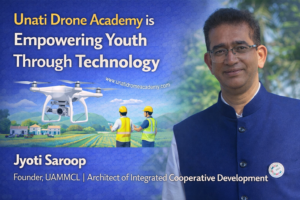
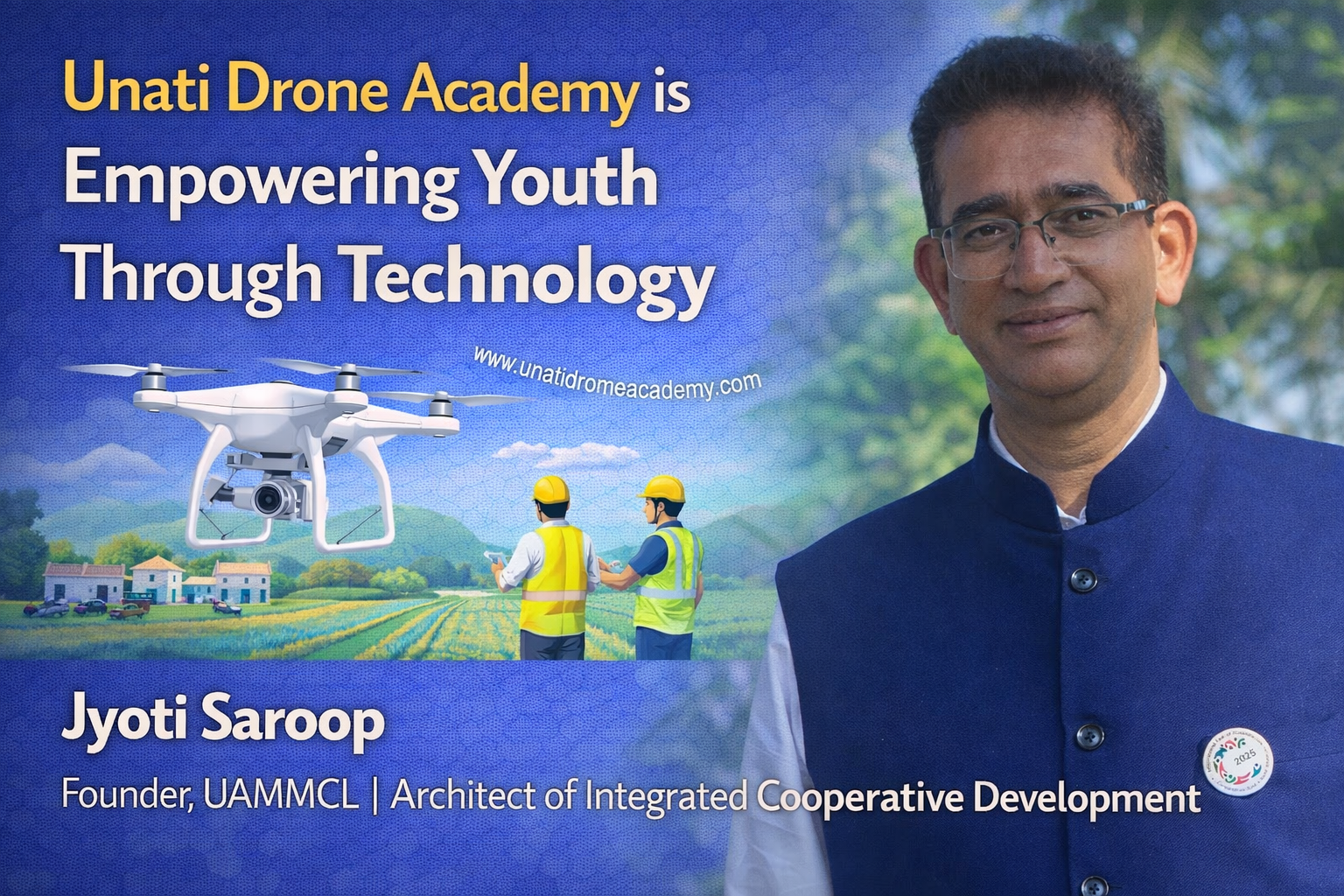

Jyoti Saroop
Founder & Director, Unati Cooperative.
The Unati Drone Academy is a pioneering initiative under the vision of The Unati Agri Allied and Marketing Multistate Co-operative Society Limited (UAMMCL) which aims to build a technology-enabled, cooperative-driven sustainable rural economy. The Unati Drone Academy, which proudly stands as India’s first DGCA-affiliated Remote Pilot Training Organization (RPTO), aims to, empower youth to become skilled, certified, and future-ready professionals in India’s rapidly growing drone-ecosystem. The details of this Academy can be known from www.unatidroneacademy.com
In conversation with Sanjay Verma, Founder, Coop Talks
- How did the idea of setting up a Drone Academy was conceived?
The Drone Academy was not an isolated idea. It emerged directly from UAMMCL’s cooperative philosophy. We operate in rural Punjab where youth migration to cities is high and livelihood sustainability for small farmers remains fragile. I have always believed that running away from technology deepens inequality, but embracing technology democratizes opportunity.
When agricultural drones began entering the ecosystem, we saw three immediate strategic advantages. First, drones represent a new-age industry with exponential growth potential. Training rural youth as certified drone pilots converts them from job seekers into job creators. Second, drone-enabled precision agriculture reduces fertilizer and pesticide misuse, directly cutting input costs and increasing productivity for small farmers. Third, precision spraying and mapping significantly reduce environmental damage by minimizing chemical overuse.
For UAMMCL, drones were not gadgets. They were instruments of cooperative transformation. Drone Academy is therefore not a training centre. It is a technology gateway for rural economic sovereignty.
- Did you face problems in setting up the Academy? When did it start functioning?
We approached this initiative with seriousness and compliance discipline. We secured DGCA authorization in the last week of July 2025. The Academy began functioning in September 2025 after completing all regulatory and infrastructure requirements. Since we built it correctly from the beginning, we did not face operational obstacles. We did not rush for visibility. We built credibility first. That is how institutions are created.
- What is the current state of functioning? What programs are running? Who are the participants?
The Academy is fully operational as a certified RPTO. Currently, we are conducting the Remote Pilot Certificate program. Youth participation is strong, and importantly, women are actively enrolling. We are now launching a unique three-month program titled ‘Junior Engineer Drone (R&D)’ in collaboration with IIT Ropar. Necessary approvals are in place, and this course will move beyond flying to technology understanding, maintenance, and research orientation. Our objective is clear. We are not producing operators alone. We are building drone engineers, rural technologists, and cooperative entrepreneurs.
- Is this initiative aligned with the Ministry of Cooperation’s agenda?
Completely aligned. The Ministry has planned to create two lakh new Multipurpose PACS. UAMMCL’s roadmap is to empower and integrate these MPACS through technology. Drone services can become a revenue stream for PACS. Crop mapping, spraying, land surveys, insurance assessment, and infrastructure inspection can all be routed through cooperatives.
Technology must not bypass cooperatives. It must strengthen them. UAMMCL is building a model where every MPACS becomes a technology-enabled service centre. Drone Academy is one pillar of that architecture.
- How are you sustaining the functioning of this Academy? What is the business model?
Profit is not the objective. Impact is. However, sustainability is essential. Our model includes:
-Subsidized skill training for rural youth
-Service deployment through cooperative networks
-Institutional collaborations
-Entrepreneurship pathways for certified pilots
We are building a cooperative drone service network where trained pilots operate under structured service contracts.
The Academy trains.
Cooperatives deploy.
Youth earn.
Farmers benefit.
This is circular rural economics.
- Are you looking for collaborators? How can collaboration be win-win?
Yes, collaboration is central to scale. We are working and exploring partnerships with institutions such as IIT Ropar, IIIM Jammu, ANNAM.AI Foundation of IIT, and other research bodies so that our member PACS and farmers are benefitted through deep technologies. We are also in the process of establishing a Cooperative Incubator in collaboration with RICM Chandigarh to nurture new MPACS and technology-driven cooperative enterprises. We welcome collaboration with organizations like IFFCO, KRIBHCO, NFL, government departments, universities, and technology firms. Our advantage is last-mile rural presence. Our collaborators gain structured rural deployment. Together, we bridge the urban-rural technology divide. This is not networking. This is ecosystem building.
- What type of government support are you seeking? Any policy support?
Two forms of support will accelerate impact.
First, structured sponsorship for rural youth to undergo drone skilling through certified academies.
Second, capital subsidy or financing mechanisms for drone purchase. The cost of drones remains a barrier for rural entrepreneurs.
If policy integrates drone services into cooperative schemes and ensures financial support for trained pilots, rural drone entrepreneurship will scale rapidly.
- What are the challenges? What are your action plans?
The biggest challenge is capital cost and access to financing for youth. We are addressing this through cooperative-owned drone fleets; Cluster-based deployment; Maintenance and R&D training modules; and Institutional service contracts. Another challenge is technological confidence. Rural youth must see themselves as technology leaders. That is why we are building a basket of deep technologies.
- To what extent will this Academy benefit youth?
This Academy equips rural youth with aviation-grade certification and new-age technical capability. Drone applications span agriculture, surveillance, infrastructure inspection, disaster management, logistics, and defence support systems.
But the deeper impact is psychological. When a rural youth flies a drone over his own cooperative farmland, technology stops being distant. It becomes owned. That ownership mindset changes everything.
- What is your long-term vision for this Academy?
Our vision is not limited to pilot training.
We aim to build:
-Drone R&D programs
-Maintenance and repair certification
-Surveillance and infrastructure inspection services
-Data intelligence integration
-Cooperative drone grids across districts
Simultaneously, UAMMCL is establishing Automatic Weather Stations in collaboration with IIT Ropar to deliver hyper-local weather intelligence to farmers. We are in dialogue with ANNAM.AI Foundation to integrate artificial intelligence tools for agriculture advisory.
We are building a deep technology basket—drones, AI, weather systems, agri-research linkages—and delivering it at the doorstep of our member farmers and cooperatives. This is integrated technological empowerment.
- Any other issue you would like to discuss?
Yes. India is entering a precision agriculture era. If cooperatives fail to adopt deep technology now, they risk irrelevance. UAMMCL is positioning cooperatives at the centre of technological adoption. Drone Academy is not about flying machines. It is about ensuring that technology is community-owned, skill-driven, and cooperative-controlled. We are not building an institute. We are building the technology arm of cooperative India.