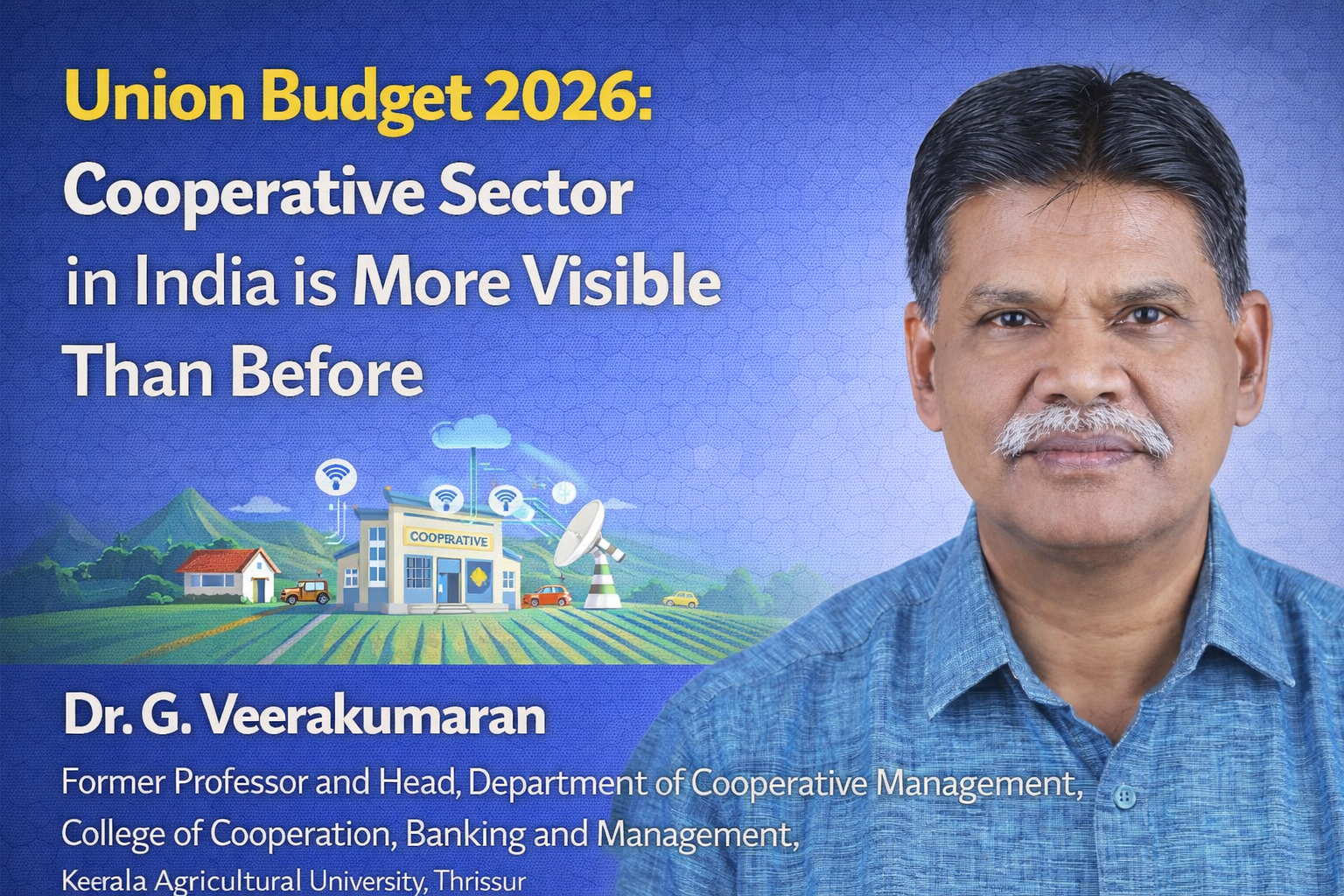

Dr.G.Veerakumaran,
Former Professor and Head, Department of Cooperative Management,
College of Cooperation, Banking and Management,
Kerala Agricultural University, Thrissur
Prior to the presentation of the Union Budget, the Finance Minister tabled the Economic Survey 2025–26 in Parliament on 29 January 2026. Despite global geopolitical tensions, trade disruptions, and inflationary pressures, India’s First Advance Estimates project real GDP growth at 7.4% and GVA growth at 7.3% for FY 2026.
The Survey notes a 7% increase in consumption expenditure, attributed to low inflation, stable employment, improved real purchasing power, and strong agricultural performance. Financial inclusion initiatives of the Union Government, along with growth in exports, remittances, food grain production, manufacturing output, and both direct and indirect tax collections, have contributed positively during the year.
The Survey highlights that prudent fiscal management has strengthened confidence in India’s macroeconomic framework. It also reports a significant decline in child mortality and the Multidimensional Poverty Index (MPI). Improvements in health, education, and the skilling ecosystem are seen as contributing to a better quality of life and leveraging India’s demographic dividend. The vision of moving ‘from import substitution to strategic resilience and strategic indispensability’ is termed as ‘Swadeshi’.
With regard to the cooperative sector, the Survey advocates the adoption of updated and consolidated regulations and the use of Artificial Intelligence in cooperative operations. It recognizes that cooperatives, along with other institutions, can play a vital role in India’s pension ecosystem.
Echoing the vision of the Ministry of Cooperation, the Survey emphasizes the transformation of Primary Agricultural Credit Societies (PACS) into multi-service centres and encourages their integration with digital initiatives such as e-NAM. It also underlines the role of cooperatives in the seed ecosystem and calls for an integrated agricultural extension system in which farmer collectives, including PACS, work collaboratively.
The success of the Kisan Rin Portal (KRP), launched in 2023, is expected to strengthen cooperative credit delivery. Under the Integrated Scheme for Agricultural Marketing (ISAM) through the Agriculture Marketing Infrastructure (AMI) sub-scheme, cooperatives continue to receive financial support as part of a demand-driven, credit-linked, back-ended subsidy programme.
The Survey reiterates the government’s plan to establish multipurpose PACS, dairy, and fisheries cooperatives across all panchayats, indicating an ambition to universalize cooperative presence. It also appreciates the formulation of the National Cooperation Policy and the establishment of Tribhuvan Sahkari University for professionalizing cooperative management.
A key observation is that the strengthening of cooperatives alongside Farmer Producer Organizations (FPOs) has expanded access to credit, technology, and efficient value chains.
On 1 February 2026, the Finance Minister presented the Union Budget 2026–27, in which the cooperative sector finds greater visibility than before. The Budget reiterates Atmanirbharta as a guiding principle towards Viksit Bharat and emphasizes commitment (Sankalp) towards the poor, underprivileged, and disadvantaged—sections traditionally served by the cooperative movement.
This commitment is structured around three duties (Kartavya):
1. Accelerating and sustaining economic growth through productivity, competitiveness, and building resilience to face volatile global dynamics..
2. To fulfill aspirations of our people and build the capacity of citizens as partners in national prosperity.
3. Ensuring access to resources, amenities and opportunities for every family, community, region and sector aligned with our vision of ‘Sabka Saath, Sabka Vikas’.
These principles resonate with the Sustainable Development Goals and the values upheld by the International Cooperative Alliance.
Key Budget Provisions Benefiting Cooperatives
Handloom Cooperatives
The Mahatma Gandhi Gram Swaraj initiative aims to strengthen khadi, handloom, and handicrafts through branding, global market linkage, skilling, and quality enhancement. With 19,610 cooperatives and over 4.8 million members in this sector—more than half in rural areas—this initiative is expected to benefit weaving communities significantly.
Cooperative Banking
The proposal to establish a High-Level Committee on Banking for Viksit Bharat to review the banking sector with a focus on financial stability and inclusion inevitably concerns cooperative banks and credit cooperatives which cannot be ignored.
Health Cooperatives
The budget projects a vision of strong Care Ecosystem, covering geriatric and allied care services combining core care and allied skills, such as wellness, yoga and operation of medical and assistive devices, In the coming year, 1,5 lakh caregivers will be trained.. . Health cooperatives, such as the 188 hospital and dispensary cooperatives in Kerala, can utilize this opportunity to develop skilled healthcare professionals.
Fishery Cooperatives
Initiatives for the integrated development of 500 reservoirs and Amrit Sarovars, and strengthening fisheries value chains with market linkages involving start-ups and women-led groups together with Fish Farmers Producer Organisations, will benefit 23,134 fishery cooperatives and their member fishermen and women.
Animal Husbandry Cooperatives
Credit-linked subsidies, modernization of livestock enterprises, integrated value chains, and promotion of Livestock FPOs will support dairy, poultry, piggery, and related cooperatives, creating rural employment opportunities.
Agricultural Production, Processing, and Marketing Cooperatives
Support for high-value crops such as coconut, sandalwood, cocoa and cashew in coastal areas, and a provision for the cultivation of Agar trees in North-East, will help in doubling of farmers’ income. The introduction of Bharat-VISTAAR, a multilingual AI tool integrating AgriStack and ICAR advisories, will aid cooperative members with improved farm decision-making and risk reduction.
Direct Tax Provisions
Deduction under Section 80 P of the Income Tax Act is already allowed to a primary cooperative society engaged in supplying milk, oilseeds, fruits or vegetables raised or grown by its members. Section 80P deductions are now extended to include cattle feed and cotton seed supplied by members. This will certainly improve the animal husbandry and cotton production in India. Inter-cooperative dividend income is allowed as a deduction when redistributed to members. A three-year exemption is also provided for dividend income received by notified national cooperative federations from investments made up to 31 January 2026, subject to redistribution to member cooperatives.
Conclusion
The Union Budget 2026 addresses a wide spectrum of cooperative enterprises. Its vision aligns with global sustainable development principles and cooperative values. While support for the livestock and fisheries sectors is notable, the effective use of provisions related to the seed sector and digital agricultural advisory systems will depend on cooperative preparedness.
Reductions in subsidies for food, fertilizer, and fuel may indirectly affect agriculture and cooperatives. However, value addition in fisheries, growth in animal husbandry, and AI-enabled advisory systems offer new opportunities. Cooperative banking and credit societies may also find expanded roles through emerging service ventures.
At the same time, greater allocation for agriculture would further strengthen the cooperative base. The Union Government’s commitment to implementing these schemes while upholding the spirit of cooperative federalism remains crucial.
Selected References
Economic Survey 2025–26, Government of India.
Union Budget Speech 2026–27.
Ministry of Cooperation, Government of India.
Department of Cooperation, Government of Kerala.