


Dr. Prashant V Kadam
Professor and Editor in Chief,
GoaTV24, Mapusa-Goa.
The Ministry of Cooperation’s plan to launch a cooperative taxi service, tentatively named “Bharat,” is a significant step towards empowering drivers and providing a more equitable alternative to private ride-hailing giants like Ola and Uber. This model aims to redirect profits back to the drivers, who are also members and owners of the cooperative, rather than to large corporations. While the cooperative model holds immense promise, its success hinges on its ability to navigate several complex issues and challenges, particularly in the highly competitive and technology-driven ride-hailing market.
Issues and Challenges
The cooperative taxi service faces a multi-faceted set of issues, ranging from technological hurdles to market competition and operational complexities.
- Technological Infrastructure and App Development
Developing a competitive mobile application for a cooperative taxi service presents a formidable technological challenge, necessitating a platform that can rival established market leaders. The application’s success is contingent upon four key pillars. First, scalability and performance are paramount; the system must be engineered to efficiently manage a high volume of users, real-time data, and transactions without compromise to ensure a seamless user experience. Second, a refined User Interface (UI) and User Experience (UX) are crucial, as the design must be intuitive and frictionless to facilitate quick and easy navigation, booking, and payment. Third, the application must achieve feature parity, integrating all the functionalities that modern consumers have come to expect, including real-time GPS tracking, diverse payment gateways, and a robust feedback mechanism. Finally, stringent data security and privacy protocols are essential to safeguard sensitive user information and build the foundational trust required for user adoption and retention. Failure to meet these demanding technological requirements could critically undermine the service’s operational viability and market competitiveness.
- Market and Competitive Landscape
The cooperative’s entry into the ride-hailing market is a formidable challenge, as it must compete directly with well-funded private entities like Ola and Uber. These established companies possess significant market share, strong brand recognition, and extensive capital for marketing and aggressive pricing strategies. The new service will need to effectively lure both customers and drivers away from these dominant platforms. A key issue lies in the cooperative’s commitment to fair pricing, which may preclude the use of surge pricing during peak hours. While this benefits consumers, it could disincentivize drivers who are accustomed to maximizing their earnings through such a model, potentially leading to a scarcity of available taxis during periods of high demand. Furthermore, the cooperative must not only attract but also retain a critical mass of drivers, many of whom “multi-home” across various apps. The cooperative’s business model and operational efficiency must be so compelling that drivers consistently prioritize its platform over others to ensure a reliable and thriving service.
- Operational and Management Issues
Beyond the technological and market-based challenges, the daily operations of a cooperative taxi service face significant management hurdles. A key issue is balancing the democratic governance model, where members have a voice, with the necessity for agile and efficient decision-making. This can lead to slow processes and internal conflicts. Furthermore, ensuring service quality and standardization across a large network of member-drivers is complex, requiring a robust system for driver training, background verification, and adherence to vehicle standards to build a reputation for safety and reliability. Finally, the establishment of an effective customer support and dispute resolution system is non-negotiable; a clear and fair process is vital for handling complaints, mediating driver disputes, and maintaining operational integrity and user trust.
Recommendations for Success
To overcome the challenges and build a sustainable, successful cooperative taxi service, the following recommendations are crucial:
- Develop a World-Class App and Technology Platform
To develop a world-class application for the cooperative, a strategic technological approach is essential. Rather than building from the ground up, the cooperative should partner with established technology firms or utilize open-source frameworks like ONDC to create a scalable and feature-rich platform. Concurrently, a substantial investment in User Experience (UX) and User Interface (UI) design is critical to ensure the application is intuitive and efficient for both riders and drivers, a goal best achieved through rigorous user testing. Finally, a robust backend is non-negotiable; it must be engineered for real-time matching, dynamic routing, and seamless payment processing to guarantee reliability and cultivate customer loyalty.
- Implement a Smart Business and Pricing Strategy
To create a sustainable and attractive business model, the cooperative should adopt a strategic approach that prioritizes driver welfare while remaining competitive. This includes implementing a hybrid pricing model that, while avoiding predatory surge pricing, uses a transparent, flexible premium during peak hours to ensure a reliable supply of cabs. Furthermore, the cooperative must offer driver-first incentives beyond just higher earnings, such as social security benefits, health insurance, and access to training and loans, capitalizing on the unique structure of the cooperative to build a compelling value proposition. Finally, a subscription-based revenue model—charging a fixed daily or monthly fee instead of a percentage-based commission—would provide drivers with more predictable and transparent earnings, making the platform a more appealing and stable option.
- Focus on Operations and Marketing
Case Study of Cooperative Taxi Service
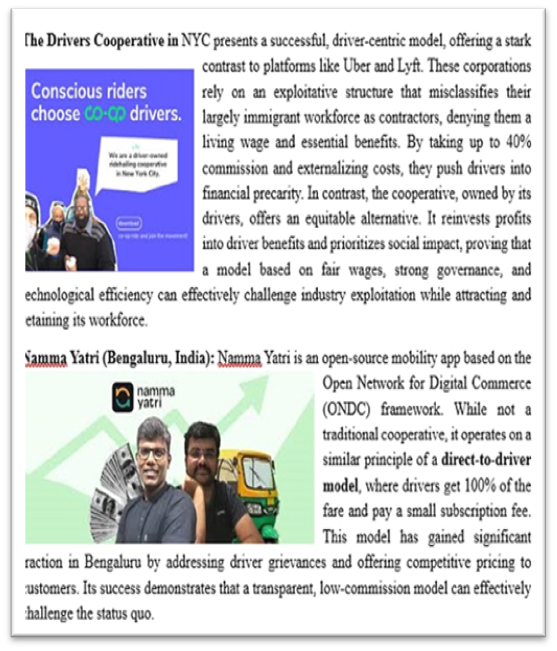
To effectively launch and sustain the cooperative’s taxi service, a comprehensive operational and marketing strategy is crucial. The service must build a strong brand identity that transcends a mere transportation app, positioning itself as a social movement for fair trade and driver empowerment to attract socially conscious consumers. Simultaneously, the cooperative must ensure service quality by implementing mandatory training for all drivers on customer service, safety protocols, and route efficiency, coupled with a strict zero-tolerance policy for unprofessional conduct. A phased approach to expansion, focusing on building a dense, reliable network within specific cities before scaling, will be critical for establishing a strong local presence. Finally, an effective, human-centric grievance redressal system is non-negotiable to handle customer and driver disputes transparently, fairly, and promptly, thereby building trust and maintaining operational integrity.
By addressing these issues and adopting a strategic approach, the cooperative taxi service can not only compete with private giants but also create a new, more sustainable, and equitable future for the ride-hailing industry in India.





3 Responses
Ride in comfort with a trusted taxi from Nassau Airport to Baha Mar. This airport-to-resort transportation offers punctuality and convenience. Choose Nassau Airport to Baha Mar taxi for a quick, comfortable, and dependable ride.
Get from Nassau Airport to Atlantis with ease. Our shuttles and private cars provide door-to-door convenience and reliability. Atlantis to Airport transportation is equally efficient, offering peace of mind with every scheduled pickup.
Bahamas Premium Transfers is proud to serve private transportation from Nassau Airport to Rosewood Baha Mar with professional cheuffeur.