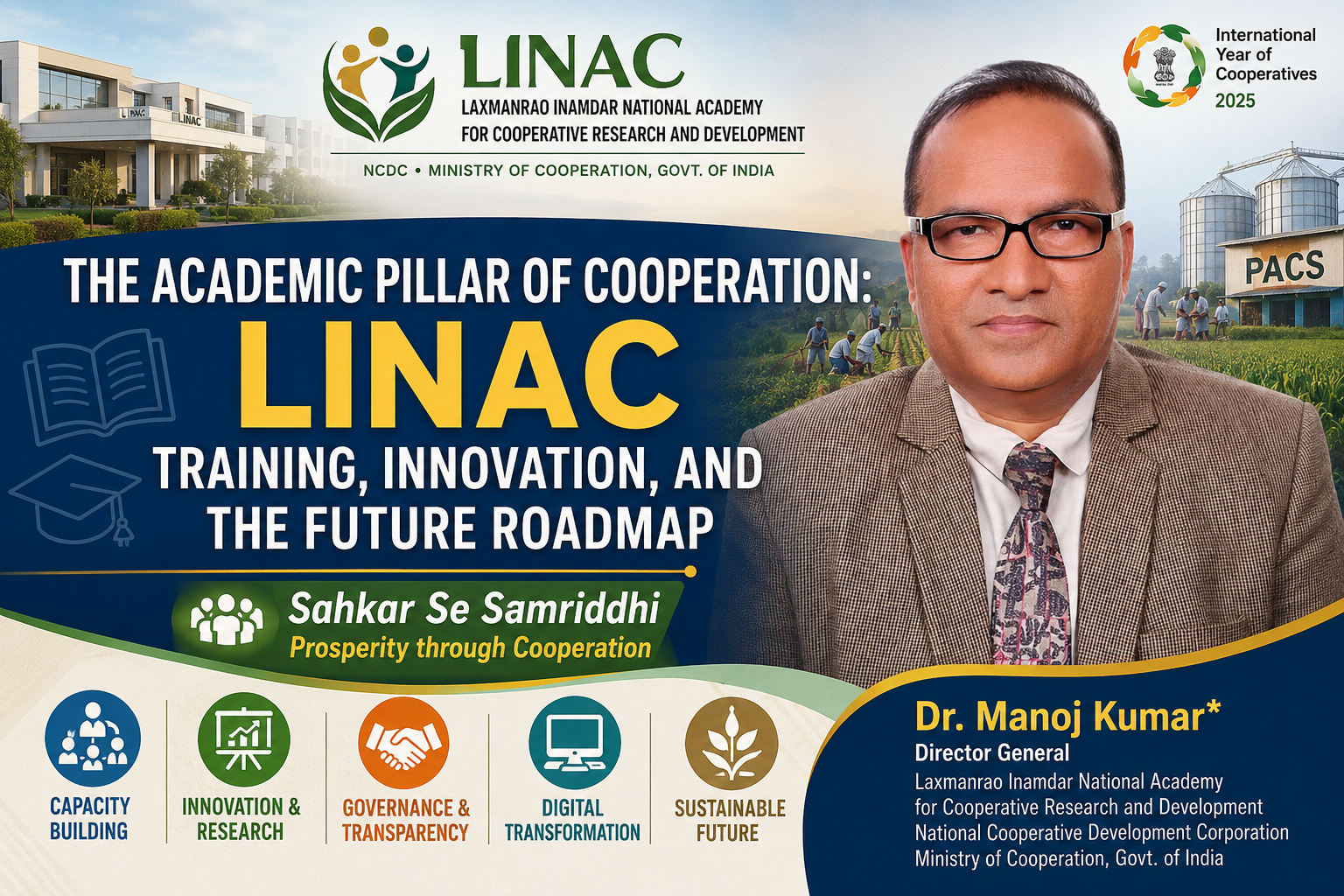

Dr. Manoj Kumar
Director General
of the Laxmanrao Inamdar National Academy for Cooperative Research and Development (LINAC) under the National Cooperative Development Corporation (NCDC), Ministry of Cooperation, Government of India.
Introduction: Cooperation as a Social Movement
In a vast and agrarian country like India, cooperation is not merely a medium for economic transactions; it is a powerful social movement. The path to prosperity and self-reliance in rural India runs through the lanes of cooperative societies.
However, the success of any movement depends on the competence of its leadership and workers. The Laxmanrao Inamdar National Academy for Cooperative Research and Development (LINAC) is effectively fulfilling the responsibility of honing these “skills.” Operating under the National Cooperative Development Corporation (NCDC), this academy has become the most vital academic centre for manifesting the national resolve of ‘Sahkar se Samriddhi’ (Prosperity through Cooperation) on the ground.
1. Origin, Background, and Multidimensional Objectives
Historical Context and Evolution The foundation of LINAC was laid in 1985 in Gurugram (Haryana). Initially known as a ‘Training of Personnel in Cooperatives (TOPIC),’ it was primarily established to support NCDC-funded projects. In February 2018, it was reorganised as a ‘National Academy’ and renamed as Laxmanrao Inamdar National Academy for Cooperative Research and Development, which played a pivotal role in weaving cooperative philosophy with Indian values.
Vision and Objectives
LINAC aims to strengthen cooperative institutions by enhancing the managerial, technical, and leadership capacities of cooperative personnel, board members, farmers, women entrepreneurs, and youth. The Academy focuses on developing professionally competent and socially committed human resources for the cooperative sector.
Its major objectives include:
- Capacity building and training for cooperative stakeholders
- Promotion of cooperative education and research
- Development of innovative training modules and learning resources
- Strengthening governance, transparency, and professionalism in cooperatives
- Encouraging digital transformation and modern management practices
Diverse Training Programmes
Over the years, LINAC has significantly expanded its training outreach across multiple sectors, including dairy, fisheries, agriculture, women cooperatives, FPOs, SHGs, and rural enterprises. The Academy conducts national, regional, and state-level training programmes designed to address emerging challenges and opportunities in the cooperative ecosystem.
Specialised programmes are organised on topics such as:
- Cooperative governance and leadership
- Financial management and accounting
- Digital cooperatives and e-governance
- Fisheries and dairy value chain management
- Entrepreneurship development
- Climate-resilient agriculture and sustainable livelihoods
- Market linkage and business development
LINAC has also played an important role in implementation of flagship government schemes through awareness and capacity-building programmes. Training related to schemes such as Pradhan Mantri Fasal Bima Yojana (PMFBY), PMMSY, PMKSSY, PMFME, FPO, FFPO, etc., rural entrepreneurship, and cooperative reforms has helped cooperatives and grassroots stakeholders better understand policy frameworks and implementation strategies.
Multilingual Learning and Grassroots Outreach
Recognising India’s linguistic diversity, LINAC has initiated translation and localisation of training materials into regional languages to ensure effective field-level learning. This approach has strengthened outreach among rural participants and enhanced the practical impact of training programmes.
The Academy has collaborated with various state cooperative departments, cooperative federations, universities, and development institutions to deliver customised training modules tailored to local needs. Such partnerships have enabled wider dissemination of cooperative knowledge and improved institutional efficiency at the grassroots level.
2. Recent Achievements: A ‘Quantum Jump’ in Training
In recent years, LINAC has recorded record growth in its capacity and reach at both qualitative and quantitative levels. During the financial year 2024-25, LINAC set a milestone by training over 1.41 lakh participants. This success was made possible by the academy’s network of 19 Regional Training Centres (RTCs).
Specific Programs and Their Impact
The LINAC-NCDC Fisheries Business Incubation Centre (LIFIC), established under the aegis of National Cooperative Development Corporation (NCDC) at Laxmanrao Inamdar National Academy for Cooperative Research and Development (LINAC), is India’s first dedicated fisheries business incubation centre aimed at promoting entrepreneurship, innovation, and cooperative-led development in the fisheries sector. Established under the Pradhan Mantri Matsya Sampada Yojana (PMMSY), LIFIC provides incubation support, mentoring, skill development, business planning, and market linkage assistance to fisheries startups, cooperatives, Fish Farmer Producer Organizations (FFPOs), and young entrepreneurs. Through its structured training and handholding support, the centre is helping create sustainable fisheries enterprises, generating rural employment opportunities, and strengthening the vision of “Sahakar Se Samriddhi” through cooperative-based fisheries development.
In the short span of its establishment, the LINAC-NCDC Fisheries Business Incubation Centre (LIFIC) has emerged as a successful platform for fisheries entrepreneurship development. Over the years, LIFIC has trained around 320 incubatees from different parts of the country, providing them with technical knowledge, business mentoring, and incubation support in the fisheries sector. Notably, more than 150 incubatees have successfully implemented their business plans and are running their enterprises successfully, reflecting the effectiveness of LIFIC’s incubation model and its significant contribution towards promoting sustainable fisheries businesses, employment generation, and cooperative-led economic development.
Pradhan Mantri Fasal Bima Yojana (PMFBY): Cooperative banks often act as a bridge between farmers and insurance companies. LINAC organised specialised workshops to explain the technical complexities of crop insurance, leading to faster claim settlements and increased trust in the ‘Digital Insurance Portal’ among farmers.
Sahakar Pragya: Under this initiative, more than 45 new training modules have been developed based on the ‘Learning by Doing’ methodology.
LINAC regularly conducts specialised training programmes for officials of Cooperative Departments of various State Governments with the objective of strengthening their professional competencies and enhancing institutional efficiency in the cooperative sector. These programmes provide participants with practical exposure to modern cooperative management practices, governance systems, digital initiatives, successful cooperative models, and emerging developments in sectors such as dairy, fisheries, agriculture, and rural entrepreneurship. Through interactive sessions, field visits, expert lectures, and exposure programmes, LINAC plays a vital role in capacity building and knowledge enhancement of government officials associated with cooperative development across the country.
Integration of FPOs and Cooperatives: LINAC has provided intensive training on registering Farmer-Producer Organisations (FPOs) as cooperative societies and their professional management, including business planning, branding, and marketing.
3. Alignment with New Initiatives of the Ministry of Cooperation
The establishment of an independent Ministry of Cooperation in July 2021 created a new roadmap for LINAC. The academy now serves as the backbone of the Ministry’s ‘Professional and Transparent Cooperation’ policy.
- Modernisation of PACS: The Ministry’s largest scheme is the computerisation of 63,000 PACS. LINAC training to these societies to teach data entry and digital governance at the local level.
- Multi-Purpose Role: The Central Government has permitted PACS to function as Common Service Centres (CSCs), distribute fertilisers, and participate in grain storage (the World’s Largest Grain Storage Plan). LINAC provides ‘Logistics and Management’ training for these new roles.
- Legal Awareness: To implement new cooperative By-laws nationwide, LINAC has conducted special sensitisation programs for State Registrars and cooperative officers.
4. Future Vision: New Dimensions and Emerging Sectors
LINAC’s vision is not just to impart knowledge but to prepare the cooperative sector for the future through training. The academy will focus on the following specialised areas:
Futuristic Training Strategies:
- Digital Literacy and Cybersecurity: Given the increasing digitalisation of cooperatives, LINAC is preparing to provide in-depth training on online security and data management alongside software operations.
- Niche Skills: Instead of general management, specialised modules are being developed for tasks such as Cold Storage Management, Logistics, and E-commerce Marketing.
- Financial Strengthening and Audit: Training focused on Risk Management and modern methods of Credit Appraisal will be organised for cooperative banks to ensure financial discipline.
- Sustainable Agriculture: Specialised workshops for societies involved in organic and natural farming regarding certification processes and business management.
5. Suggestions for Revamping the Cooperative Training System
To make the Indian cooperative movement globally competitive, certain fundamental reforms are necessary:
- Hybrid and Mobile-Based Learning: Training needs to move beyond physical classrooms to digital platforms. LINAC could develop a portal where recorded lectures and interactive sessions are available 24/7 in all regional languages.
- Hands-on Training: The emphasis should shift from theory to practical knowledge. Trainees should have more opportunities to visit successful cooperatives and observe their working models firsthand.
- Mandatory Certification and Refresher Courses: A mandatory ‘Refresher Course’ every 3 to 5 years should be required for personnel in the cooperative sector. Furthermore, certification should be linked to promotions and career growth.
- Localization of Content: Considering India’s linguistic diversity, modules and tutorials should be available in local dialects and languages to ensure grassroots workers can easily absorb the information.
- Impact Assessment: Training should not end with the event. There should be regular data-driven analysis of how much a society’s performance has improved post-training to refine future programs.
The Laxmanrao Inamdar National Academy for Cooperative Research and Development (LINAC) holds the potential to transform India’s rural and semi-urban landscape. Through training and research, it not only enhances individual skills but also strengthens the nation’s economic sovereignty. If LINAC’s efforts receive full cooperation from the states and the support of modern technology, the day is not far when India’s cooperative model becomes a global case study.