
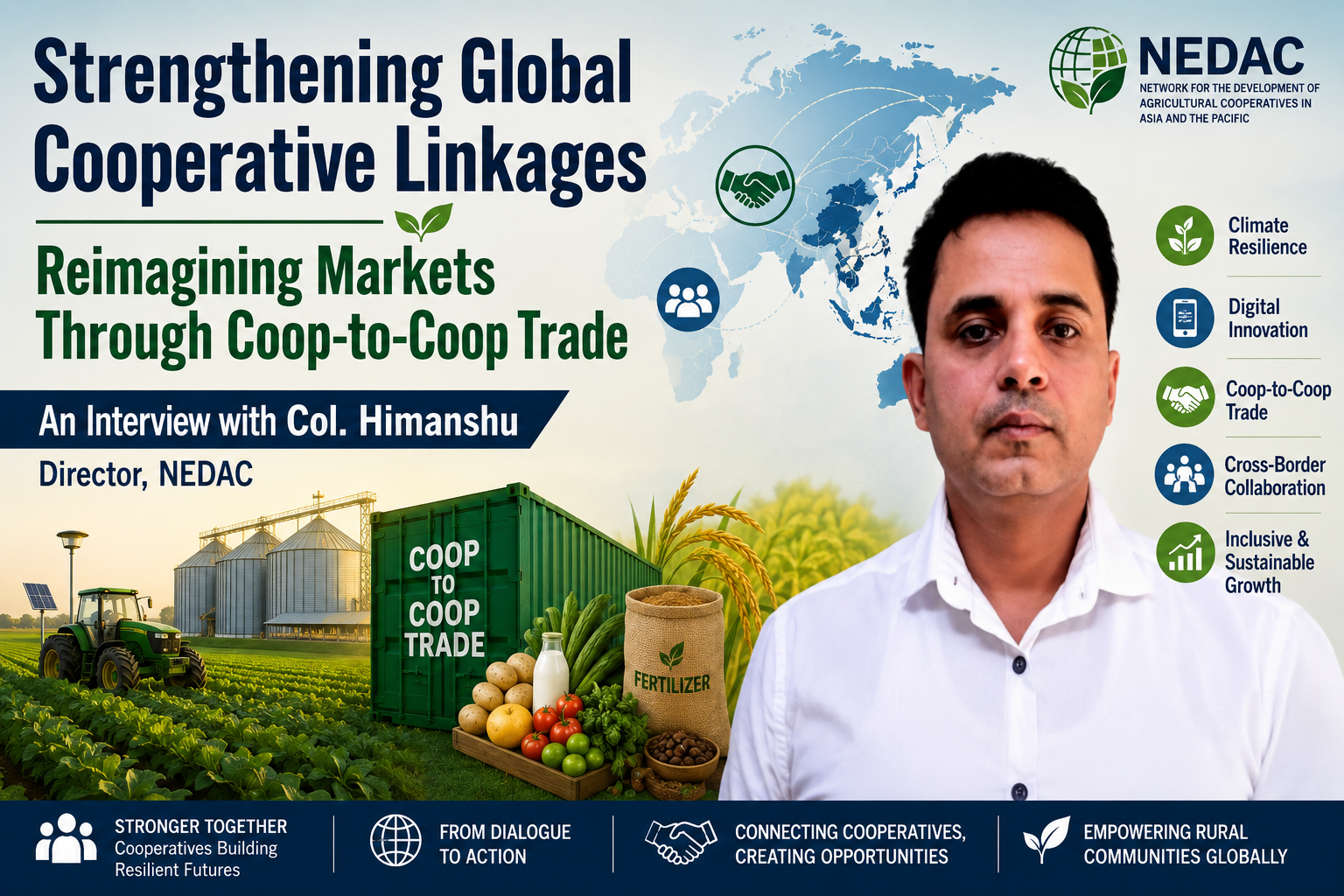

Col. Himanshu
Director, NEDAC
In this insightful interview, we explore the evolving role of cooperatives in a globally connected economy with Col. Himanshu, Director of the Network for the Development of Agricultural Cooperatives in Asia and the Pacific.
As rural economies across Asia and the Pacific face increasing pressures—from climate variability and fragmented markets to rising input costs—cooperatives are being reimagined as engines of resilience, inclusion, and growth. Drawing from his experience across the region, Col. Himanshu shares how cooperative institutions are adapting to these challenges while leveraging cross-border collaboration to enhance their impact.
A central theme of the conversation is the growing importance of coop-to-coop trade, enabling direct engagement between cooperative institutions across countries.
Q: The Asia-Pacific region is witnessing rapid shifts in agriculture due to climate change, market volatility, and digital disruption. How is Network for the Development of Agricultural Cooperatives in Asia and the Pacific repositioning itself in this evolving landscape?
A: NEDAC is transitioning from being a platform for dialogue to becoming a catalyst for action. Today, the focus is on building resilient cooperative ecosystems by facilitating cross-border partnerships, strengthening institutional capacity, and promoting innovation. Climate resilience, digital inclusion, and market integration are now central pillars of our work across the region
Q: What does coop-to-coop trade mean in practice?
A: Coop-to-coop trade allows cooperatives to directly engage across borders, reducing dependence on intermediaries and improving value realisation for producers.
For instance, in India, organisations like Indian Farmers Fertiliser Cooperative Limited have demonstrated how cooperative-led trade can ensure reliable supply chains and better price stability for farmers. Similarly, dairy cooperatives such as Amul have built strong export linkages, showing how collective models can compete in global markets.
There is also growing collaboration between cooperatives in India and Sri Lanka, particularly in areas such as fertilizer supply, agri-inputs, and food commodities.
More recently, exposure visits and engagements in the Philippines have opened new avenues for India–Philippines cooperative trade, especially in areas such as agri-processing, capacity building, and institutional partnerships. These interactions are expected to translate into concrete trade linkages and collaborative initiatives in the near future.
Across ASEAN, cooperatives in countries like Vietnam and Thailand are increasingly engaging in cross-border trade of commodities such as rice, coffee, and fisheries products.
“There is a clear shift from dialogue to action—direct trade between cooperatives can significantly strengthen both market access and trust-based supply chains.”
These examples demonstrate how coop-to-coop trade is evolving into a practical pathway for building stable, transparent, and equitable market systems.
Q: Many cooperatives still struggle with competitiveness in global markets. What structural gaps need urgent attention?
A: The key gaps lie in governance, access to technology, and market intelligence. While cooperatives are strong on member mobilisation, they often lag in professional management and global market positioning. Strengthening value chains, branding, and compliance with international standards is critical for competing globally
Q: How is technology transfer being facilitated among cooperatives?
A: Technology transfer and adoption must be contextual and scalable. Instead of high cost solutions, cooperatives can start with digital tools for member management, traceability, and market access. Regional platforms like Network for the Development of Agricultural Cooperatives in Asia and the Pacific enable sharing of proven models and innovations across countries.
In India, dairy digitisation and supply chain innovations pioneered by cooperatives like Amul have influenced similar approaches in neighbouring countries, including Sri Lanka’s dairy sector. Likewise, fisheries cooperatives in Indonesia and the Philippines have adopted improved cold chain and processing technologies through such exchanges.
“When proven models are shared across regions, it accelerates learning and enables cooperatives to scale impact much faster.”
Q: Why are exposure visits important for cooperative leaders?
A: They provide first-hand exposure to successful models, helping leaders understand implementation realities and adapt them to local contexts.
For example, delegations from Sri Lanka and ASEAN countries—including recent participants from the Philippines—have visited India’s dairy and fertilizer cooperatives to study large-scale member-driven operations. These visits not only build knowledge but also act as entry points for future trade and institutional partnerships.
“Exposure to real-world success stories builds both confidence and clarity—often leading to long-term partnerships.”
Q: Across the Asia-Pacific, countries like Vietnam, Thailand, and Indonesia are strengthening their cooperative sectors. What lessons can India both offer and learn?
A: India offers strong models in scale, particularly in dairy and fertiliser cooperatives. The wide-ranging initiatives taken by the Indian government to strengthen cooperatives also present a model which can guide other cooperatives in the Region. At the same time, countries in ASEAN are demonstrating agility in integrating cooperatives with export markets, especially in commodities like coffee, fisheries, and rice. The real opportunity lies in mutual learning—combining India’s scale with ASEAN’s market responsiveness.
Q: Climate change is emerging as a major threat to agriculture. What role can cooperatives play in building climate resilience?
A: Cooperatives are uniquely positioned to aggregate resources and implement community-level solutions. From climate-smart agriculture practices to risk-sharing mechanisms like crop insurance, cooperatives can drive collective resilience. Regional cooperation can further accelerate the adoption of sustainable practices. NEDAC is actively promoting Climate -Resilient Smart Agriculture to help farming communities adapt to climate change, boost productivity, and improve food security. Through partnership with apex cooperative organisations, NEDAC focuses on training, technology adoption, and policy advocacy to transition traditional farming towards green, sustainable , and climate-smart practices.
Q: There is increasing emphasis on digital agriculture and AI. How can cooperatives ensure they are not left behind in this transformation?
A: Digital transformation must be inclusive. Cooperatives can act as intermediaries, ensuring that small farmers benefit from AI-driven insights, market data, and digital platforms. NEDAC collaborates with various organizations to promote AI in agriculture, enhancing rural value chains, and driving grassroots transformation through technology. The NEDAC training programs also focus on AI and machine learning..
Q: Policy support remains critical. What kind of policy environment is needed to unlock the full potential of cooperatives in the region?
A: Policies must move beyond regulation to enable innovation. This includes ease of cross-border trade, incentives for cooperative enterprises, support for digitalisation, and investment in capacity building. Governments should also recognise cooperatives as key players in achieving food security and rural development goals.
Q: How do international platforms support cooperatives?
A: They bring together cooperatives, governments, and development partners, enabling collaboration beyond national boundaries. Regional platforms have facilitated connections between Indian cooperatives and counterparts in Sri Lanka, ASEAN countries, and more recently the Philippines—opening up opportunities in fertilizer trade, agri-processing, and cooperative capacity building.
“Stronger global linkages are essential to making cooperatives more resilient, competitive, and future-ready.”
Q: What is the future outlook for cooperatives in a globalised economy?
A: Cooperatives will play a crucial role in ensuring inclusive growth, particularly for small and marginal producers. In India, the expansion of Farmer Producer Organisations (FPOs) reflects renewed emphasis on collective action, while in Sri Lanka and ASEAN countries—including the Philippines—cooperatives remain central to agriculture, fisheries, and rural livelihoods. The promising areas for cross-border cooperation include agro-processing, fertliser supply chains, dairy development, fisheries , and capacity building .
“Cooperatives are uniquely positioned to address some of the most pressing development challenges of our time.”
Q: What is your vision for NEDAC going forward?
A: NEDAC will continue to focus on scaling up coop-to-coop trade, deepening technology partnerships, and strengthening global connectivity.
There is also a strong emphasis on enabling cooperatives to become more competitive in international markets while remaining inclusive and member-driven.
“The goal is to build a globally connected cooperative ecosystem that is resilient, competitive, and future-ready.”
Q: What is your final message for policymakers and practitioners?
A: Cooperatives can play a transformative role in addressing rural livelihoods, food security, and equitable growth.
What is needed is a supportive ecosystem—policies that enable innovation, platforms that foster collaboration, and investments that strengthen institutional capacity.
“With the right support, cooperatives can become central to building resilient and inclusive economies.”





One Response
Heartiest congratulations to Col. Himanshu for his visionary leadership and inspiring contribution towards strengthening the cooperative movement at national and international level. Your insightful thoughts on “Coop-to-Coop Trade” and global cooperative linkages reflect a futuristic approach that can empower millions connected with the cooperative ecosystem.
Your dedication towards creating sustainable opportunities, promoting inclusive growth, and connecting cooperatives across borders is truly commendable. The way you are encouraging innovation, collaboration, and self-reliance through cooperative models is highly inspiring for youth, farmers, drivers, and small entrepreneurs of India.
The cooperative sector needs more dynamic leaders like you who believe in “Prosperity through Cooperation.” Wishing you great success in your mission to strengthen cooperatives globally and make them a powerful tool for socio-economic transformation. Best wishes for your continued journey of service and leadership.🙏🙏🙏🙏🙏