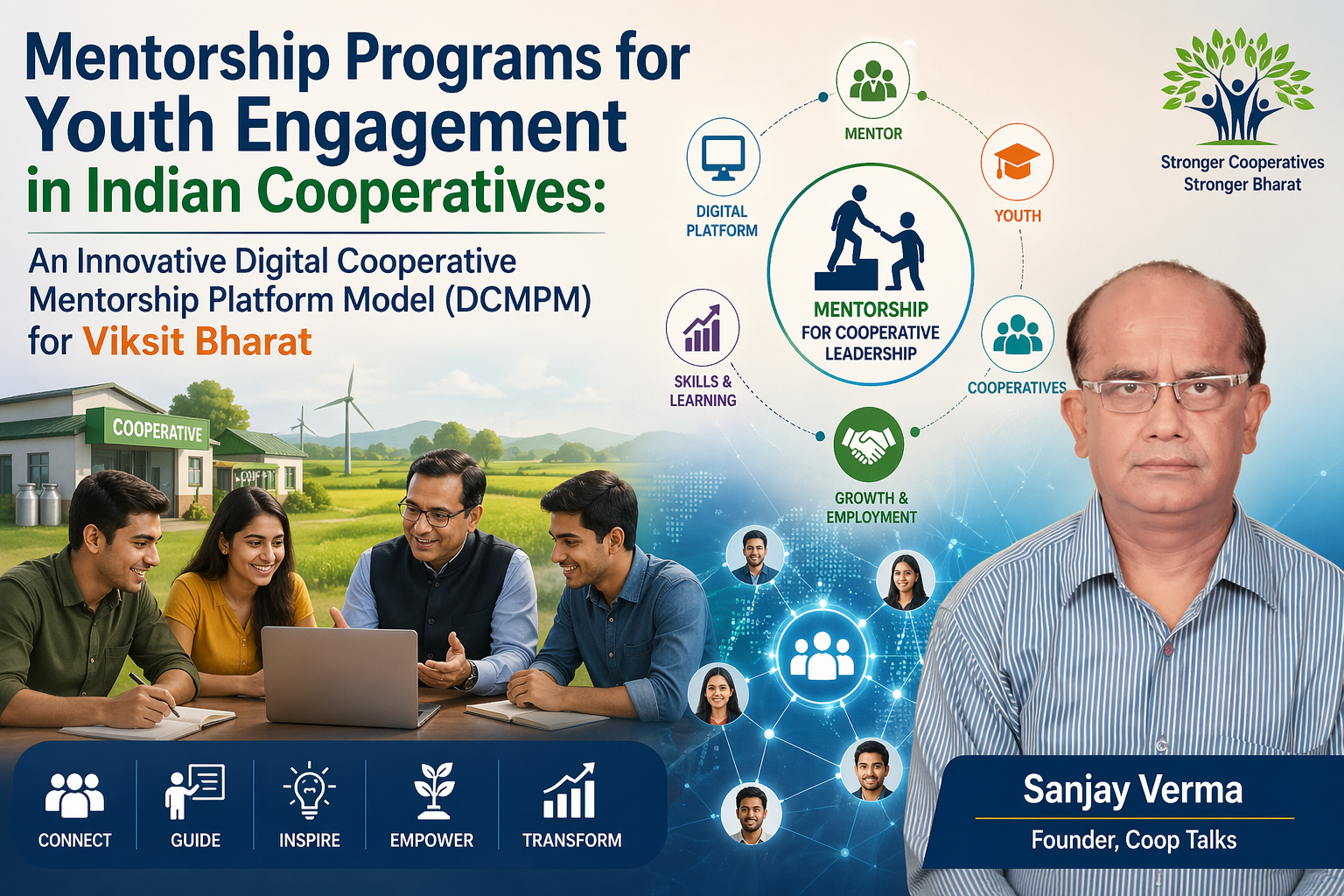

Sanjay Verma
Founder, Coop Talks
Introduction
Engaging youth in cooperatives in an innovative manner is the biggest challenge before the cooperative movement today. At various forums, it has been effectively argued that today’s youth need well-conceptualized mentorship programs to foster their engagement with the cooperative sector.
With more than eight lakh cooperatives covering all socio-economic areas, the cooperative movement is the largest in the world. India has the largest youth population in the world, and there are many potentialities for active youth participation. Cooperatives in India operate across many sectors (dairy, agriculture, fisheries, credit, housing, handicrafts, tourism, etc.). While cooperatives have a huge network and reach, youth participation is limited. Mentorship provides sustained, relational support beyond workshops and short training programs. A digital platform can scale mentorship access, match mentors and mentees across geographies and sectors, and institutionalize measurable pathways for youth leadership and enterprise creation.
Indian Cooperative Scenario
NCUI organizes a very popular youth engagement program called ‘Coop Connect,’ under which students from schools, colleges, and universities are sensitized to various aspects of cooperative development, provided knowledge on success stories, and briefed on ways to form cooperative societies, etc. NCUI has a Youth Committee comprising young members whose role is to visualize ways that help in undertaking effective action plans for active youth participation in cooperatives. NCUI’s role in youth engagement offers an institutional anchor for mentorship; however, there is no specific program for this.
NCDC’s Yuva Sahakar scheme supports youth cooperative enterprises and can be linked with mentorship to improve business viability and provide loans. There are several MBA courses in Cooperation. Besides the four new MBA courses started by Tribhuvan Sahkari University, MBA courses offered by cooperative organizations like VAMNICOM and Institutes of Cooperative Management provide opportunities for youth to pursue these courses, though there is no mentorship scheme linking these courses.
International Cooperative Examples
Mondragon (Spain) and JA models (Japan) demonstrate structured pipelines and mentoring for managerial roles. ICA-sponsored youth initiatives such as Coopathon demonstrate that structured mentorship combined with seed support can yield tangible and measurable outcomes. Therefore, the Coopathon model, based on mentorship, clearly indicates the need for creating a permanent model that is well-functioning and based on digital foundation support.
Review of Current Practices
Key gaps are:
-Absence of a national, continuous mentorship framework — current initiatives are fragmented, short-term, or training-focused.
-Weak link between mentorship and finance, incubation, and educational courses.
-While cooperatives have adopted digital tools for transactions and membership management, they have yet to fully leverage technology for mentorship matching and scalable learning. There is no digital marketplace for mentors and mentees in cooperatives.
-Digital practices remain inadequate, with no standardized indicators or dashboards to assess the progression of youth-led leadership.
-Geographic and language barriers affect youth access to cooperatives.
The Digital Cooperative Mentorship Platform Model (DCMPM) — Overview
The core idea is to build a national online platform that brings together mentors (cooperative leaders, academics, professionals, and entrepreneurs); mentees (students, young cooperative members, and aspiring founders); cooperatives; government bodies; universities; incubators; and development agencies.
Key Features
Digital Registration System: This includes verified mentor and mentee profiles with self-declared areas of interest and expertise.
AI–Based Matching: This component focuses on intelligent mentor–mentee matching based on skill requirements, sectoral classification (such as dairy, fisheries, credit, rural tourism, handicrafts, and platform cooperatives), geographic location, and career aspirations. By leveraging artificial intelligence, the system can analyze profiles, competencies, and goals to ensure more precise, need-based alignments.
With the increasing integration of AI-driven solutions across industries, such a data-enabled matching mechanism has become the need of the hour for the cooperative sector. It enhances efficiency, reduces subjectivity in pairing, and enables scalable, structured mentorship across regions and cooperative domains.
Mentorship Modes: This framework includes one-on-one mentoring, group mentoring circles, project-based mentorship, internships, and field-learning support. By offering multiple formats, the model presents a diversified and flexible mentorship ecosystem. Such variety enables young participants to associate with the program according to their convenience, interests, and aptitude, thereby enhancing engagement, inclusivity, and long-term commitment to the cooperative sector.
Knowledge Hub: A digital platform will not serve its purpose unless it functions as a robust knowledge hub. The platform should therefore include case studies, instructional videos, and comprehensive content on cooperative law. Additionally, it must provide multilingual resources in Hindi, English, and relevant regional languages to ensure wider accessibility and inclusivity across diverse user groups.
Impact Dashboard: To assess impact, the platform tracks the progress of mentees and mentors and generates institutional reports. By incorporating measurable indicators and feedback systems, it serves as a scientific and evidence-based tool to strengthen youth engagement in the cooperative sector.
Integration with Government and Cooperative Institutions: The platform will include integration features so that mentees and mentors have strong coordination with NCUI, NCDC, NABARD, state federations, universities, etc.
Gamified Engagement: As encouragement incentives, this includes digital badges, certificates, and leaderboards for active mentees.
Impact Dashboards: This will indicate real-time indicators for mentors, mentees, cooperative organizations, etc. This measurement index is important for evaluating the platform.
How the Model Works (Step-by-Step)
Case A
Youth Registration: A college student in Bhopal signs up and indicates interest in dairy cooperatives and digital marketing.
Mentor Identification: The platform suggests a manager from AMUL or Sudha Dairy.
Mentorship Agreement: The mentorship duration is 3–6 months with expected learning outcomes.
Learning Process: This consists of monthly online sessions, field visits, or virtual exposure. For example, a small project on improving SHG-led milk collection branding can be undertaken.
Evaluation: While the mentee submits a progress report, the mentor assesses improvements.
Opportunities: All this leads to internships, job placements, entrepreneurship support, and leadership roles with the help of cooperative and other organizations linked to this platform.
Case B: Women SHG Leader in Kerala (Fisheries)
-An SHG leader registers through a local hub that inputs member data. The platform matches her with a fisheries cooperative manager and a marine logistics expert.
-Group mentoring circle: Eight women learn cold-chain basics, and the project develops a cold-storage plan.
-The mentor helps prepare an application for NCDC linkage and Yuva Sahakar or a state fisheries grant.
Result: A pilot cold room is established, prices improve, and women take formal governance roles.
Case C: Platform Cooperative for Auto Drivers in Delhi
A founder of a platform cooperative of auto drivers registers and requests technical mentors. A youth data analyst mentors senior drivers on basic data dashboards, while a tech mentor advises on data privacy and fair pricing.
Outcome: A driver-owned app with transparent pricing and cooperative revenue-sharing is developed, and the pilot gets seed funding with the help of cooperative organizations.
Governance & Institutional Arrangements
For the creation of this platform, strong governance and institutional arrangements should be established. A National Level Steering Committee may be formed comprising representatives from NCUI, NCDC, the Ministry of Cooperation, ICA youth representatives, selected state federations, civil society, and academic partners. Its responsibilities may include formulating accreditation standards for mentors, policy alignment, and mobilization of funds.
The platform management may be undertaken by an independent, technology-focused body with support from other cooperative organizations. An online training module for mentors may be developed. After 8–10 hours of training and one observed mentoring session, mentors may receive a digital badge.
For monitoring and evaluation, there should be core indicators in the form of dashboards. The inputs may include registered mentors (sector, region, gender), registered mentees, average mentoring hours per match, project completion rate, etc. The outputs may be measured in terms of the percentage of mentees completing certification or micro-courses, internships offered post-mentorship, the percentage of mentees in cooperative jobs or leadership positions, youth-led cooperatives registered, etc. The impact (over 3–5 years) may be seen in youth retention in cooperatives, improved governance indicators, and community-level indicators, etc. This may be tested through a pilot in a few states and then, based on the response, scaled up in other states.
How DCMPM Helps Achieve Viksit Bharat
–Local employment and livelihoods: Youth-led cooperative enterprises reduce migration and increase local incomes.
-Inclusive growth: Focused quotas and outreach enable women and SC/ST youth to gain leadership and economic roles.
–Digital inclusion: Platform literacy spreads digital payments, MIS, and e-commerce capabilities.
–Food security and value addition: Mentor-led food processing entrepreneurship adds value to agriculture.
–Green solutions and innovation: Mentors connect cooperatives with renewable energy projects and climate-resilient practices.
–Democratic governance: Mentorship strengthens accountability and member participation—core to cooperative contribution to a developed nation.
Policy Recommendations
-Launch DCMPM with the support of the Ministry of Cooperation.
Integrate mentorship completion as a favorable criterion in Yuva Sahakar applications.
-Require large cooperatives (state federations, multi-state cooperatives) to run local mentorship programs.
-Promote university–cooperative internship linkages through the platform.
-Link all general cooperatives, particularly those running youth and skill-based training programs, with this platform by encouraging participants to explore opportunities to join as mentors and mentees.
-Advocate the use of this platform for increasing youth engagement, participation, and leadership development in cooperatives.
Conclusion
Mentorship is not an insignificant activity—it is key to strengthening cooperative leadership, enabling innovation, and ensuring that cooperatives contribute to achieving the Viksit Bharat agenda. DCMPM offers a pragmatic, technology-enabled, and human-centered approach: it scales relational mentorship, links youth to finance and governance pathways, measures outcomes, and creates an institutional ecosystem for continuous learning. With well-designed pilots, careful monitoring and evaluation, and public–private collaboration, DCMPM can become a stepping stone and an innovative tool for strengthening youth participation in cooperatives.