

Komal Gupta
Director-Strategy and Policy, Coop Talks & Founder, Konsult Komal
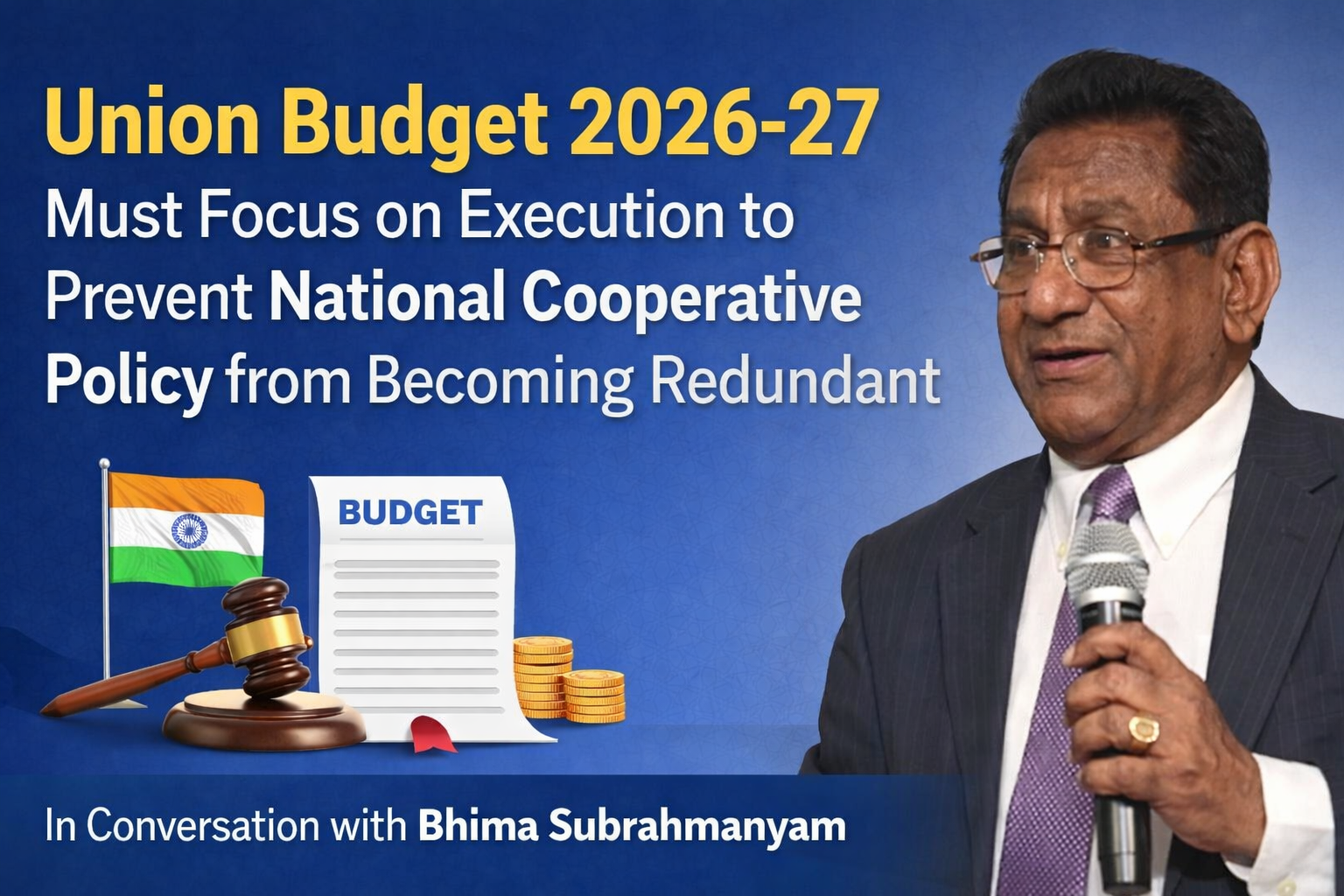
In conversation with Bhima Subrahmanyam, Managing Director and CEO of the National Federation of State Cooperative Banks (NAFSCOB) and President of the International Cooperative Banking Association (ICBA).
Q1. With the National Cooperative Policy announced in 2025, what should the Union Budget prioritise to ensure effective implementation?
Bhima Subrahmanyam:
The National Cooperative Policy 2025 (NCP) is built upon six strategic mission pillars and sixteen objectives designed to facilitate technological integration, professional management, and sectoral diversification. These six strategic mission pillars are:
- Strengthening the Foundation
- Promoting Vibrancy
- Making Cooperatives Future Ready
- Promoting Inclusivity and Deepening Reach
- Entering New and Emerging Sectors
- Shaping the Young Generation for Cooperative Growth
As cooperation is a state subject, the appropriate execution of these six strategic mission pillars is possible only with the close association of all states and effective monitoring of their policy formulation on the lines of the NCP of the Government of India. It is essential to ensure the continuation of member-driven, democratic, and autonomous cooperative organisations in all states to strengthen the foundation. Otherwise, the NCP 2025 may likely become redundant.
From a budgetary perspective, it is necessary to implement the recommendations of the NCP 2025. The best option is to assign the task of coordinating with state governments to formulate the State Cooperative Policy 2026 and to organise different events to popularise the salient features of the NCP 2025 for implementation at all levels of cooperatives. This responsibility should be entrusted to national-level sectoral federations such as the NAFSCOB under the Multi-State Cooperative Societies Act, 2023.
There should also be adequate budgetary provision to assist sectoral federations like NAFSCOB in designing specific, need-based programmes, based on needs assessment studies, to ensure capacity building, ethics, values, and principles of cooperation. This will facilitate shaping the younger generation for cooperative growth and support the other pillars of the NCP 2025.
Q2. What should be the Budget’s focus to strengthen cooperatives at the grassroots level, particularly PACS?
Bhima Subrahmanyam:
Implementing a Human Resource Policy is essential to strengthen cooperatives, particularly Primary Agricultural Credit Societies (PACs), at the grassroots level. Initiatives intended for implementation at the PAC and grassroots levels become redundant without the adoption of a structured HR Policy.
The HR Policy was presented to the Ministry of Cooperation, Government of India, by NAFSCOB in 2022–23. The first-ever HR Policy for PACs in the country was formulated by NAFSCOB in 2018, and its recommendations were subsequently submitted to the MoC.
There is, therefore, a strong need for a comprehensive transformational package for PACS. The Government of India may implement this comprehensive package as a Central Sector Scheme (CSS), paving the way for strong, vibrant, and sustainable PACs capable of extending all services required by their members. Necessary budgetary provision may be considered to implement this comprehensive package.
Q3. Are there any regulatory, compliance, or financing-related constraints faced by cooperatives that the Budget could help address?
Bhima Subrahmanyam:
There are several issues which have not been seriously addressed. One key concern is the duality of control, which requires roles and responsibilities to be clearly identified and categorised.
Another major issue concerns the scheduled status of District Central Cooperative Banks (DCCBs). There is a discriminatory approach in not addressing the issue of giving scheduled status to DCCBs. There is no statutory or regulatory provision that prevents eligible DCCBs from being accorded scheduled status for any justifiable reason. Therefore, amendments, if required, to the Second Schedule of the Reserve Bank of India Act, 1934, need to be considered urgently and in detail to facilitate scheduled status for eligible DCCBs.
There is also significant interference in the governance, management, and functional autonomy of democratic cooperatives, particularly in matters relating to recruitment, fit-and-proper criteria, election procedures, and the terms and tenures of boards of directors of cooperatives.
In addition, issues relating to Single Nodal Agency Accounts (SNA) require urgent attention. There is a need to impress upon the Public Financial Management System (PFMS) and the Ministry of Finance to re-issue or modify the existing office memorandum with clear procedural guidelines. These guidelines should specify that the SNA will open a Single Nodal Account for each Central Sector Scheme (CSS) at the state level in a Scheduled Cooperative Bank, which may also be authorised by the state government to conduct government business.
Q4. How can budgetary measures better support digitisation, capacity building, and professional management within cooperatives?
Bhima Subrahmanyam:
The prevailing practices adopted by authorised organisations for digitisation, capacity building, and professional management within cooperatives have been financially very expensive, yet they have not achieved the desired results. The outcomes do not align with the expenditure incurred.
While recognising the importance of digitisation, capacity building, and professional management, it would be more sensible to entrust these responsibilities to the concerned sectoral federations, such as NAFSCOB for rural cooperative banks, with suitable budget allocations to ensure effective implementation of strengthening measures. Budgetary support directed to sectoral federations would be more results-oriented and aligned with the Ministry of Cooperation’s vision.
Initiatives to digitise cooperative banks have not appeared to significantly strengthen the cooperative banking sector. Transparency through digitisation remains weak across all levels of cooperatives. While these initiatives deserve appreciation, budget proposals should focus on enabling sectoral federations like NAFSCOB to implement policies and regulations, along with financial incentives and support, to realise the Government of India’s vision of Sahakar Se Samriddhi.
Q5. Are there any specific recommendations you would like to highlight for your sub-sector or region?
Bhima Subrahmanyam:
There is a need for clarification of regulations, particularly regarding the demarcation of dual control. Refinements to the Banking Regulation Act are required to allow Rural Cooperative Banks (RCBs) greater flexibility to raise capital through innovative instruments, such as long-term subordinated bonds, without diluting their cooperative character. There is also a need to clearly define the Reserve Bank of India’s role in the rural cooperative banking sector and to distance the RBI from the non-regulatory affairs of RCBs.
The interest subvention scheme needs to be revisited. Recapitalisation of RCBs requires the constitution of a committee. The One Time Settlement mechanism also needs to be reviewed.
With regard to CSS, the Government of India should continue to release funds under the Central Sector Integrated Scheme on Agricultural Cooperation for the establishment of planning, research, and development cells and for managing those cells at the national level, multi-state cooperative societies, which are primarily advocacy-based, non-profit, and non-business national-level federations. Issues relating to SNA Accounts also need to be addressed.
As part of the diversification of business, particularly for PACs functioning as multi-service centres, the budget may provide specific incentives for PACs to create and operate well-conceived facilities, such as cold storage and processing units. PACs should also be supported to act as the primary nodal agencies or parent bodies for Farmer-Producer Organisations.
There is also a need to consider a budget proposal for a new organisational device for rural cooperatives. NABARD appears to have developed serious constraints in carrying out its functions in line with the original objectives of its establishment in 1981–82. The relevance of NABARD to member-driven rural cooperative organisations at all levels needs to be thoroughly examined. The original objective of providing undivided attention, forceful direction, and focused attention to agricultural credit through rural cooperative organisations has been ignored, contributing to the low share of cooperatives in agricultural lending. There is therefore an urgent need for a new organisational device mandated to address issues relating to State Cooperative Banks, DCCBs, and PACs.
The formulation of an Institutional Protection System should also be considered to strengthen the rural cooperative credit and banking structure and contribute to its corpus.
Union Budget proposals must focus on structural reforms, digital parity, and financial sustainability, including digital infrastructure and cybersecurity-related issues for RCBs. This includes full integration with national payment systems, expansion of micro ATMs, and a digital literacy fund.
While the recent reduction in surcharge for cooperatives has been noted, there is an increasing demand for a reduction in the income tax rate for all RCBs to 15 per cent, bringing them on par with the new tax regime for domestic manufacturing companies. This would allow cooperatives to retain higher earnings to strengthen their Capital-to-Risk-Weighted-Assets Ratio.





One Response
Well articulated!
Let’s hope that Hon’ble FM will respond positively to the needs of RCBs and PACS.