
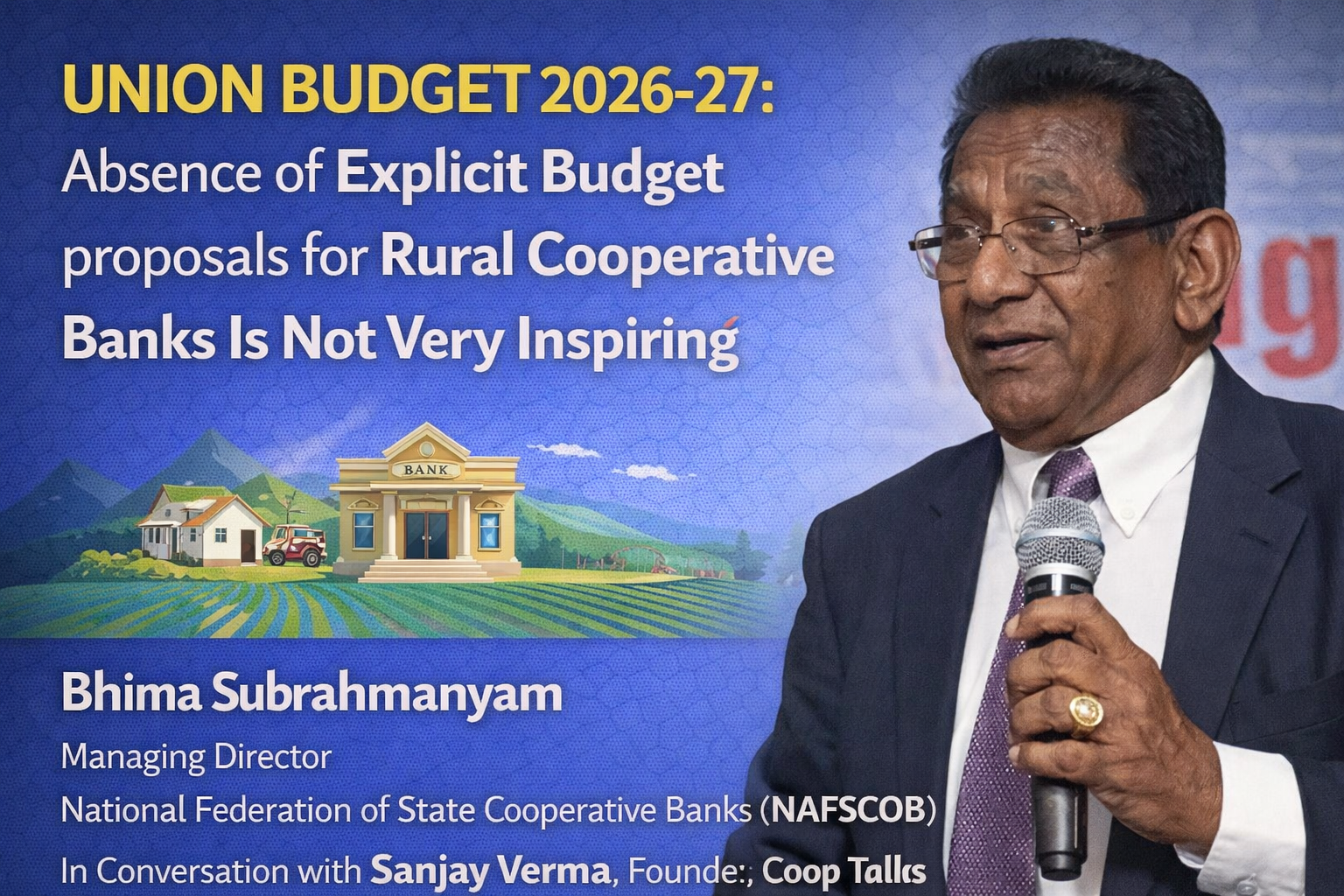

Bhima Subrahmanyam
Managing Director National Federation of state Cooperative Banks (NAFSCOB)
The Union Budget 2026-27, based on and inspired by 3 kartavyas, was presented on 1st February 2026 by Hon’ble Finance Minister of India Nirmala Sitharaman. In order to address these three kartavyas, a threefold approach as supportive ecosystem has been adopted. The approach involves:
- Momentum of structural reforms, (ii) A robust and resilient financial sector and iii) cutting–edge technologies, including AI applications, which can serve as force multipliers for better governance.
Let us at the outset understand the reasons for rating the Union Budget ‘Not very Inspiring ‘ for RCBs.
- Implication for Rural cooperative Banks (RCBs). Despite sectoral expectations, the Budget neither clearly announced nor explicitly provided the following most important issues to facilitate all-round strengthening of RCBs:
- Amendments to consider Scheduled Status to District Central Cooperative Banks (DCCBs)
- Structural Reforms to address adverse implications of duality of
- Need for establishment of a new organizational device for providing undivided attention, forceful direction and pointed focus to the agriculture credit issues arising from the absence of well-conceived implementation policies and procedures, with an implementable mandate to address the issues pertaining to Rural Cooperatives which include State Cooperative Banks, District Central Cooperative Banks and Primary Agriculture cooperative Credit Societies.
- Need for proposal for formulation of Institutional Protection System (IPS)to strengthen Rural Cooperative Credit & Banking structure and consider contributing to its Corpus. This reduces dependence on the financial assistance from both Central & State
- Need to constitute a committee to examine the inadequate, inappropriate, illogical and incomplete execution of the acceptable recommendations which emerged from the Task Force on Revitalization of Cooperative Credit Institutions, under the chairmanship of Prof. A. Vaidyanathan (2005) .This clearly demonstrated the need to constitute a Committee, which can look into the need for further recapitalization support to ,more particularly to DCCBs and suggest the modalities and extent of required
support for this.
vi)Continuation of Interest Subvention scheme and well-defined system to ensure direct interest subvention settlement reforms/payments.
- Central Sector scheme (CSS) : Need to continue the discontinued Central Sector Integrated Scheme to release funds under Central Sector Integrated Scheme on Agricultural Cooperation (ISAC) of Assistance for Planning, Research and Development Cells and also managing those cells in national level Multi State Cooperative Societies registered under MSCS Act,2002, which are primarily advocacy & non-profit, non- business national level federations.
viii)Flexibility to allow RCBs in raising capital through innovative instruments (like long- term sub-ordinated bonds) without diluting the “cooperative” character -new capital- raising instruments for RCBs.
Other measures: i) A specific & well-defined framework to execute the six strategic mission pillars and 16 objectives designed to facilitate technological integration,
professional management, and sectoral diversification as per the National Cooperative Policy 2025.
- Need for Comprehensive Transformational Package for PACS as a Central Sector Scheme (CSS) paving way for a strong, vibrant and sustainable PACS extending all the services required by their members based on the first ever HR Policy formulated by
Having presented the above, let me now analyze the budget proposals on issues most relevant to cooperatives, RCBs, support to MOC, other cooperative organizations and tax reforms.
B. Indirect operational Gains for RCBs: Appreciated
The Union Budget 2026–27 reinforces the government’s ongoing strategy & policy direction to strengthen the cooperative and rural economic ecosystem, with indirect but meaningful measures for strengthening Rural Cooperative Banks (RCBs), District Central Cooperative Banks (DCCBs), and PACS-linked credit structures. While no explicit measures have been announced specifically for RCBs, the Budget focused on several tax incentives, PACS modernization, institutional, and rural development /economic expansion measures which positively influence their operating environment. In other words, several ecosystem measures have a positive influence on the credit environment, operational efficiency, and growth potential of RCBs.
C. Key Budget Measures Affecting Cooperative Banking Ecosystem
The key budget measures which directly and/or indirectly influences/affects
the cooperative banking ecosystem are illustrated based on the following selective parameters:
- Creating “Champion SMEs” and supporting micro enterprises: Recognising MSMEs as a vital engine of growth, the budget proposed a three- pronged approach to help them grow as ‘Champions’:
- Equity Support: Proposed to introduce a dedicated ₹10,000 crore SME Growth Fund, to create future Champions, incentivizing enterprises based on select criteria. The budget proposes to top up the Self-Reliant India Fund set up in 2021, with ₹2,000 crore so as to continue support to micro enterprises and maintain their access to risk capital.
- The Budget proposals on creating “Champion SMEs” and strengthening MSMEs can significantly benefit rural cooperatives and RCBs, even when not directly named, because many rural cooperatives function as micro and small enterprises in production, processing, credit, and This directly benefits DCCBs, & PACS transforming into multi-service centers. As MSMEs grow, the credit demand rises, the working capital cycles expand, and supply-chain financing needs increase. All this leads to strengthening cooperative banks’ business ecosystem
D. High level Committee on Banking for Viksit Bharat: Part of Financial Sector:
As has been rightly presented by FM, the cooperative sector got a major boost in the budget, as several new reforms have been undertaken with sustained efforts by the Ministry of Cooperation. These initiatives have strengthened the sector’s institutional framework, expanded its economic role, built up its image and positioned cooperatives as a key player in country’s growth economy. The Union Budget 2026-27 proposed setting up a “High Level Committee on Banking for Viksit Bharat”, to comprehensively review the functioning of the sector and align it with India’s next phase of growth, while safeguarding financial stability, inclusion and consumer protection. The proposed committee will examine structural and regulatory aspects of the banking sector and recommend measures to strengthen financial stability, deepen financial inclusion, and enhance consumer protection, while supporting India’s long-term development goals under the Viksit Bharat vision. But it is not very clear whether the proposed High-Level Committee on Banking will comprehensively review the cooperative banking sector. The Terms of Reference for the High-level committee need to be thoroughly examined by all those who have exposure to financial sector reforms since introduction in 1990s.
E. 2026-27 Budget Allocations/Financial Assistance/support/Grants: Partial Commitment to the cooperative sector: Agency wise allocations.
- According to the notes on Demands for Grants, the Ministry’s total outlay has risen to Rs 1,744.74 crore in 2026-27, from Rs 1,186.29 crore in 2025-26..The breakup of total outlay of Rs 1,744.74 crore, is as follows:
- Rs 47.77 crore: to meet the establishment expenditure of the Union Ministry of Cooperation. (Ministry’s Secretariat as well as its attached and subordinate offices, such as the Central Registrar of Cooperative Societies, the Cooperative Election Authority, and the Office of the Ombudsman).
- Rs 500 crore annual grant-in-aid to the National Cooperative Development Corporation (NCDC) for strengthening cooperatives including cooperative sugar mills
- Rs 450 crore to the National Co-operative Exports Limited (NCEL) in 2026-27 to promote cooperative exports and enhance international market access.
- Rs 364 crore for the computerization of Primary Agricultural Credit Societies (PACS), covering over 67,930 functional PACS across the country.
- Rs 300 crore allocated for cooperative education, including grants for the creation of capital assets at Tribhuvan Sahkari University (TSU),Anand
- Rs 96 crore for the National Council for Cooperative Training (NCCT)
- Rs 10 crore for the Vaikunthlal Mehta National Institute of Cooperative Management (VAMNICOM).
- Additional funds have been provided under IT-based intervention schemes for strengthening Agricultural and Rural Development Banks (ARDBs)-for 1851 units and the
offices of Registrars of Cooperative Societies in 35 States and Union Territories, aimed at improving
But there is no proposal for Central Sector Scheme to assist the non-profit, non-business National level cooperative Federations registered under MSCS Act ,2002
- Tax Incentives for Cooperatives: A very Welcome step:
The Union Budget 2026-27 announced a major relief package for the cooperative sector, with a series of targeted tax incentives aimed at strengthening primary cooperatives, inter- cooperative institutions, and national cooperative federations. The measures, are expected to enhance financial sustainability, improve liquidity, and prevent double taxation within the cooperative framework. They are:
i) Deduction of profit and gains to a primary co-operative where they supply cattle feed and cotton seed to a federal co-operative.
- Deduction of profit and gains is presently allowed to a primary cooperative society engaged in supplying milk, oilseeds, fruits or vegetables raised or grown by its members to a federal cooperative society and others engaged in the same It is proposed to extend this deduction to a primary co-operative engaged in supplying of cattle feed and cotton seed to, inter alia, a federal co-operative or government organizations.
- Deduction of inter-cooperative society dividend income under the new tax regime. The dividend received by a cooperative society from another cooperative society is allowed as a deduction in the old tax regime. Non-allowance of this deduction in the new tax regime may result in double taxation as it may be taxed in the hands of the members on further distribution by the cooperative societies. Therefore, it is proposed to allow the inter-cooperative society dividend income as deduction under the new tax regime to the extent it is further distributed to the members.
(iii) Deduction of dividend income received by a notified national co- operative federation in the new tax regime.
- It is proposed to allow exemption to dividend income received by a notified national federal cooperative from a company for a period of three years. This deduction is limited to the dividend received on investments made till 31.1.2026.
- Further, this exemption would be allowed only to the extent that the dividends are further distributed to the members of the co- operatives.
G. Tax Reliefs for Cooperatives:
- Reduced surcharge on income tax from 12% to 7% for cooperative societies with
incomes between ₹1 crore and ₹10 crore.
- Reduced MAT (Minimum Alternate Tax) from 5% to 15%.
- Reduced tax rate (15%) for new manufacturing cooperative
Sum Up: The Union Budget 2026-27 focuses on long-term structural reforms and prioritizing infrastructure rather than populist relief measures. The budget presented has several more acceptable & efficient tax proposals. It is investment-led growth budget. Though the budget did not explicitly & directly provide measures to strengthen RCBs, the budget reaffirms Government’s commitment to address vision of Sabka Sath, Sabka Vikas towards a Viksit Bharat.