
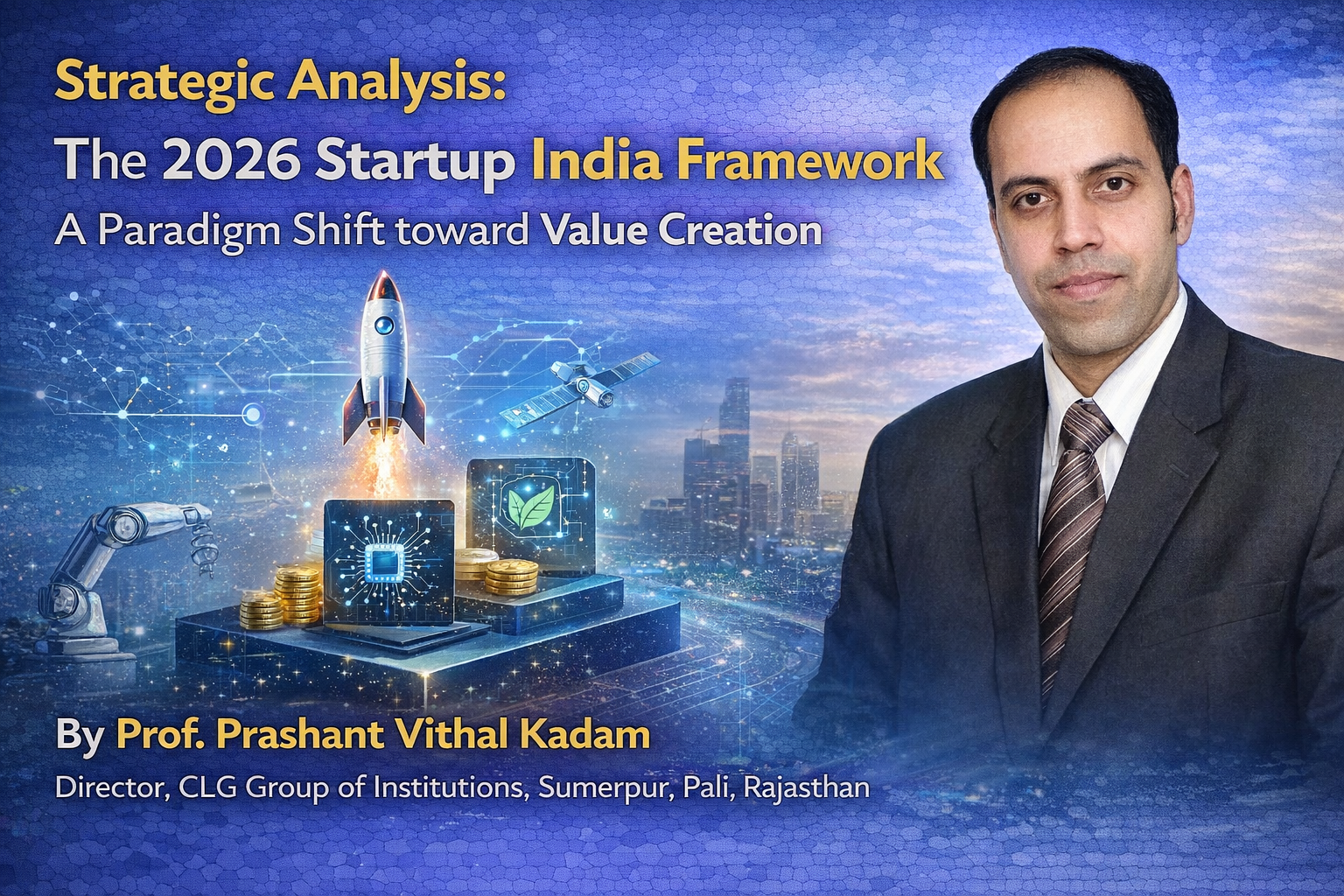

Prof. Prashant Vithal Kadam
Director, CLG Group of Institutions,
Sumerpur, Pali, Rajasthan.
The most significant revision in the 2026 framework is the extension of the Deep Tech age limit to 20 years and the turnover cap to ₹300 crore. This is a strategic move that acknowledges the unique “gestation periods” of ventures in biotech, semiconductors, and quantum computing, which, unlike traditional e-commerce platforms, often exceed a decade. This policy shift provides a critical safety net for India’s space-tech trailblazers like Skyroot Aerospace and Pixxel, ensuring that these research-intensive entities—which require massive “patient capital”—do not lose vital tax benefits such as Section 80-IAC just as they transition into their commercialization phase. By addressing a historical data gap where Deep Tech received less than 10% of total venture funding in India, this pivot effectively de-risks long-term bets for institutional investors, thereby fostering a more sustainable ecosystem for high-stakes innovation.
Building on this technological de-risking, the revision of the general turnover threshold from ₹100 crore to ₹200 crore serves as a strategic intervention against “premature graduation.” It effectively addresses the inflationary pressures inherent in modern startup valuation and revenue cycles. This expansion ensures “scaling without suffocation,” as many high-growth ventures previously found themselves pushed out of the recognition net and deprived of public procurement relaxations and self-certification benefits just as they were gaining momentum. The impact is particularly profound for manufacturing-led startups, such as early-stage EV manufacturers like Ather Energy, where high unit costs often lead to a rapid breach of the ₹100 crore limit long before the entity achieves true profitability. By raising this ceiling, the government allows these “Soonicorns” to remain within the protective ambit of the Startup India umbrella for a longer duration, thereby fostering a more resilient path toward sustainable industrial scale.
Complementing this structural scaling is the “Cooperative Revolution,” perhaps the most “Indianized” aspect of the reform. It bridges the gap between high-tech labs and the rural heartland by allowing cooperatives to be recognized as startups under an “Amul Model 2.0” framework. This inclusion is particularly transformative for agriculture and allied sectors in regions like Rajasthan, where significant water scarcity and logistical challenges necessitate grassroots innovation. By granting a cooperative-led startup focused on Agri-Tech or IoT-enabled irrigation the same access to tax holidays and IPR support as a Bengaluru-based software firm, the government effectively democratizes innovation. Ultimately, this shift ensures that the Startup India vision transcends Tier-1 “tech bubbles,” empowering community-based enterprises to drive sustainable, high-tech solutions from the very foundation of the Indian economy.
While the framework is visionary, its ultimate success will depend on “execution rigidity,” beginning with a precise, tech-driven vetting process for defining “Deep Tech” to prevent “policy shopping” by regular software firms seeking the extended 20-year window. This administrative clarity must be matched by enhanced IPR support. For students at institutions like CLG who already hold patents in IoT and AI, the speed of patent examination is often more critical than increased turnover limits. Hence, the government must complement these policy shifts with a robust, fast-track intellectual property system.
Finally, achieving true national impact requires seamless state-level synergy, particularly in regions like Rajasthan, where local policies must align with this central vision to ensure that a startup registered in Sumerpur experiences the same “ease of doing business” as one in Gurugram. This alignment is essential to transform policy aspirations into reality.
In conclusion, the 2026 revision represents a profound “coming of age” for the Indian startup ecosystem, signaling a fundamental shift from the pursuit of valuation to the cultivation of true value creation. For academic institutions, this serves as a clarion call to pivot our research mandate toward applied technology and patents, supported by the knowledge that the government is now prepared to sustain the long and arduous journey from a campus laboratory to a ₹300 crore global enterprise. This policy ensures that the brilliance of our students is no longer constrained by short-term capital but is instead fueled by a vision that matches their potential. As we embark on our transformational journey, we should always remember that we must sustain our efforts and keep our hopes of victory alive even after setbacks in life.