
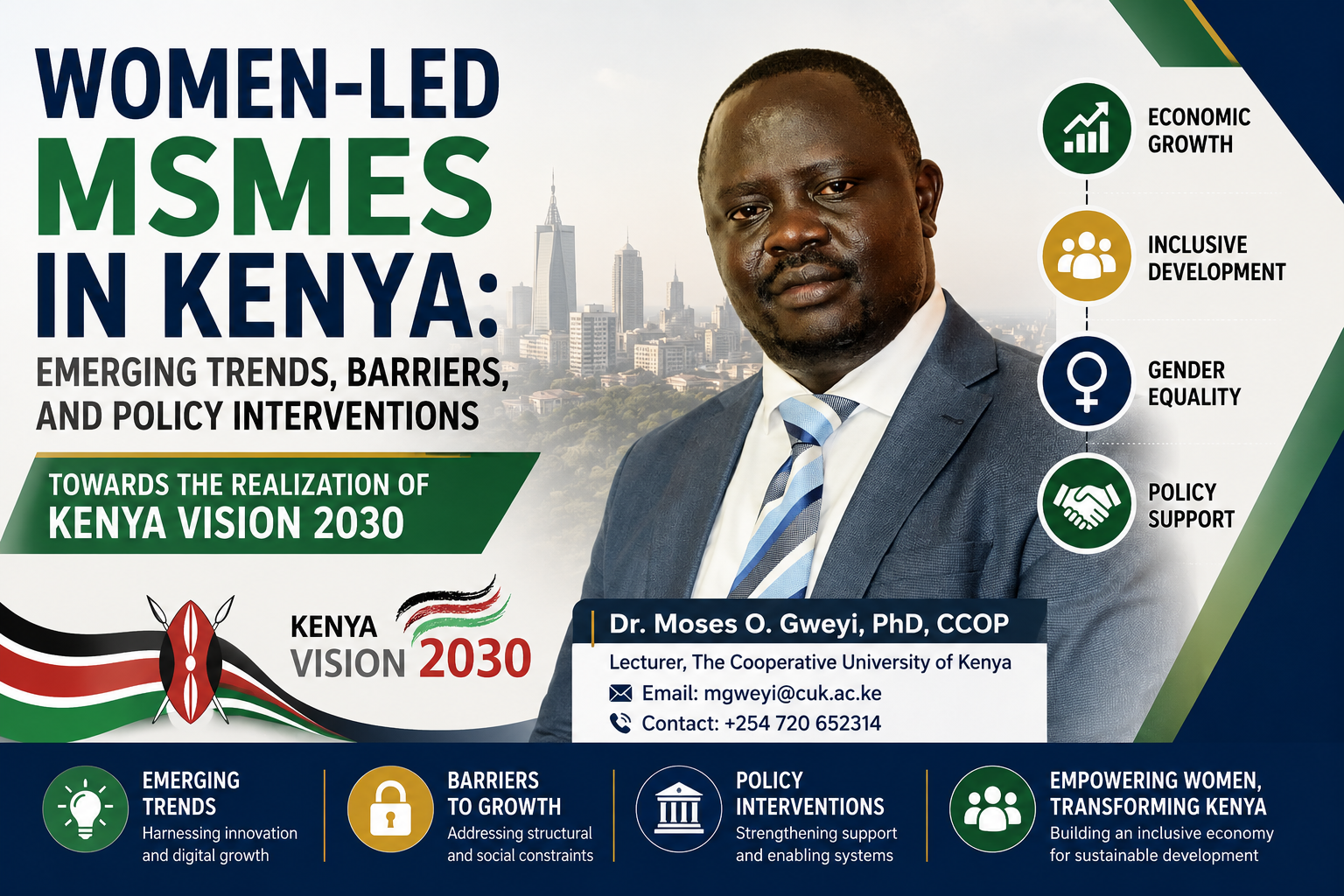

Dr. Moses O. Gweyi
PhD, CCOP
Lecturer, The Cooperative University of Kenya
Email: mgweyi@cuk.ac.ke
Contact: +254 720 652314
1. Introduction
Entrepreneurship among women is an area of concern for policymakers, development practitioners, and academics globally. Women entrepreneurs play a crucial role in job creation, poverty reduction, wealth creation, and social transformation in the context of developing economies. Kenya’s micro, small and medium enterprises (MSMEs) represent a huge proportion of economic activities and offer employment to millions of its citizens. Among these entrepreneurs, women have made significant contributions to Kenya’s economic development particularly in retail trade, agribusiness, manufacturing, hospitality, and services industries.
According to Kenya’s long-term vision document, Kenya Vision 2030, entrepreneurship, private sector development, innovation and inclusive growth are among key factors that will lead to Kenya’s development as a competitive global economy. One of the most important elements of the success of the country’s long-term blueprint lies with women entrepreneurs. Despite the growing interest and increasing involvement of women in business activities in Kenya, challenges have continued to hinder them from attaining their full economic potential.
2. Theoretical Foundation
This study is guided by Liberal Feminist Theory, Resource Based View Theory, and Social Capital Theory. Liberal Feminist Theory asserts that the differences in achievements between men and women are not a result of differences in innate capabilities but rather disparities in opportunity access. This theory opines that an unjust social structure imposes disadvantages on women in forms of lack of access to education, capital, technology and productive resources. In Kenya context, women enterprises suffer constraints such as low ownership of productive assets, inability to access credit, lack of access to the profitable segments of the economy and low level of involvement in high growth enterprises.
Resource Based View (RBV) theory is used to highlight importance of strategic resource to firm success and competitiveness. The theory maintains that access to financial, technical, managerial resources and technology can influence the growth and performance of enterprises. Due to limited financial, managerial and technological resources, women-owned MSMEs have challenges to compete effectively and be innovative in an increasingly competitive environment.
Social capital Theory asserts the importance of relationships, networks, trust and affiliations as factors to success. Business success is linked to relationships with other individuals, business associations, government agencies, and other entities, which can provide access to valuable information, financial capital, expertise, mentoring, market opportunities, and support. However women often find it difficult to access strong influential networks, especially where they are limited by factors like social capital deficits (e.g., networks of powerful men) which impacts their firm’s ability to obtain information, resources and political connections.
3. Women- Led MSMEs and Kenya Vision 2030
Women-led MSMEs contribute to Kenya Vision 2030 objectives across the three pillars of development: the economic, social and political. In the economic pillar, women entrepreneurs significantly contribute to job creation, income generation, value addition, economic growth and diversification, productivity increases and local economic development.
In the social pillar, women play a vital role in fostering social development by improving household well-being, facilitating access to education, health, reducing poverty, and promoting inclusion and equity. The role of women entrepreneurship in achieving social transformation, as research on women in developing economies has repeatedly shown, involves substantial investment of earnings into their children’s education and family well-being.
Under the political pillar, women entrepreneurs play a role in advancing gender equity and promoting economic empowerment of women that can strengthen political participation. Empowering women through economic development can enhance their engagement in decision-making, governance and leadership roles.
4. Emerging Trends Among Women-Led MSMEs in Kenya
One of the most prominent trends is the rapid adoption of digital technologies. Kenya’s ongoing digital revolution has enabled women entrepreneurs to harness mobile money services (M-Pesa), digital banking, e-commerce platforms (e.g. Jumia, Kilimall), social media marketing (WhatsApp Business, Facebook Marketplace, Instagram Shops) to reduce transaction costs, improve business visibility, and access new markets. The digital space has facilitated participation of women in online markets, and in some cases opened access to regional and global markets.
Second, the increasing involvement of women in the agribusiness sector value chain has been observed. In addition to their traditional role in farming, women are increasingly involved in processing, packaging, value addition and marketing of agricultural produce, contributing to food security and commercialization of agriculture. Opportunities exist in value addition activities such as processing dairy products, fruit and vegetable canning, poultry farming, Horticulture export etc.
Third, there is a growing participation of women in environmentally sustainable businesses. Climate change concerns have led to the emergence of sectors such as renewable energy, waste management and recycling, climate-smart agriculture and green manufacturing, where women entrepreneurs are increasingly involved.
Fourth, the cooperative model continues to play an indispensable role. Women-focused savings and credit cooperative societies (SACCOs), women investment groups and producer cooperatives provide access to financial services, business development support and market linkages, fostering collective economic empowerment and enterprise development.
5. Barriers Facing Women-Led MSMEs
Despite the progress achieved and the emergent trends, women entrepreneurs continue to face numerous barriers that limit the growth and sustainability of their enterprises. The lack of access to affordable financial resources is arguably the most persistent challenge. Most formal financial institutions require collateral that many women cannot readily provide due to historical disparities in property ownership. This often forces them to rely on informal, albeit expensive and less effective, financing.
Informality is also a significant hurdle. A large number of women-owned enterprises operate in the informal sector, hindering their access to government support programs, procurement opportunities, formal financing, and legal protection, which stunts their growth.
Market access remains a critical barrier, with women entrepreneurs often facing difficulties in entering lucrative value chains, accessing government tenders, or penetrating export markets due to factors such as information asymmetry, lack of market intelligence, and limited networking opportunities.
Although digitalization has expanded horizons, technological gaps remain. Disparities in digital literacy, access to internet services, technology uptake and use, and cybersecurity awareness persist, especially in rural and marginalised regions.
Socio-cultural norms and practices also continue to pose challenges, including the disproportionate burden of childcare responsibilities, gender stereotyping which impacts resource allocation and opportunities, and discriminatory attitudes within some communities.
6. Policy Interventions
A comprehensive and coordinated set of policies and programmatic interventions is required to address these barriers. Policies should be designed to strengthen access to finance through, for example, tailored financial products, credit guarantee schemes for women-led businesses, and innovative collateral-free lending mechanisms by financial institutions that consider alternative creditworthiness assessments.
Digital inclusion policies are vital. These policies should promote affordable internet access, enhance digital literacy skills, and provide support for technology adoption among women entrepreneurs through targeted training and incubation programs. Furthermore, market access for women-led MSMEs should be enhanced.
Government should ensure effective implementation of procurement programs for women-owned businesses, support their participation in trade fairs, promote export market linkages, and improve access to market information and market intelligence.
Support to cooperative societies remains critical. Both public and private actors should leverage the extensive reach and potential of women-focused and other cooperative structures (e.g., SACCOs, investment groups, producer cooperatives) to provide financing, business development services, entrepreneurship training and investment opportunities.
7. Conclusion
Women-led MSMEs occupy a strategic position within Kenya’s development framework and represent an important pathway towards the realization of Kenya Vision 2030. Their contributions extend beyond enterprise development to encompass employment creation, poverty reduction, innovation, social inclusion, and sustainable economic growth. Nevertheless, persistent barriers related to finance, technology, market access, informality, and socio-cultural norms continue to limit their potential.
Realizing the transformative potential of women entrepreneurship will require deliberate and sustained policy interventions aimed at strengthening access to resources, enhancing entrepreneurial capabilities, and creating an enabling business environment. Policymakers, financial institutions, development partners, and cooperative organizations must work collaboratively to ensure that women entrepreneurs are fully integrated into Kenya’s development agenda. Such efforts will not only promote gender equality but also accelerate economic growth, enhance national competitiveness, and contribute significantly to the successful realization of Kenya Vision 2030.
References
Government of Kenya. (2007). Kenya Vision 2030: A Globally Competitive and Prosperous Kenya.
Government of Kenya. (2023). Fourth Medium-Term Plan (MTP IV) 2023–2027.
International Finance Corporation. (2024). Women-Owned Enterprises and Access to Finance in Kenya.
Kenya National Bureau of Statistics. (2024). Economic Survey.
KIPPRA. (2024). Women Entrepreneurship and Job Creation in Kenya.
United Nations Development Programme. (2024). Gender Equality and Women’s Economic Empowerment in Kenya.
World Bank. (2024). Women, Business and the Law Report.
African Union Commission. (2015). Agenda 2063: The Africa We Want.