
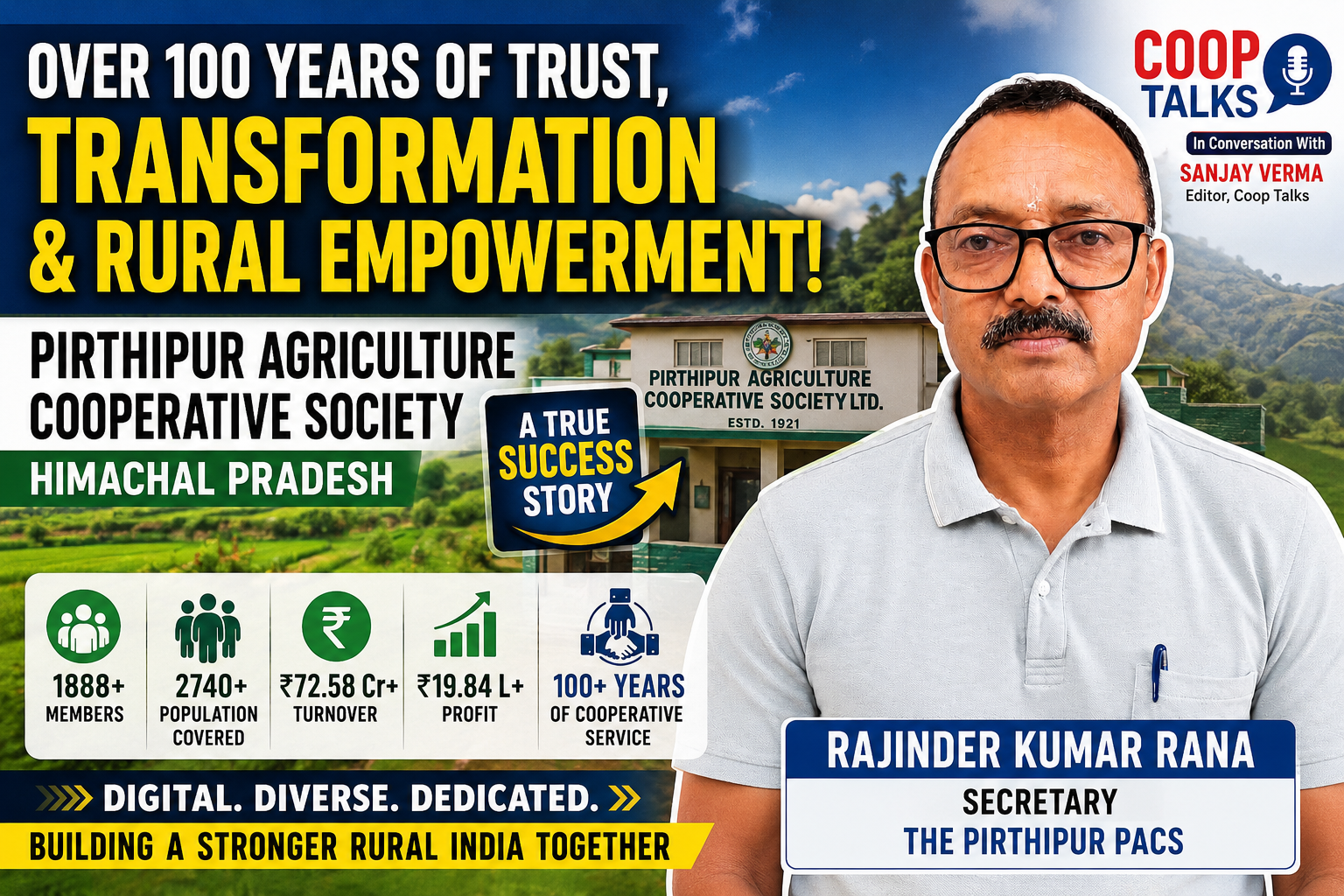
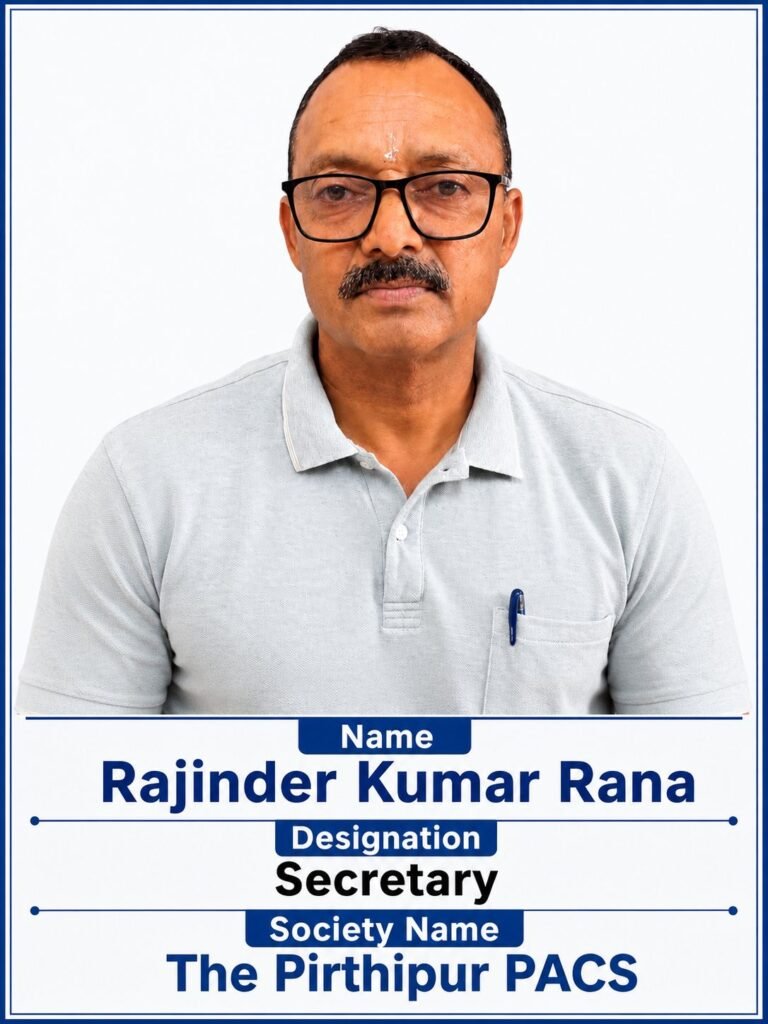
Aligned with the initiatives of Ministry of Cooperation, Pirthipur Agriculture Cooperative Society in Himachal Pradesh, with more than 100 years of existence, is a success story in PACS transformation. Rajinder Kumar Rana, Secretary of this Society, in conversation with Sanjay Verma, Editor, Coop Talks, shows strong determination that his society will achieve the objective to build a self-reliant, prosperous, and digitally empowered rural community through the spirit of cooperation .
Q1. Please tell the name of your society. When was it formed? What were the reasons for its formation?
A: The name of our society is The Pirthipur Agriculture Cooperative Service Society Limited, Village and Post Office Pirthipur, Tehsil Ghanari, District Una, Himachal Pradesh – 177204.The society was established on 23rd July 1921.The main objective behind its formation was to protect farmers from exploitation by moneylenders and creditors and to improve their economic and social conditions. Since its inception, the society has been committed to enhancing the standard of living of rural people and promoting cooperative values

Q2. Please tell about the number of members and other details of the society. What are the objectives and functions of the society?
A: As per the Balance Sheet for the year ending 31 March 2026:
* Total Members: 1,888
* Total Population Covered: 2,740
* Total Ration Cards: 725
Objectives and Functions:
* To provide banking services to people near their homes.
* To distribute essential commodities through the Public Distribution System (PDS).
* To ensure that senior citizens and less educated people can access banking facilities conveniently.
* To provide Government-to-Citizen (G2C) services through CSC, such as Ayushman Bharat cards, Tele-Law, PM-Kisan, PM Vishwakarma, etc.
* To provide Aadhaar enrolment and updation services authorized by UIDAI.
* To work for the social and economic upliftment of rural communities.

Q3. What were the challenges faced by the society? How did it overcome them?
A: Challenges Still Being Faced:
* Restrictions under Section 118 of the Himachal Pradesh Tenancy and Land Reforms Act limit the purchase of land, affecting diversification plans.
* Lack of direct government financial support for developmental projects.
* PDS operations are carried out on a “No Profit-No Loss” basis, resulting in limited financial gains.
Challenges Successfully Overcome:
* Farmers were initially reluctant to adopt Nano Urea. We organized field demonstrations and drone spraying trials, which helped build confidence among farmers.
* During the COVID-19 pandemic, we maintained uninterrupted PDS services by ensuring sanitization, social distancing, ward-wise distribution schedules, and distribution of free face masks.
* To avoid inventory pressure from electronics companies, we adopted the CSC Grameen e-Store model and successfully supplied electronic goods to rural households.
* Due to our goodwill and credibility, UIDAI entrusted Aadhaar services to our cooperative society, which is generally limited to government institutions.
Q4; What is the financial performance of the society in terms of profit, turnover, deposits, etc.?
A:As per the financial statements for 2025-26:
* Profit: ₹19,84,278
* Turnover: ₹72,58,55,362
* Deposits: ₹29,34,04,756
* Loans Outstanding: ₹2,25,33,258
These figures reflect the strong financial position and sustainability of the society.

Q5. What are the other achievements of the society? What initiatives have you taken in recent years?
A:Major Achievements:
* Under the Samagra Shiksha Shimla–UIDAI Joint Project, our society carried out one of the highest numbers of student Aadhaar updates in the state.
* Through CSC, we received the award for the highest number of transactions by a VLE in Himachal Pradesh.
* Under CSC Grameen e-Store, we achieved the highest number of transactions in India.
* We secured second position in Himachal Pradesh for sales of Tata Batteries.
* Our MLA honoured us for social initiatives such as:
* Donation of ₹2 lakh to the Chief Minister’s Relief Fund during floods.
* Beti Vivah Shagun Scheme.
* Installation of reflective collars for stray animals.

Q6; Are the elections held regularly? What is the level of women and youth engagement?
A:For nearly three decades, the Management Committee has been reconstituted every five years through consensus and voluntary participation. Women and youth constitute nearly 50% of the account holders in the society. Women Self-Help Groups (SHGs) actively avail credit facilities and contribute significantly to local entrepreneurship and economic activities.

Q7. What is the level of digitalization in the society?
A:The society has completely migrated to the new PACS software, UNITE ERP.
Daily transactions are recorded digitally, while physical books of accounts are also maintained for record purposes. This combination ensures transparency, accuracy, and regulatory compliance.
Q8; How has the society aligned itself with the initiatives of the Ministry of Cooperation?
A: The Ministry of Cooperation emphasizes diversification of PACS activities to generate employment and contribute to the growth of the Indian economy. Following this vision, our society has diversified into multiple sectors and continuously works towards strengthening the cooperative movement and creating sustainable livelihoods in rural areas.

Q9; Do you think your society is a success story? List five main reasons for its success.
A; Yes, I firmly believe that our society is a success story.
Five Main Reasons for Our Success:
- Diversification through CSC Services
We provide various G2C and B2C services including Ayushman Bharat, Tele-Law, PM-Kisan, PM Vishwakarma, PMGDISHA and many others, strengthening the connection between citizens and the government.
- Aadhaar Services and Social Commitment
Due to our credibility and goodwill, we received UIDAI authorization. Under the Samagra Shiksha Shimla–UIDAI project, we provide free Aadhaar updates for students and doorstep services for disabled persons.
- CSC Grameen e-Store
Through affordable electronic goods and financing support, we have become one of the top-performing Grameen e-Stores in the country.
- Establishment of a Modern Test Centre
In collaboration with TCS iON, we have established a 3,000 sq. ft. test centre with 200 computers, where examinations such as UPSC, IBPS, and RRB are conducted.
- Agricultural Development and Community Welfare
After receiving training from Krishi Vigyan Kendra, we expanded into fertilizers, pesticides, seeds, and insecticides and educated farmers regarding their proper use.
Other Social Initiatives:
* Planning an ITI, cold storage and marriage palace on leased government land.
* Providing distance education programmes in collaboration with Shoolini University.
* Beti Vivah Shagun Scheme for daughters of members.
* Plantation of 50 neem trees under “Ek Ped Maa Ke Naam”.
* Reflective collars for cattle and stray dogs under “Pashu Suraksha” to prevent accidents.
Q10. What are the problems and challenges before the society? What is your future vision? What support do you seek from the government and other stakeholders?
A:Present Challenges:
* Limited availability of land for expansion and diversification.
* Lack of direct financial assistance for developmental projects.
* Need for more training, infrastructure and technological support.
Future Vision:
Our vision is to transform our cooperative society into a model institution for rural development and to strengthen the cooperative movement in India.
We aspire to:
* Establish an ITI, cold storage facility and marriage palace.
* Create more employment opportunities for rural youth.
* Expand educational and digital services.
* Promote agricultural innovation and value addition.
* Contribute to the vision of “Sahkar Se Samriddhi” and make the cooperative sector one of the strongest pillars of India’s economy.
Support Expected from Government and Stakeholders:
* Financial assistance and subsidies for diversification projects.
* Easier access to land and infrastructure support.
* Capacity-building and skill-development programmes.
* Technical and digital support for modernization.
* Collaboration with government departments and other institutions to strengthen rural development.

Q11. ‘ Cooperation Among Cooperatives’ is one of the important principles of Cooperatives. How are you implementing this principle?
A; In association with Unati Cooperative, we are undertaking several collaborative activities/programmes. These are work related to technology, non-grocery PDS items, popularizing NCCF’s ‘ Janah’ brand, plot demonstration, etc. Most importantly, NCCF is facilitating us in implementation of several initiatives of Ministry of Cooperation.
Q12; What is your concluding statement ?
A; Concluding Statement;
“Our society is not merely a financial institution; it is a trusted partner of the people. For more than a century, we have served our villagers with honesty, trust, and commitment. Guided by the vision of the Ministry of Cooperation, we aim to build a self-reliant, prosperous, and digitally empowered rural community through the spirit of cooperation .”




One Response
Great content! Keep up the good work!