
Jyoti Saroop
Founder & Director, Unati Cooperative.
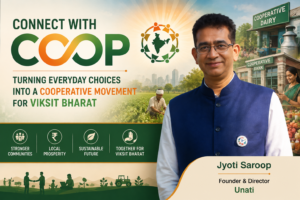
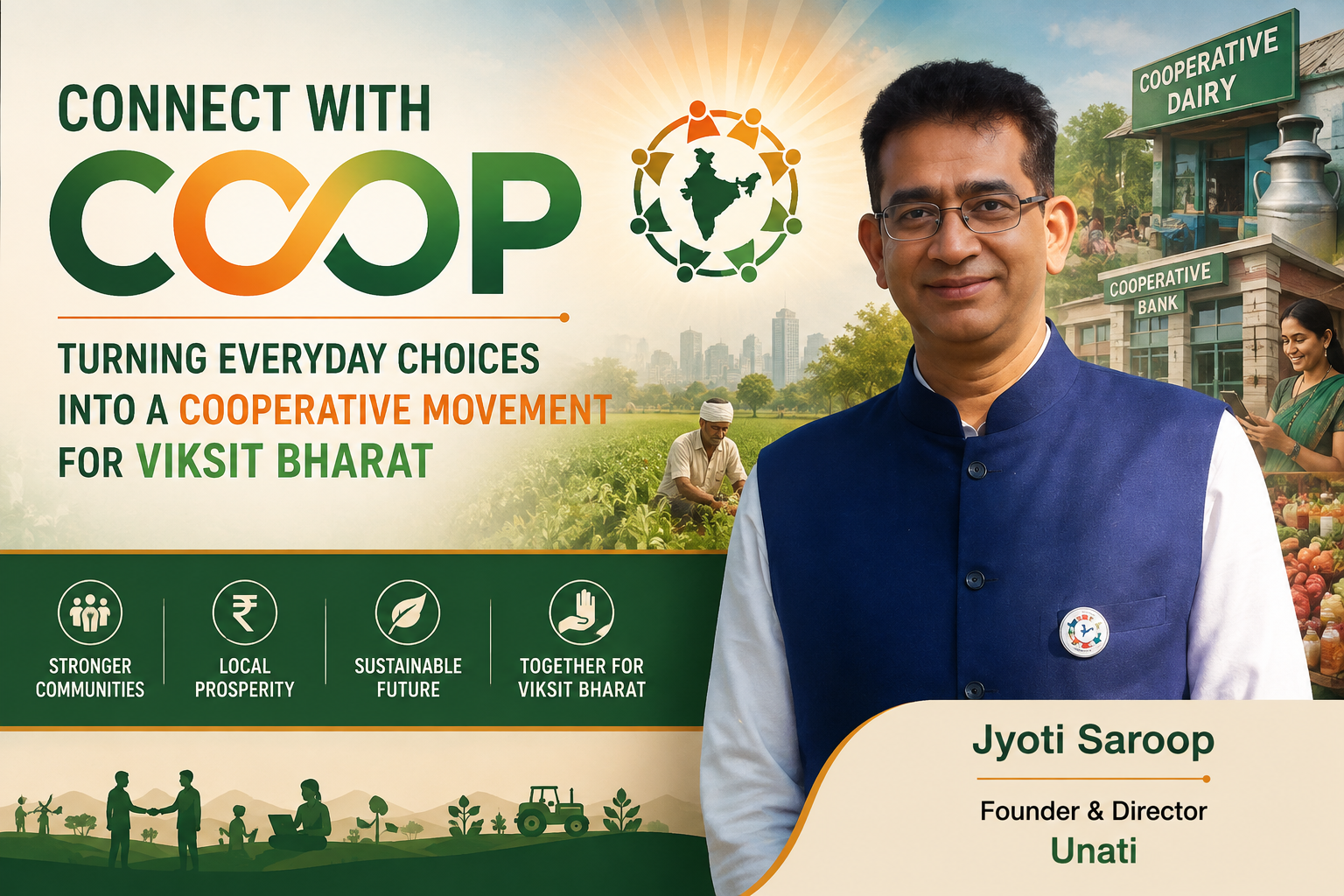
India’s cooperative movement has a strange paradox. It touches the lives of millions of people every day, yet most Indians do not necessarily recognise those connections as part of one larger cooperative story.
A person may buy milk from a cooperative dairy, use cooperative banking services, purchase agricultural inputs from a cooperative institution, live in a housing cooperative, buy food products associated with cooperative organisations or depend on cooperative networks for agricultural markets. Yet these activitiesare rarely seen as parts of a single national economic movement.This is the gap that the proposed “Connect with Coop for Viksit Bharat” campaign seeks to address.
The central idea is simple but potentially powerful: every Indian makes economic choices every day. We decide what to buy, where to buy it, where to sell our produce, how to use our skills, which services to use and where our money ultimately flows. What if some of those everyday decisions could strengthen cooperative enterprises, create local livelihoods and keep more economic value circulating within communities?
That is the thinking behind Connect with Coop.The campaign is therefore not intended to be another institutional publicity exercise. Its larger ambition is to turn awareness into participation and participation into economic activity. The strategy document describes it as a “national participation engine” rather than a conventional advertising campaign. Its central emotional proposition is that every decision helps shape Bharat and that people can consciously make some of those choices cooperative.
The idea becomes particularly relevant at a time when India’s cooperative ecosystem is expanding into new areas of agriculture, food, exports, technology, women-led livelihoods, mobility, digital services and community-based commerce. The challenge is no longer simply to explain what a cooperative is. The bigger challenge is to make cooperation visible, contemporary and attractive to ordinary citizens, particularly young Indians.
The campaign’s underlying message is therefore straightforward: Connect with Coop. Connect with Bharat.The thinking behind the campaign fits closely with the emerging direction of Unati Agri Allied and Marketing Multi-State Cooperative Society Ltd. (UAMMCL). Its current public positioning describes a member-owned cooperative institution seeking to connect farmers, women, communities, markets and consumers through cooperative value chains. Its stated objectives include improving farmer market access, creating women-led livelihoods and providing consumers with affordable and trusted products.
This is also a period in which Unati itself is moving beyond its traditional identity. Its recent activities demonstrate a growing emphasis on technology, youth, farmer-market linkages and cooperation among institutions. Unati recently served as knowledge partner for HARVEST 2.0, an Asia-Pacific summit on future-ready cooperatives that brought together cooperatives, FPOs, youth entrepreneurs and institutions from several Indian states and other countries. Its involvement in facilitating the first reported export of fresh Hoshiarpur lychees to Oman also illustrates how cooperative production can be connected to wider markets.
The above developments give the Connect with Coop concept a practical foundation. It does not have to sell cooperation as an abstract idea. It can demonstrate cooperation through real people, products, markets, technology and livelihoods.
The campaign’s biggest opportunity lies in changing the public meaning of the word “cooperative”. For many young people, the word can still sound institutional, traditional or bureaucratic. That perception has to change. Cooperation must be presented as an opportunity to earn, create, innovate, participate and build something larger than oneself.
For Gen Z and young professionals, the message cannot simply be “join a cooperative”. It has to answer the question: What is in it for me?A young designer could contribute to a cooperative’s branding. A coder could help build a digital platform. A social media creator could tell the story of a farmer or women entrepreneur. An MBA student could work on a cooperative business model. A logistics professional could improve supply chains. A young farmer could access technology, processing and markets. A consumer could consciously choose cooperative products.
The campaign strategy captures this idea through the proposition of cooperation as India’s “open-source economy”. In an open-source ecosystem, different people contribute different skills to create something larger than themselves. In the cooperative equivalent, farmers contribute produce, women contribute enterprise and community networks, youth contribute technology and skills, PACS contribute local infrastructure, consumers contribute demand and institutions contribute organisational strength.
That analogy could become one of the campaign’s most powerful tools for reaching young Indians.The farmer’s entry point, however, must be different. Farmers are unlikely to respond to slogans alone. They need better prices, reliable markets, technology, processing facilities and reduced risk. The campaign can therefore shift the conversation from simply producing a crop to connecting production with demand.
The message is powerful: “Fasal ugane se pehle demand jodo.”
Instead of waiting until after harvest to search for a buyer, farmers can increasingly be connected to demand, processing, aggregation and markets in advance. The strategy proposes linking farmers and FPOs with technology, procurement, value addition and export opportunities.This is where the cooperative model can move from being merely a social philosophy to becoming a practical business proposition.
Women provide another powerful entry point.The proposed Unati Behan model places women at the centre of a local cooperative commerce ecosystem. The concept is not simply about creating another sales network. It seeks to turn trusted women in communities into local economic connectors who can collect household demand, promote products, support farmers and create livelihood opportunities.
The strategy envisages women using digital tools such as WhatsApp ordering, digital billing and payment systems while operating within a cooperative framework. Unati’s public material similarly presents Unati Behan as a women-focused initiative aimed at livelihood creation and community participation.
The message is deliberately simple: “Your phone can become your shop.”
For a homemaker or rural woman, the attraction is not only additional income. It is also identity, confidence, social recognition and participation in the local economy.The consumer is equally important. A cooperative movement cannot become a mass movement if consumers remain spectators. They have to be given a practical reason to participate.
The campaign therefore proposes a “Coop Consumer Club”, through which households can access cooperative products and services. The underlying message is that a household’s monthly grocery expenditure is not merely consumption; it is also an economic choice. Where people spend their money influences which producers, businesses and supply chains grow.
This creates an interesting form of economic patriotism. Patriotism does not have to remain limited to slogans or ceremonial occasions. It can also appear in everyday economic choices.“Your grocery basket is a development decision.”That is the kind of message that can make cooperation relevant to an urban middle-class household as well as a rural producer.
PACS, FPOs, SHGs and other local institutions represent another important link. The campaign proposes that these institutions should be seen not merely as administrative or credit points but as potential village business hubs. A PACS could support aggregation, storage, retail, services, farmer linkages or digital commerce. SHGs could become part of local distribution and livelihood networks. FPOs could connect producers with processing and markets.In this way, Connect with Coop seeks to connect the local institution with the national market.
The strategy deliberately avoids asking every Indian to “join a cooperative” in exactly the same way. Instead, it proposes multiple entry points. A farmer could register for market and technology support. A woman could become an Unati Behan. A consumer could join the consumer network. A young person could contribute a skill. A PACS or FPO could become a local partner. A shopkeeper could become a cooperative point. A startup could contribute technology. A vehicle owner could explore cooperative mobility. An export-oriented farmer could connect with cooperative export opportunities.
This “one nation, many entry points” approach is important because the strength of the cooperative movement is precisely its diversity.The campaign can potentially connect this diversity around a common public identity without pretending that all cooperatives are one organisation. That distinction is particularly important for UAMMCL.
The strategy correctly argues that UAMMCL should not present itself as the owner of India’s cooperative movement. Its role should be to activate, connect and organise communities and value chains. The suggested narrative is compelling: “We are not replacing cooperatives. We are connecting cooperatives.” Such positioning could help the campaign work with existing cooperative institutions rather than appear to compete with them.
The campaign can draw strength from the country’s growing cooperative product and service universe. Dairy cooperatives such as Amul, Verka and Nandini demonstrate the power of cooperative production. NAFED and NCCF provide examples in food and agricultural marketing. Bharat Organics and cooperative seed initiatives show how the model can extend into new value chains. Cooperative export structures can connect farmers to global markets. Cooperative mobility, housing and financial institutions provide additional examples.
The point is not to claim that every one of these institutions is part of UAMMCL. Rather, they demonstrate that cooperation already exists across multiple dimensions of Indian economic life. The campaign’s job is to help citizens see the larger picture.This makes the campaign’s communication strategy particularly important.
The content cannot sound like a government circular. Nor should it become an overly commercial advertising campaign. It needs to be proud, practical, warm and urgent.A 15-second reel might ask a young person: “What if your next reel created income for rural women?”
A farmer could be asked: “Before you harvest, find your buyer.”
A woman could hear: “Your phone can become your shop.”
A consumer could be asked: “Your grocery bill can either leave your community—or build it.”
A freelancer could be told: “Bharat needs coders, designers and marketers for cooperatives.”
A PACS could be challenged: “Can your PACS become the business hub of your village?”
These are not complicated messages. Their strength lies in connecting cooperation to a person’s immediate interest.
The campaign should also move rapidly from the digital world to the physical world. Social media can create curiosity, but trust is often built face-to-face, particularly in rural communities. The strategy therefore proposes Coop Connect Camps at PACS offices, mandis, SHG meetings, colleges, dairy centres, housing societies, cooperative banks, village haats and other community locations.
A simple camp could have separate counters for farmers, women, consumers, skills and cooperative institutions. Each participant would have a clear next step rather than merely receiving a brochure.Technology can make this process scalable. The campaign proposes a digital registration system that does more than collect names. It should understand what each participant can contribute or needs: who can produce, who can buy, who can sell, who can store, who can process, who can provide skills and who can support technology.
In other words, the real asset created by the campaign should not simply be social-media reach. It should be a living cooperative economic database. The funnel is therefore straightforward: awareness, trust, registration, activation, transaction and community.
This is perhaps the most important distinction between a campaign and a movement.A person who watches a reel has created awareness. A person who scans a QR code has expressed interest. But a person who buys a cooperative basket, lists a crop, completes a training programme, becomes an Unati Behan, contributes a professional skill or helps activate a PACS has become a participant.And ultimately, the campaign must produce transactions.
The strategy is clear on this point: a campaign without commerce eventually becomes a slogan. The first phase must therefore lead to real consumer orders, farmer listings, women-led sales, institutional onboarding and skill assignments. This is also where Unati’s evolving technology agenda becomes relevant. Its public communication increasingly highlights technology-enabled cooperation, youth skills and digital transformation. The Unati Drone Academy, for example, has been positioned as a technology and skills initiative aimed at preparing rural youth for the emerging drone economy.
The Connect with Coop campaign can bring such initiatives into a larger narrative: cooperation is not about going back to the past; it is about using collective ownership to build the future.
The same principle should govern the campaign’s youth strategy. Colleges, agricultural universities, ITIs, polytechnics, management institutions and professional networks can become recruitment grounds for a new generation of cooperative contributors. Students could undertake internships, help digitise PACS, develop product catalogues, work on communication or participate in cooperative hackathons. This could fundamentally change the way young people perceive cooperatives.Instead of asking them to inherit an old movement, the campaign can invite them to build its next version.
There is also a strong international dimension. The strategy connects the Indian campaign with the 2026 International Day of Cooperatives theme, “Cooperatives for a Peaceful World”, linking shared prosperity with social cohesion. The message can be adapted to India’s development context: cooperation is not only an economic model but also a way of strengthening communities.
However, credibility will determine whether the campaign succeeds.The campaign must not promise employment, income or membership automatically to everyone who registers. Registration should mean that a person has expressed interest and can potentially be matched with relevant opportunities, subject to eligibility, demand, training and availability. The strategy explicitly recognises this requirement.
Data protection will also be critical. If citizens are asked to share phone numbers, locations, skills, production details or household consumption information, they must know why the information is being collected and how it will be used. Consent, privacy, opt-out mechanisms and responsible data management must therefore be built into the campaign from the beginning.
Quality will be equally important. A single poor-quality product or unfulfilled promise can damage the credibility of the entire movement. Product verification, licensing, traceability, grievance redressal and customer support cannot be treated as secondary matters.
The campaign should also maintain a clear distinction between supporters, registered participants, trainees, active contributors and actual cooperative members. Not everyone who registers online automatically becomes a shareholder or member. Cooperative membership must continue to follow the relevant rules and statutory requirements.
If these safeguards are respected, Connect with Coop can develop into something much larger than a communication campaign.Its real test will be whether the word “coop” becomes an action in everyday conversation.
Can people say, “I connected with Coop”?
Can a farmer say, “I found a market through Coop”?
Can a woman say, “I became an entrepreneur through Unati Behan”?
Can a young person say, “I used my skill to solve a cooperative problem”?
Can a consumer say, “I bought this because I wanted my spending to support cooperative value chains”?
Can a PACS say, “We have become connected to a wider market”?
If the answer to these questions becomes yes, the campaign will have achieved something significant.
Unati’s own journey makes the idea particularly relevant. What began as a grassroots cooperative initiative in Punjab has increasingly developed into a broader ecosystem around farmers, natural resources, processing, women, technology and markets. UAMMCL is a multi-state cooperative , while recent activities—from international cooperative events to agricultural exports and youth-focused technology initiatives—show a widening ambition.
Against the above backdrop, Connect with Coop can provide a common public narrative for this next stage.The ultimate ambition should not be to make people merely aware of cooperatives. It should be to make cooperation part of how people think about their economic lives.
A farmer should think beyond production to market ownership.
A woman should think beyond household work to community enterprise.
A young person should think beyond employment to contribution and entrepreneurship.
A consumer should think beyond price to trust, value and community impact.
A PACS should think beyond credit to becoming a local economic hub.
And a cooperative institution should think beyond its own boundaries to cooperation among cooperatives.
This is how the idea of Connect with Coop becomes larger than a brand campaign. It becomes a proposition for a new kind of economic citizenship—one in which people do not merely consume, produce or work individually but participate in networks where value, opportunity and prosperity can circulate within communities.
India’s cooperative movement already possesses the institutions, people, products and experience needed for such a story. The recent initiatives of Ministry of Cooperation has placed the cooperative movement on a strong pedestal. What has often been missing is a contemporary public narrative capable of bringing these different pieces together. Connect with Coop can attempt to fill that gap.
The deepest message is therefore not simply about buying cooperative products or joining a cooperative organisation. It is about recognising that the way Indians produce, purchase, sell, work, share skills and build businesses can influence the kind of economy India creates.
Viksit Bharat will not be built only by what we produce. It will also be shaped by how we connect, how we buy, how we sell, how we share and how prosperity circulates.The campaign’s most powerful public invitation can therefore remain simple:
Connect with Coop. Connect with Bharat. Choose Coop. Build Viksit Bharat.