
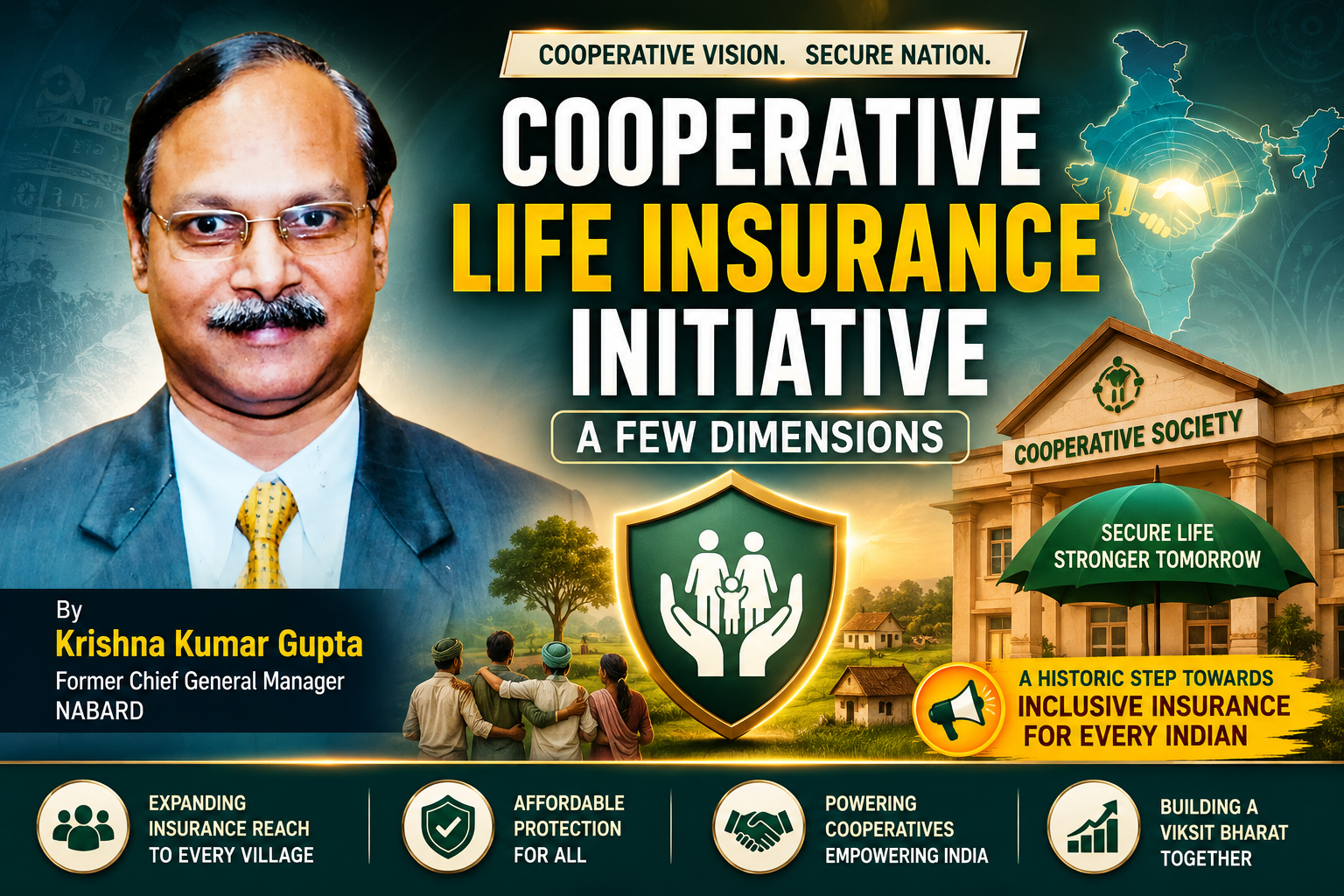

Krishna Kumar Gupta
( Retd) Chief General Manager of NABARD
The cooperative movement in India, which traces its origins to the institutional framework established under the Credit Cooperative Societies Act, 1904, has now completed well over a century of service. Throughout its evolution, it has remained committed to improving the socio-economic conditions of the weaker and disadvantaged sections of society. Although the movement has made significant contributions in achieving these objectives, a sense of stagnation has gradually emerged in the functioning of many cooperative institutions, particularly in the context of the rapidly changing economic environment.
Recognising the need to broaden both the outreach of cooperative institutions and the scope of their services, especially in the agricultural sector, the Central Government as well as various State Governments have introduced numerous initiatives and reform measures from time to time. However, the establishment of the Ministry of Cooperation by the Government of India in FY 2021–22 has ushered in a renewed phase of policy support and institutional impetus for strengthening the cooperative sector.
The National Policy on Cooperation, 2025, has laid down a comprehensive roadmap to transform cooperatives into “Future Ready” organisations capable of playing a greater role in the vision of Viksit Bharat. Cooperatives are now being encouraged to diversify into new business areas, with several emerging sunrise sectors being identified for their participation. Bharatiya Beej Sahkari Samiti Ltd. (BBSSL), National Cooperative Exports Limited (NCEL), and National Cooperative Organics Limited (NCOL) have already commenced operations to strengthen seed production, exports, and organic farming, respectively. More recently, Sahakar Taxi Cooperative Ltd. (STCL) has been launched under the brand name Bharat Taxi. Further, on 6 July 2026, the Hon’ble Union Minister of Cooperation announced that a Cooperative Life Insurance Company would be established to expand the business horizons of the cooperative sector. This landmark announcement has generated considerable interest both within the insurance industry and the cooperative movement. This paper attempts to examine some of the key dimensions of this emerging opportunity for cooperatives in India’s life insurance sector.
Insurance as a Regulated Business
Insurance is a highly regulated sector in India and is governed by the Insurance Regulatory and Development Authority of India (IRDAI). Any entity intending to establish or operate an insurance business must obtain the requisite licence from IRDAI. No insurance-related activity can legally be undertaken in the country without such authorisation.
The insurance sector comprises several categories, including Life Insurance, General
Insurance, Health Insurance, Reinsurance, Insurance Broking, Corporate Agency, Third-Party Administration (TPA), Insurance Web Aggregation, Insurance Distribution, and other insurance intermediary services. Although the licensing requirements vary across different categories, the financial strength and credibility of the applicant remain among the most critical parameters for evaluation. The procedures governing the registration of an insurance company are prescribed under the IRDAI (Registration of Indian Insurance Companies) Regulations, as amended from time to time.
The Historic Announcement
According to the announcement made by the Hon’ble Union Minister of Cooperation, the proposed entity will be established as a company and will undertake life insurance business. The principal objective of this historic initiative appears to be expanding access to affordable life insurance in remote rural areas, small towns, and villages, where the cooperative movement enjoys an extensive presence through more than 8.57 lakh cooperative societies operating across sectors such as credit, dairy, sugar, seeds, and fertilisers.
The recent launch of Bharat Taxi is also aimed at bringing a large number of users and drivers into the cooperative fold. Integrating this vast cooperative ecosystem with life insurance services is expected to extend the protection of life insurance to even the most arginalized sections of society at affordable premium rates.
The Hon’ble Minister also referred to the existing presence of cooperatives in the insurance sector through IFFCO-Tokio General Insurance Company, in which Indian Farmers Fertiliser Cooperative Limited (IFFCO) holds a 51 per cent stake, while the remaining 49 per cent equity is owned by Japan’s Tokio Marine Group. This joint venture operates successfully in the general insurance segment.
The proposal to establish a Cooperative Life Insurance Company has also been facilitated by the Presidential assent to the Sabka Bima Sabki Raksha (Amendment of Insurance Laws) Act, 2025. Among its significant provisions is the revised definition of an insurance cooperative society, which removes the earlier requirement of a minimum paid-up share capital of ₹100 crore for undertaking life, general, and health insurance business.
Indian Life Insurance Landscape
The life insurance sector in India is currently well established. At present, 24 life insurance companies operate under the regulatory framework of the Insurance Regulatory and Development Authority of India (IRDAI). Of these, one—Life Insurance Corporation of India (LIC)—belongs to the public sector, while the remaining 23 operate in the private sector.
In addition, the Department of Posts administers the Postal Life Insurance (PLI) and Rural Postal Life Insurance (RPLI) schemes, which are not regulated by IRDAI. It is also noteworthy that several cooperative banks are already engaged in distributing insurance products as corporate agents or intermediaries for various insurance companies, thereby generating fee-based income while expanding insurance outreach among their customers.
Organisational Structure
As announced, the proposed cooperative life insurance entity will be established as a company. If this model is adopted, leading national cooperative organisations such as NCDC, NAFED, IFFCO, KRIBHCO, NDDB/GCMMF, NCCF and other major cooperative institutions may come together to incorporate a company under the Companies Act, 2013. An experienced life insurance partner could also be inducted to provide the specialised technical and managerial expertise required for successfully operating a life insurance business.
At the same time, the Sabka Bima Sabki Raksha (Amendment of Insurance Laws) Act, 2025 has introduced the concept of an “insurance cooperative society”. It defines such a society as an insurer registered under the Cooperative Societies Act, 1912, any applicable State Cooperative Societies Act, or the Multi-State Cooperative Societies Act, 2002, whose sole purpose is to undertake life insurance, general insurance, or health insurance business.
Accordingly, an Insurance Cooperative Society could also be established on the lines of the recently created national-level cooperative institutions such as BBSSL, NCEL and NCOL under the Multi-State Cooperative Societies Act, 2002. In such a model, an appropriate mechanism could be devised to facilitate the participation of a technically competent life insurance partner while preserving the cooperative character and ownership structure of the institution.
Once the proposed entity—whether incorporated as a company or registered as a multi-state cooperative society—is legally established, the process of obtaining registration from IRDAI should commence in accordance with the prescribed regulatory framework. This process would require close coordination between the Ministry of Cooperation and IRDAI, supported by experienced professionals from the life insurance industry.
The registration process prescribed by IRDAI broadly involves three stages and requires fulfilment of several critical conditions. These include the prescribed minimum share capital, a comprehensive operational and financial business plan, a well-defined product and revenue strategy, adequate funding arrangements, long-term investment planning, robust actuarial and accounting systems, an appropriate organisational structure, a professionally qualified management team, an efficient distribution network, sound underwriting arrangements, a comprehensive risk management framework, effective regulatory compliance and reporting systems, strong customer protection mechanisms, and other statutory requirements.
One important issue that remains open for discussion is how the proposed cooperative life insurer will uphold the fundamental principles of democratic cooperative governance. Specifically, it will be necessary to determine whether policyholders will also become members and part owners of the institution, exercising their rights on the basis of the cooperative principle of “one member, one vote.”
Since the primary objective of this initiative, as envisaged by the Ministry of Cooperation, is to deepen financial inclusion through wider geographical outreach and more inclusive insurance products, product development will assume critical importance in the evolution of the proposed institution. The products introduced by the cooperative should address the specific requirements of rural communities, particularly low-income households, by offering affordable and accessible micro-insurance solutions.
The product portfolio should also reflect the expectations and perceptions of the general public regarding life insurance. Before designing these products, it would be worthwhile to undertake a comprehensive study of the existing Government of India insurance schemes to identify any gaps or limitations. Such an exercise should include programmes such as Aam Aadmi Bima Yojana (AABY), Pradhan Mantri Jeevan Jyoti Bima Yojana (PMJJBY), Pradhan Mantri Suraksha Bima Yojana (PMSBY), and Ayushman Bharat–Pradhan Mantri Jan Arogya Yojana (PM-JAY). The findings of such a study could provide valuable inputs for developing innovative, affordable and need-based insurance products suited to the cooperative sector.
Distribution Network
The development of an effective distribution network will be another critical determinant of the success of this initiative. The mere existence of more than 8.57 lakh cooperative societies across the country, along with their vast membership base, cannot by itself guarantee the successful launch of a cooperative life insurance institution. The distribution strategy will need to be carefully planned, meticulously calibrated, and implemented in a phased manner.
Several distribution models, both in India and internationally, provide useful reference points for developing an appropriate framework. Among these, the bancassurance model appears to be the most suitable for the proposed cooperative life insurance venture. Under this model, grassroots cooperative societies of various types, along with the branches of cooperative banks—both rural and urban—could serve as distribution channels for life insurance products while continuing to provide their regular financial and non-financial services.
The bancassurance model itself has several variants. Under the Corporate Agency Model, a bank acts as an authorised agent of a particular insurance company and markets its products. Under the Broker Model, the bank is permitted to distribute insurance products of multiple insurers, thereby offering customers a wider range of choices. Another option is the Joint Venture Model, under which the bank and the insurance company jointly develop products and share revenues in accordance with mutually agreed terms.
Even today, many urban cooperative banks and rural cooperative banks distribute insurance products offered by different insurance companies. Nevertheless, establishing such a large and integrated distribution system for a new cooperative life insurer will present several challenges. These include obtaining the necessary licences from IRDAI, establishing robust operational systems and procedures, creating efficient financial and accounting mechanisms, ensuring regulatory compliance, building the capacities of all distribution partners, and, above all, developing a comprehensive, secure, and user-friendly digital operating system that can be easily understood and operated by grassroots cooperative personnel as well as prospective policyholders.
Distribution models based on Corporate Agency, Insurance Broking, Insurance Web Aggregation, and other categories of insurance intermediaries will each require separate licences and regulatory approvals from IRDAI. Consequently, the selection of appropriate distribution channels should be preceded by a detailed examination of their respective regulatory requirements, operational feasibility, and long-term sustainability.
Computerised Environment
As indicated earlier, the creation of a fully computerised ecosystem, seamlessly integrated from the grassroots to the national level and vice versa, will be indispensable for the success of the proposed cooperative life insurance initiative.
Considering the present level of computer infrastructure and digital literacy available in many grassroots cooperative societies, the entire customer life cycle—from product selection and counselling to policy servicing—will need to be digitised. This would include product marketing, assisting customers in selecting suitable insurance products, online submission of proposals, preliminary approvals, documentation, Aadhaar-based authentication, payment of initial premiums through digital platforms such as UPI, digital wallets and cards, generation of acknowledgements, issuance and printing of policy documents in real time, creation of customer accounts on the insurer’s portal, payment of renewal premiums, regular customer servicing, revival of lapsed policies, settlement of claims, and grievance redressal.
Similarly, all back-end operations—including accounting, data management, regulatory reporting, management information systems, compliance monitoring, and business analytics—must be fully integrated into the digital platform. The system should be simple, secure, scalable, and capable of being operated efficiently through internet-enabled computers at cooperative counters as well as through smartphones used by customers.
Another important consideration will be the integration of this digital platform with the computerisation already undertaken in a large number of Primary Agricultural Credit Societies (PACS) under various Government of India initiatives. Such integration would facilitate seamless linkage between insurance services and customers’ deposit and loan accounts maintained with District Central Cooperative Banks (DCCBs) and operated through PACS. At the same time, the software architecture should be sufficiently flexible to accommodate other categories of cooperative societies beyond PACS.
The development of such a comprehensive digital platform will require substantial financial investment, significant technological expertise, and considerable time and effort for software design, system integration, testing, implementation, and continuous upgradation.
International Experience
Several additional issues are likely to emerge as the process of establishing this prestigious institution progresses. These can be addressed progressively as the initiative takes shape. However, considerable insights can be drawn from the experience of well-established cooperative financial institutions across the world that have successfully ventured into insurance services.
For instance, Raiffeisen offers life insurance through its branch network in partnership with UNIQA Group in Central and Eastern Europe and La Luxembourgeoise Group in Luxembourg. Through these partnerships, a wide range of linked and non-linked life insurance products is made available to cooperative members, demonstrating how strategic collaboration between cooperative financial institutions and insurance specialists can successfully expand insurance outreach.
Rabobank offers insurance products through its strategic partner, Interpolis. Among its offerings is term life insurance, which not only provides financial security to the nominee but also helps repay the outstanding mortgage loan of the deceased insured. Depending upon the policy terms, it may also provide financial support to meet the living expenses of the nominee(s). This partnership demonstrates the effective integration of banking and insurance services within a cooperative framework.
Desjardins Group, one of Canada’s largest cooperative financial institutions, operates as a federation of credit unions based on cooperative principles that emphasise member participation, democratic governance, transparency, and community development. The Group ensures that its profits are reinvested for the benefit of members through dividends and various community development initiatives.
To cater to the diverse financial needs of its members, Desjardins has established nearly twenty subsidiary companies and corporations. Although these entities operate as corporate organisations with their own Boards of Directors, they remain accountable to the cooperative governance structure of the parent organisation and, ultimately, to its grassroots members.
Its insurance business is conducted through Desjardins Insurance, which operates through two principal subsidiaries—Desjardins Financial Security and Desjardins General Insurance. Desjardins Financial Security offers a comprehensive portfolio of life insurance, health insurance, and loan and credit insurance products. These services are delivered through the organisation’s branch network as well as through the Caissassurance model, whereby insurance products are distributed through local credit unions (Caisses Populaires).
Desjardins General Insurance provides business insurance, automobile and transport insurance, and home insurance. Both subsidiaries maintain dedicated customer service centres and provide extensive online and mobile-based services. In addition, The Personal, a subsidiary of Desjardins General Insurance, specialises in group insurance products for automobile and home insurance. The investment portfolios of these insurance subsidiaries are managed by Desjardins Global Asset Management (DGAM).
The Desjardins model illustrates how a cooperative institution can successfully combine democratic governance with professionally managed corporate subsidiaries.Another notable example is State Farm in the United States, which began as a mutual automobile insurance company owned by its policyholders. Today, it has evolved into one of the world’s largest mutual insurance organisations. It offers a comprehensive range of insurance products covering motor vehicles, property, business, and personal insurance. Life insurance services are provided through State Farm Life Insurance Company and State Farm Life and Accident Assurance Company.
State Farm’s business model combines strong central corporate management with an extensive decentralised network of independent agents, who exclusively market State Farm products. This model demonstrates how a customer-owned insurance organisation can achieve scale while maintaining high standards of service and operational efficiency.Another outstanding example is the National Mutual Insurance Federation of Agricultural Cooperatives (JA Kyosai or Zenkyoren) in Japan. Established in 1951, it functions as a cooperative insurance organisation serving members of the farming community. It forms an integral part of the Japan Agricultural Cooperatives (JA) Group, which comprises local agricultural cooperatives supported by prefectural and national-level organisations.
Zenkyoren offers a comprehensive range of insurance products, including life, accident, medical, building endowment, and automobile insurance. These products are specifically designed to meet the needs of rural communities that may otherwise have limited access to private insurance providers.
The local JA Cooperative serves as the primary contact point through which farmers and rural residents access insurance services. The organisation follows a mutual aid principle, under which risks are collectively shared. Premiums collected at the local level are pooled into a central Mutual Aid Fund managed by Zenkyoren, enabling claims to be settled efficiently across the country, even in regions affected by natural disasters or other major risks. Importantly, policyholders are also members of the cooperative and therefore participate in its ownership and governance.
In the United Kingdom, Co-op Insurance operates as part of the Co-op Group, one of the world’s largest consumer cooperative organisations. It offers a wide range of insurance products, including motor, home, travel, pet, and life insurance. Along with competitive insurance services, the organisation provides various member benefits and supports community-focused initiatives. Its services are delivered through local cooperative outlets, online platforms, and mobile applications, while customer service representatives across the country assist policyholders with enquiries, renewals, and claims.
Another significant international example is Crédit Agricole Assurances, the insurance arm of Crédit Agricole Group in France. It provides life, property and casualty, borrower, and other insurance products in France and several international markets through an integrated bancassurance model.Its principal subsidiaries include Predica, Pacifica, Spirica, and CA Creditor Insurance (CACI). Predica is one of France’s leading life insurers and offers an extensive portfolio covering life insurance, health insurance, personal protection, borrower protection, group insurance, and pension products. It distributes these products through Crédit Agricole’s regional banks and LCL (Le Crédit Lyonnais).
Pacifica specialises in property and casualty insurance and markets its products through Crédit Agricole’s regional banks, LCL, and other strategic partners. Spirica focuses on innovative and customised life insurance solutions designed for specific customer segments and distributes them through wealth management advisers, private banks, internet-based brokers, and direct channels.
CA Creditor Insurance (CACI) specialises in creditor protection by providing insurance against unforeseen life events that may affect borrowers’ ability to repay loans. Its products are distributed through the Crédit Agricole banking network as well as specialised financing companies and retail lending institutions.
Spirica and Pacifica have jointly established UAF Life Patrimoine, an open-architecture distribution platform responsible for product design, administrative management, and marketing through an extensive network of independent partners.
These international examples clearly demonstrate that cooperative and mutual insurance institutions have adopted diverse organisational structures suited to their respective legal and economic environments. However, they all share certain common characteristics, including strong member orientation, professional management, technological sophistication, and diversified insurance portfolios.
The international experience also indicates that successful cooperative insurance institutions have generally expanded beyond life insurance alone to provide a comprehensive range of insurance services tailored to the evolving needs of their members. It may therefore be expected that the proposed Indian Cooperative Life Insurance initiative, once firmly established, will gradually diversify into other segments of insurance, thereby meeting the broader insurance requirements of rural communities and cooperative members across the country.
International Cooperation and Knowledge Support
An important institutional resource available to the proposed Cooperative Life Insurance initiative is the International Cooperative and Mutual Insurance Federation (ICMIF), a global organisation representing more than 220 cooperative and mutual insurance institutions across the world.
ICMIF serves as an important platform for knowledge sharing, capacity building, research, innovation, and the exchange of international best practices in the cooperative and mutual insurance sector. Membership of this organisation would enable the proposed Indian Cooperative Life Insurance institution to establish meaningful partnerships with leading cooperative insurers across the globe and benefit from their vast experience in governance, product development, technology, risk management, customer service, and regulatory compliance.
Over the years, ICMIF has developed several internationally accepted standards, guidelines, and best practices for cooperative and mutual insurers. These knowledge resources could prove immensely valuable while designing the organisational structure, governance framework, operational systems, and long-term business strategy of the proposed cooperative life insurer in India.It is also noteworthy that IFFCO-Tokio General Insurance Company is already a member of ICMIF. The experience and professional insights of IFFCO-Tokio could therefore provide valuable guidance during the conceptualisation and implementation of this new initiative.
Concluding Remarks
The announcement of establishing a Cooperative Life Insurance Company (or, alternatively, an Insurance Cooperative Society) is a significant and welcome initiative of the Ministry of Cooperation. It represents yet another milestone in the ongoing efforts to expand the role of cooperatives into emerging sectors of the Indian economy while deepening financial inclusion.
The operationalisation of this ambitious initiative, however, will require careful planning, coordinated action, and sustained institutional support. The Ministry of Cooperation will need to play a proactive leadership role in facilitating the various stages of implementation, including policy coordination, stakeholder consultations, regulatory engagement, and institutional capacity building.
The enactment of the Sabka Bima Sabki Raksha (Amendment of Insurance Laws) Act, 2025 has created an enabling legal framework for the entry of cooperatives into the insurance sector. The cooperative leadership must now seize this opportunity by initiating the necessary organisational, financial, and regulatory processes without delay. These would include mobilising adequate initial capital, forging appropriate strategic partnerships, developing competent professional management, and establishing a governance framework that successfully combines cooperative values with modern corporate and professional practices.
Particular attention should also be paid to creating a truly member-driven institution that upholds the fundamental cooperative principles of democratic ownership, transparency, accountability, and member participation while simultaneously meeting the highest standards of professionalism expected in the life insurance industry.
If implemented with vision, sound planning, and professional execution, the proposed Cooperative Life Insurance institution has the potential to become a transformative instrument for extending affordable and accessible insurance protection to millions of people, particularly those living in rural and underserved areas. In due course, it could evolve into a comprehensive cooperative insurance institution catering to a wide spectrum of insurance needs across the country.
The next phase of action should therefore begin without delay so that the vision of an Indian Cooperative Life Insurance Organisation can be translated into reality, thereby making a meaningful contribution to financial inclusion, social security, and the long-term strengthening of India’s cooperative movement.