

Arvind Kumar Srivastava
Editor, Samarth Sahkarita
The country has adopted the strategy of financial inclusion through banking system, practically excluding the cooperative banks. There is no doubt that our financial inclusion reform has been transformational. However, even now till (December 2025), all the households located in states of Karnataka, Chhatisgarh, Rajasthan, Odisha as also North Eastern States (Assam, Mizoram, Manipur and Nagaland) and Jammu & Kashmir (UT) have not been covered with even opening of bank accounts[i].
. The Global Findex, 2025 (a World Bank document claimed as the world’s only demand-side survey on financial inclusion providing data on access and use of financial services by adults)[ii] reports that India has a 90 % account ownership rate. However, given that India has the largest population in the world, this still means that the country has one of the largest number of adults without bank accounts .It is well known that many of the bank accounts are inactive. The World Bank survey (Global Financial Index, 2021[iii] )also pointed out that the last mile connectivity remains a big challenge considering India’s huge population. The distant location and trust issues with the financial institutions were considered important barriers hampering financial inclusion..
The cooperatives have been considered an instrument of securing inclusion – both social and financial, for disadvantaged sections of agriculturists, particularly small and marginal farmers. The cooperatives, organized in various sectors of economic activities, have worked tirelessly for socio-development of the masses. It is well recognized that the cooperatives, in their various forms, promote the fullest possible participation of local communities, including women, whose inclusion strengthens economic and social development, contributing to the eradication of poverty and hunger. No wonder, the UN declared 2025 as the International Year of Cooperatives after celebrating the same in year 2012.
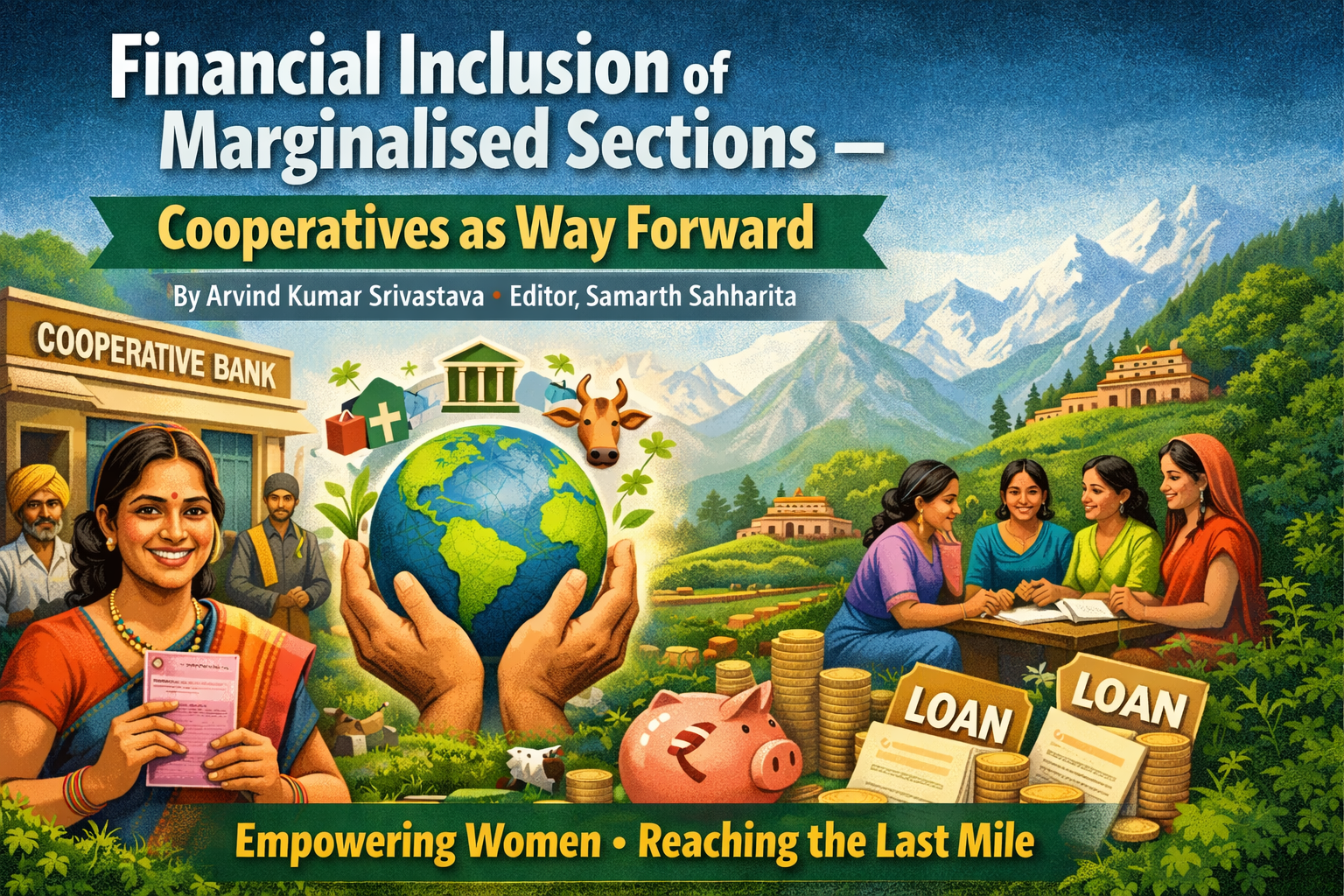
. Several initiatives have been taken by the cooperatives for securing financial inclusion of marginalized sections of the society in the country. The country has more than 75 Urban Cooperative Banks with membership of women jn different parts of the country. These banks not only accept deposits, but also provide loans and micro finance for economic activities. The banks like Shri Mahila SEWA Sahkari Bank ( Gujarat ),Mann Deshi Mahila Bank and Bhagini Nivedita Sahakari Bank (both in Maharashtra) have played an important role in ensuring meaningful financial inclusion of women. In recent years, the District Central Cooperative Banks in Gujarat like Banaskatha and Panchmahal alone have opened more than 3 lakh bank accounts of women, particularly those engaged in dairy. The institutions like National Cooperative Development Corporation(NCDC) have disbursed large sum of money to women cooperatives, particularly in the states of Andhra Pradesh and Telangana. National Cooperative Union of India organised 4 exclusive field projects for women in places like Shimoga (Karnataka), Aska (Odisha), Bhopal and Imphal West. In short, the cooperatives have been on the forefront for ensuring gender equality.
. The short term cooperative credit structure has also been able to expand its coverage in hilly and remote areas, normally not well covered by the commercial banks. Himachal Pradesh State Cooperative Bank , having its branches located in far flung hilly areas, is implementing a special scheme for financing of women. Likewise, the DCCBs in Uttarakhand (another hilly state) are facilitating implementation of Govt. Scheme providing subsidy for financial assistance to women SHGs. The Cooperative Banks, in other parts of the country, are an important agency for financing of women Self-help groups under National Rural Livelihood Mission. These initiatives have proved effective in securing effective participation of womenfolk in our economic activities.
Against this background, our country aspiring to become the third largest economy in the world, may have to leverage the strength of cooperatives to ensure faster pace of development. The country has witnessed a number of events being organized during the International Year of Cooperatives, whose theme was ‘ ‘Cooperatives Build A Better World.’ In a true spirit of International Year of Cooperatives, it would be appropriate to pursue the theme of “Leveraging Cooperatives for Last Mile Inclusion” in the year 2026 so that the cooperative sector remains in limelight. The sustained focus on cooperatives would help the country to pursue the “Agenda for Sustainable Development for the year 2030” far more effectively.
[i] These households are located in Jammu& Kashmir UT and the North Eastern States (Assam, Mizoram, Manipur and Nagaland), Karnataka, Chhatisgarh, Rajasthan and Odisha. Source: Progress Report of PMJDY- State wise https://pmjdy.gov.in/statewise-statistics
[ii] https://www.worldbank.org/en/publication/globalfindex
Since its launch in 2011, the Global Findex has provided critical insights into financial inclusion, digital payments, savings, and borrowing behaviors across various economies. The database highlights key trends such as the rise of digital financial services and the gender gap in account ownership.
[iii] https://www.worldbank.org/en/publication/globalfindex/Data – The 2021 edition contains indicators on access and offers insights into the behaviors.